Has your experience of relationship exclusivity (monogamy and non-monogamy, but also types of exclusivity within either monogamous or non-monogamous relationships) shifted multiple times?
Would you like to talk about it?
I’m putting together the beginning of a narrative project on this topic, and will be scheduling one group conversation and up to 5 individual conversations between now and November 15.
Depending on how these conversations go and whether there is interest, I will be organizing a six-week narrative practice group where we can explore and re-story our experiences of changing relationship structures. This group will be scheduled for the new year.
My goal is to better understand how people experience fluidity in relationship structure preference over time. I think that within polyamorous spaces there is often the idea that there is an ideal (and linear) trajectory from monogamy to a specific form of polyamory.
I’m interested in talking about this, especially since I think for folks who have a different trajectory (such as returning to exclusivity, or having relationship structure preference expand and then contract, or preferring exclusivity in one area of a relationship even if there is non-exclusivity in another), there can be feelings of shame or failure attached to this.
If this sounds interesting to you, let me know! Email me at sostarselfcare @ gmail, and watch this space for the group conversation information.
Editing to add: The group conversation has been scheduled for November 7 from 11-12:30 mountain time, and will be hosted on Zoom. Contact me for registration info!
(This post was available a week early to Patreon supporters.)
The picture is my sister and me, on my birthday. I’m holding a little replica of Brambles, the name we gave the giant bush in the alley that we used as a secret hideout, where we cut out two rooms and a little hallway between. Domini made the replica for me, and I love it.
I turned 40 on August 11.
40 feels significant.
The word quarantine comes from the Italian quaranta, referencing the 40 days that ships were isolated during the bubonic plague. I turned forty in this time of quarantine.
In Christian mythology, a big part of my own cultural background, 40 is also significant. 40 days and 40 nights of flooding. 40 days fasting in the desert. 40 years wandering. There is often something significant on the other side of 40. Some new beginning. Possibility.
And, too, I’m reading Astrid the Unstoppable to Astrid at bedtime, and the book makes the point regularly that round-number birthdays are a big deal!
I approached 40 with exhaustion and more than a little despair.
Everything has been feeling impossible.
I know that’s dramatic, but it’s also true.
It’s been hard to see value in my work.
Earlier in the season, I had to significantly cut back my narrative practice, and pause working with new community members because I was having so many panic attacks and my health was so unpredictable. What is the good of an unreliable narrative therapist?
In my community organizing, I have felt ineffective and unreliable. Important projects, projects that really matter to me, have been indefinitely postponed. Group conversations went in difficult directions, and it felt like my fault – I didn’t anticipate the direction and I fumbled my responses. What is the good of an underprepared facilitator?
In my contract work, time has slipped past with little progress being made. The same is true in my day job, and in my own personal projects.
I haven’t been writing – not in my journal, not on my blog, not for any of my many started-and-stalled collective documents.
I haven’t even been doing tarot, for months!, with only a handful of exceptions.
Everywhere, failure. False starts. Fumbles.
Everywhere, disappointment.
That’s what I brought to the day I turned 40.
But despite what I brought to it, the day was full of joy and hope and light, and in the last couple weeks I’ve been trying to figure out how to invite more of that into my life. How to turn towards what sustains me. How to find my way back to a sense of myself as possible, a sense of myself as worthy.
On my birthday, Joe and I spent the day together, went for a long walk along the river and drank good coffee. His card to me reminded me of the connection we share, our friendship and love. (And it included stick figures! My favourite!)
I connected with some of my favourite people. (And Nathan told me a bit about the stars on that day, and in my natal chart. Venus and Pluto, helping me get through this dark time.)
And then my mom and sister picked me up for a secret birthday dinner, which turned out to be entirely magical.
We had a lovely charcuterie picnic dinner (including a rice krispie square cake), and then… the gifts.
I arrived in this year feeling so disconnected from the good things about myself.
Mom and Domini tethered me back to myself. To the parts of me that I have chosen and cultivated over time, to the things I care about and the actions I’ve taken to invite those things into my life. And to the self that has been here for 40 years, loving things and doing things and being loved.
All of the gifts came with a note and were connected to a memory.
One gift was a copy of Beethoven Lives Upstairs, with a note that reads, I remember you listened to this a lot when you were little. One night your dad asked what you wanted to listen to. (You were only 3!) You told him but he put on different music. Your little voice called out, “Daddy that’s not the right music!”
Another was an envelope containing black lipstick and liquid eyeliner. The note – When you were a teenager, these were 2 items that were staples in your wardrobe department!
A travel journal, and the note – This reminds me of how you have wanted to travel! Like going to Europe; seeing things, planning the trip, expanding who you were becoming. Going to Australia for school! Another trip that built on your development as a person. Going to Jasper by bus! That, for me, would have taken a lot of courage. So proud of where you have been; it helped you become YOU!
A paper doll, a tin of Earl Grey tea, a jar of garlic and pesto. A telescope for watching the stars. All with notes and memories.
And letters from family – cousins and aunts and uncles sharing memories (and telling me I’ve made a difference in their lives).
And pictures.
Quite a few pictures, but this one especially. Me and Dad and Tasha, with the note, I found this picture and remember how much you put into working with Tasha to make her as good a dog as she could be, and the work you put into your relationship with your dad.
In Retelling the Stories of Our Lives, David Denborough describes degrading rituals as “rituals that make us feel unimportant, useless, or worse.” In contrast, re-grading rituals are “alternative rituals… that honor survival and all that is important to us.”
Existing within this current context often feels like an endless loop of degrading rituals. Capitalism, ableism, cisheteropatriarchy, climate emergency all impact me directly. Colonialism, racism, fatphobia, classism, and so many others impact people that I love. I often feel powerless against any of these oppressive systems, and I feel exhausted and overwhelmed.
I want to make a difference, but I don’t see the way forward. Nothing I do will ever, could ever, be enough. And the creeping intrusions of individualism and productivity culture have me convinced that because I can’t, personally, individually, ‘make the difference’, then anything I do is meaningless. What good am I, with my failures and my pain and my trauma and my exhaustion and my day job and my despair? It all feels like so much. Too much.
But my birthday was a profound re-grading ritual.
My life hasn’t magically turned around in the last week and a half, but I feel more solidly grounded, and I feel more confident about moving in the direction of what gives me life and makes me feel possible.
I came up with a plan for structuring my year, inspired partly by the reminders in birthday.
I’ve been thinking about how I want to feel, and what helps me feel alive and connected to hope and joy and possibility.
I want to focus on projects that have a beginning, middle, and end. When I’m in a good place, ongoing commitments feel sustaining and meaningful. But right now, when everything feels endless, I want to focus on smaller bites. (That’s one reason I’m wrapping up Possibilities.)
I am going to focus most of my energy on ’40 small projects’. My intention for these projects is that they will:
connect me to community
feel creative and energizing
support a sense of agency and skillfulness
be completed in less than 10 hours and/or less than 10 pages, and represent approximately one week of work
I have lots of ideas for what these projects might be, but I am not allowing myself to make a ‘to do list’ of these ideas. This post will be the first project on the page, and then we’ll see what comes next! I hope that I will complete some of the collective documents that have been languishing for months (or years), and that I will find ways to make projects smaller – to not always be working towards something massive, which often ends up being counterproductive.
I am also going to work on ‘4 big projects’.
My hope for these is that they will:
connect me to possibility
feel exciting and challenging
support a sense of growth and resourcefulness
create more financial sustainability
be completed in less than 50 hours, and represent about one season of work
I know what two of these projects will be – working with community to create something that commemorates and documents the work we did together in 11 years of Possibilities, and re-working and running another cohort of An Unexpected Light.
I have some ideas about what the other two big projects could be, but I’m definitely not going to commit to them yet. There’s only two spots left!
The constraint of limiting how many projects I can do, and putting some boundaries around how much time they can take, feels really generative. I feel less like I’m floundering around uselessly, and more like I have some structure within which to test things out.
And the final type of project is ‘ongoing’. These are meant to:
connect me to myself and my life
feel grounding and nourishing
support a sense of integration and calm
take as much time as they need
These projects are:
Journaling. The last time I journaled was May 16, after a month of not writing, and I wrote, “I don’t know where to start. It has been a pretty terrible month and I have not done well in documenting it. I want to write about it but how? It’s all this weird, sad, overwhelming, overlapping tangle.” I know that regular journaling helps me feel connected to myself and my life, so this project is one I want to come back to, even though I still feel the way I did on May 16.
Magic. Similar to journaling, I haven’t been doing anything with my tarot cards or the moon cycles. I’ve just felt so disconnected and sad. But I know that these things help me feel more hopeful and grounded, so it’s on the list, too!
Movement. The one thing I have been doing is going for walks, and I’m going to keep up with that. Or try, anyway.
Relationship care. I’ve been disconnected from many of my friendships for a long time, even pre-dating the pandemic. And I’ve made some pretty significant realizations about myself within my partnerships. I want to work on being intentional in my relationships, because being connected to myself and my life is also about being connected to my community.
So, that’s how I’m trying to find my way forward!
It feels hopeful.
I still woke up sad and tired today, as I have so many days for so many years.
But, as mom reminded me, the Gloom Fairy has been part of my way of being for a long, long time. Turning my own struggle into fuel for my work is part of my history, part of who I am and how I want to be in the world. There’s value in that. It doesn’t make me a ‘lesser’ therapist or facilitator or community member, even if it does make me imperfect and sometimes unreliable. It was good to be reminded of that.
And, as a last little note, I am slowly restarting my narrative practice now that the headaches and panic attacks are more reliably under control. So if you’ve been hoping for a session but waiting while I waded through the swamp of this summer, send me a message! I’m not booking as many sessions per week as I used to, but I am working again in my narrative practice, which feels pretty great.
(Also, puppies exist. Magical! I got to snuggle this pup on my birthday.)
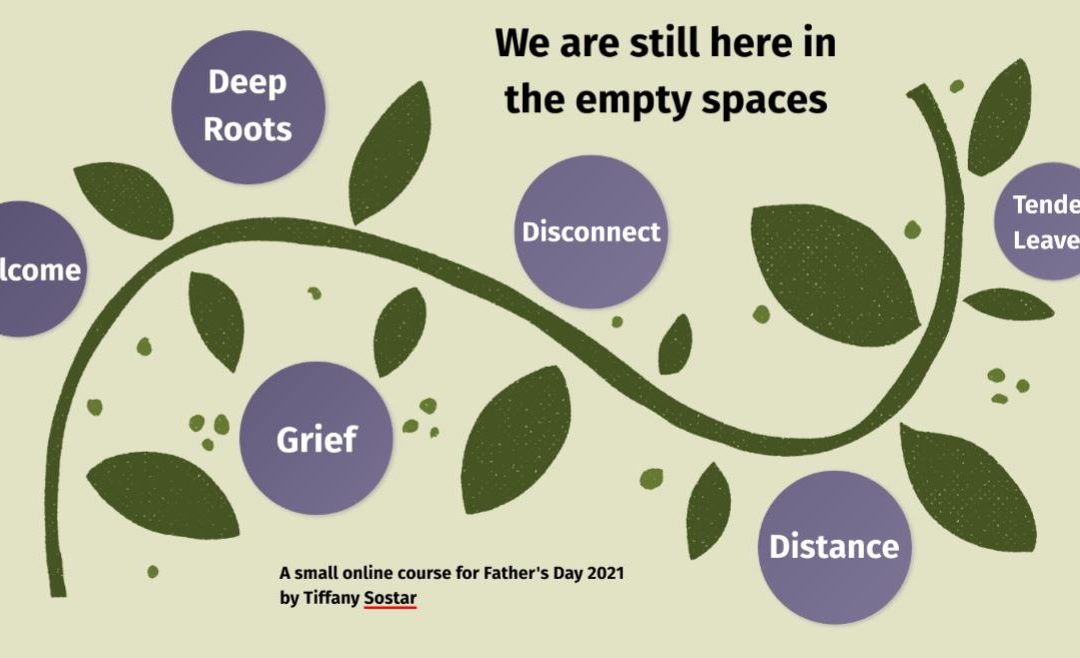
I put together a small online course for those of us who might have a hard time with Father’s Day.
It’s a 3-day, at your own pace, online course starting June 19 and ending June 21. For folks experiencing grief, disconnection, and/or distance, I hope it offers a little bit of comfort and community.
There’s a discord space for sharing and we’ll have one optional video chat during the course, but it is mostly just at your own pace.
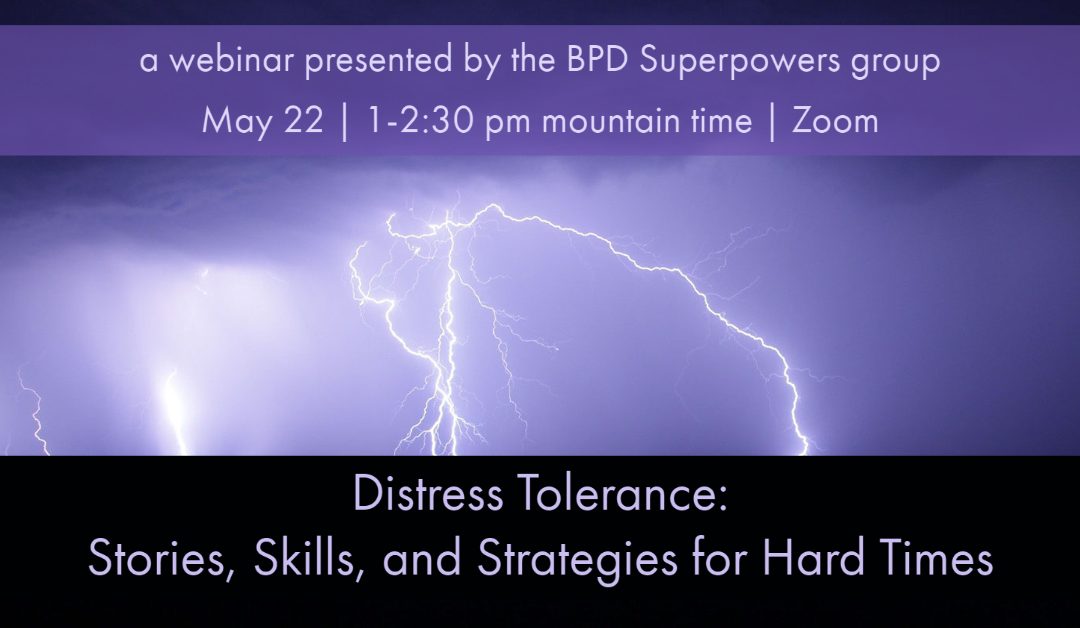
Join the BPD Superpowers group for a webinar on the topic of Distress Tolerance: Stories, Skills, and Strategies for Hard Times.
You are welcome to attend this webinar whether you identify with the label of borderline personality disorder or not. We all experience distress sometimes, and learning how to navigate moments of distress is important! This webinar is an opportunity for you to learn and benefit from the skills and insider knowledges of this amazing group of people.
This event will take place on May 22, from 1-2:30 pm Mountain time.Please note, this webinar will be rescheduled.
We are also hosting two community conversations on the topic of DBT experiences. These conversations are open to any member of the community who has lived experience accessing DBT either through groups, individual therapy, or self-directed through books and other resources. The goal of these conversations is to begin the work of creating a justice-informed DBT resource. You can find more information here.
The BPD Superpowers group has set our sights on an important new project, and we’re launching it in May for BPD Awareness Month!
We want to create an accessible DBT resource that is informed by our deeply held values of disability justice rather than ableism, decolonization rather than colonialism, collective action rather than individualism, and neurodiversity rather than pathology.
We recognize that DBT has been an incredibly helpful framework and set of skills for so many folks, many of whom identify with borderline personality disorder (and many who don’t!). We also recognize that many of the existing resources and many of the established ways of teaching the skills are ableist, individualist, and expensive, which means it has often been most accessible to white folks with financial privilege. In this project, we hope to honour what is valuable about this set of skills, and stand against what has been harmful.
Does this sound like a project you would like to be involved in?
Have you had experience with DBT resources, either through group or individual therapy, or self-directed using books or other resources?
We would love to hear from you!
Please note: Although this project is going ahead, the scheduled community conversations are going to be postponed. Individual conversations can still be arranged, and community conversations will be rescheduled.
We will be hosting two facilitated community conversations, through Zoom, in May.
If neither of these times work for you and you would like to be involved, email Tiffany to set up an individual conversation.
If you do not have lived experience with accessing DBT resources, but you do want to be involved in our BPD Awareness Month events, you can join us for a webinar on the topic of Distress Tolerance: Stories, Skills, and Strategies for Hard Timeson May 22 from 1-2:30 pm Mountain time. Register for the zoom link, or read more about the webinar here.