One of the projects that has been slowly unfolding over a series of years has reached an important milestone! We have completed the zine documenting our work together, and it’s ready to share. You can access the 52 page pdf in my proton drive here. (The switch over to proton drive is new, so if you have trouble accessing it, just send me a message at tiffany at groundfireccw dot ca.)
This project was a collective effort between me, my colleague and friend Frankie Hanman-Siegersma, and a group of community members who came together to collectively respond to the grief of a parent whose trans child had died. All of the photos in the zine were taken by people who participated in the project.
This project has taken three years to get to this point, and it’s not quite done yet. Frankie and I are working on a paper for practitioners, but that won’t be finished for a while yet. And the relationships that have grown in this work will hopefully persist for many years.
The zine is meant to document what we did together in a way that might invite other people to also undertake a collective response to grief.
It has been such a significant project – a collective response to grief, responding to a parent whose beloved trans child died by suicide.
Every time I worked on the zine, I ended up in tears. There is so much love represented in these pages, and such a commitment to showing up for community and for each other.
Everyone who was part of this project was willing to say yes to this… I know that’s obvious – of course the people in the project said yes to being in the project – but it really matters.
It matters that even though everyone involved was going through their own stuff, they said yes.
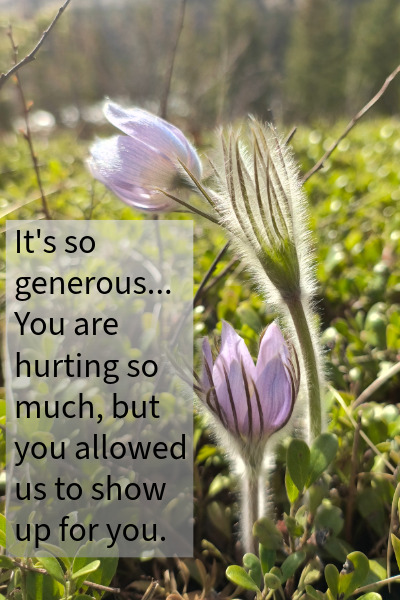
It matters that the parent said yes to sharing their story.
It matters that we all, every single person in this project, made a choice to be involved. And I hope that now that we are able to share about this work, other people will read about what we did together and will find ways to say yes to responding collectively to pain and grief and loss.
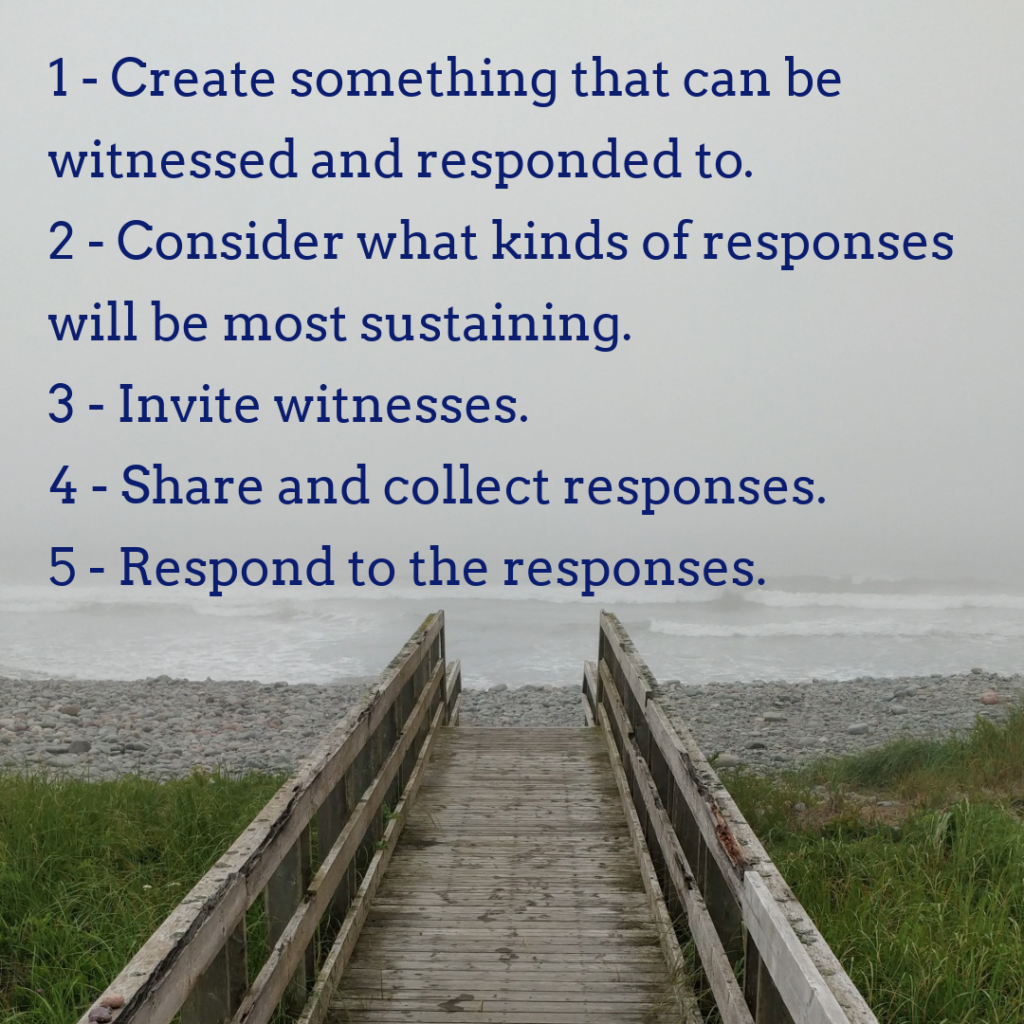
What we did in this project is only one possible way to co-create a collective response, and we outlined the steps that we took in a way that, hopefully, will invite readers (community members or practitioners) to find their own specific ways to co-create a response.
Here are the steps that we took:
This project represents a huge investment of time and energy and care.
I have no idea how many hours have gone into it, but it’s a lot. And it has absolutely been worth it.
If you find the idea interesting and there is a collective response that you’d like to organize but you’re feeling a bit daunted by the idea, let me know. I would be really happy to chat with you about how to go about it.
“There are two groups of stick figures, one on each side of the image, with three figures in each. Between the groups are 6 little zines. Text reads: We are not alone. We can imagine our way through this. Together. Zine library project.”
This post is an invitation to join a new project!
This will be a longer-term project, which I’m imagining will grow over the next year or longer, and community members are welcome to join for any part of the project (without an expectation of committing to all the parts).
I’m hoping to create a series of zines, each focused on a different metaphor or idea for getting through hard times.
The first conversation in this project will be a project launch conversation, where we’ll talk about what kinds of metaphors are sustaining us (we’ll make a list, which will become the first very small zine, and we can then use that list as inspiration for some of the zines!).
I think launching a project can be kind of nice, and a way to connect with other interested folks in a low intensity way. We can talk about what sorts of things people might want to contribute and how they might want to be involved, and I think having a whole conversation about what metaphors we’re leaning on might be really heartening right now, even if we don’t dive deeply into any of those metaphors specifically in this conversation.
The project launch will be March 18 5:30-7 pm mountain time / March 19 10-11:30 am Adelaide. If you’re interested in joining, let me know (email is easiest – tiffany @ groundfireccw.ca) and I will send you the zoom registration link. (I have had problems recently with bots registering for some of my community conversations, so since this is a public post, I’m not putting the link in here directly.)
Registration is free, though donations are gratefully accepted throughout the project to support the labour in making it all happen. (These will be processed through Groundfire.)
If you would like to share this invitation with friends and community members, we welcome any and all who might be wanting a space to be not-alone in 🙂
Some of the zines will have an open invitation to contribute (so community members can email a contribution in), many will have a co-writing session scheduled for folks who want to body-double while writing or making art, and some will be created by a smaller group of folks together without an open invite. If you have an idea for a metaphor you’d like to see become a zine for community, let me know!
One zine will be about mushrooms and the metaphors they offer for resistance. I’m co-creating this with a friend, Heather, and we’re going to host a zoom co-work session for folks to come and write or draw and chat about mushroom metaphors, and then we’ll put the zine together. That one is open to anyone to contribute to. The co-writing/art/companionship session will be April 1, 5:30-7 pm mountain time / April 2 10-11:30 am Adelaide. Let me know if you would like the registration link for this, too!
Another one is metaphors of spoon gardening/cultivating/hatching. Credit goes to Danielle for this idea, and they are happy to have it go out into community to become a zine. Christine Miserandino’s spoon theory has been so important in disability spaces, but/and it might feel joyful and possibility-making to stretch that metaphor and reflect on ways that we collectively share spoons, ways that we care for our own and each other’s spoons, ways that we adapt our lives to create contexts of spoonery, etc. – basically, disabled trans wisdom for living a spoonie life not entirely circumscribed by discourses of scarcity. This will also be open to anyone to contribute, and there is no zoom scheduled yet, but I’m thinking maybe in late April.
Another metaphor will be flotation devices, and what keeps us afloat. This will be with a small group, and I’m not sure yet if there will be an open invitation, or if this will be something we create and then offer to community from our small group.
Another metaphor will be about safety nets, and how we weave them together, and none of us can be the whole net.
I am imagining a slowly growing library of zines with different metaphors that might resonate at different times and in different ways for folks, with a range of content (hopefully including some art and maybe even some micro-fiction alongside non-fiction writing, and with narrative invitations for readers to reflect on).
I think it will be a nice project to engage with over the next while, a way to be connected and to share our ideas for getting through these hard times. Maybe I’ll see you there!
This document is, at its heart, about caring for trans community. This care might take the form of quiet friendship, vocal advocacy, public support or private support. It might be as simple as using someone’s pronouns or as involved as advocating for policy change. These actions of care might be understood as solidarity (though you’ll find some reflection on the limits of this framing in this document). These actions of care might be understood as compassion, companionship, connection, as movements towards justice and liberation, as love. They might be personal and private or very public.
This document is about actions of care, whatever they are, however you understand them, towards and with and within trans community, by which we mean, the vast expanse of gender expression and identity that is not cisgender (cisgender is when the sex you were assigned at birth aligns with the gender you know yourself to be).
We are sending this document out into a world that is increasingly hostile to trans community, especially to trans youth, trans women, racialized trans people, and disabled trans people.
This hostility is not new, and no injustice exists in isolation. Hostility towards trans community has always impacted different groups in different ways at different times, and always intersects with other systems of power and control.
Legal protections only go as far as other hostilities allow.
We hope that one action of care that extends from this document and these conversations is an interest in and invitation towards connecting with trans communities across difference, finding each other and caring together.
There are so many communities, including trans people who are racialized, who live in rural contexts, who are incarcerated, street involved, or otherwise disconnected from structural supports and “legitimate” trans identities and experiences. These are communities that governments fail to serve, and that have been left or pushed out of queer spaces.
In times like these, I think we can lose connection with the reality that trans folks and our allies have been supporting each other’s mutual existence forever. And maybe it’s hope-building to know that communities that have had less structural access have developed a richness of resources and conversations, skills and knowledges, networks of mutual aid and care to support one another in getting our needs met. There’s possibility in connecting to and working to strengthen these mutual aid systems because maybe this loosens our attachment to institutions and strengthens our connections to each other.
I hope that disconnected communities will be motivated to repair or build connections, and allow us to orient ourselves towards the movement, honouring the work, knowledges, and lineages in these communities. I hope we can remember that our liberations are collectively bound, and that this isn’t the start of something new but it is an opportunity for connection.
– Aakhil, contributor
Trans community includes people from every community. Every community includes trans people.
This document is a collective action of care extended from everyone involved in this project to every trans person who may come across this document, and we hope that it invites you, beloved reader, whoever you are, to join us in caring and in being moved to action by that care.
“Bearing witness to how many people want to do right and want to make active change and be supportive, it does inspire hope.”
– A contributor, about reading this document. We hope you feel the same.
This document has been shared in the International Journal of Narrative Therapy and Community Work. You can also hear an audio practice note about its creation and our hopes for the project here.
The conversation on December 11 was so lovely. It felt good to be in community, speaking about how we try to take care of trans and non-binary people in our lives (for many of us, that includes our own selves).
One participant wrote afterward and said, “it was the most generative convo I have had in such a while and felt so good to be apart of <3!!”
I received the transcript back from Shara (they are always such an important part of this work!) and have started pulling out themes and quotes to get started on the collective document.
The thing I’ve been thinking about most often since is how important relationships are in this work:
Our relationships with ourselves (our own experience of gender, our own learning and unlearning of gender expectations and the gender binary, our own safety as we decide whether to speak up or not in various contexts)
Our relationships with trans and non-binary community (our families, our partners, our friends, our communities, the people we don’t know but with whom we still want to be in solidarity, the safety of those people as we decide whether to speak up or not in various contexts and how we choose to speak when we do, the legacy of trans and non-binary advocacy we join when we act in solidarity)
Our relationships with people who may be acting in alignment with gender essentialism, cisnormativity, or even transphobia (these may also be our families, our partners, our friends and communities!)
And even our relationships with ideas and ideals, values and hopes, curiosities and possibilities.
The original topic was “how we avoid misgendering others”, and I had imagined a conversation about how we’ve unlearned our own cisnormative habits and the skills and strategies we’ve developed for our own internal relationship with gender and gendering. I’d like to talk more about that, still, but in the conversation on the 11th we ended up speaking more about how we respond when we witness misgendering, which is a related (but also very different) thing.
We talked quite a bit about the barriers that get in the way of acting in solidarity, and part of this conversation was bringing some nuance to the idea of what ‘acting in solidarity’ can mean. It is not a binary or a single correct answer – there are always a variety of actions available, and when we determine which action we take, there are many relevant factors. We are always responding based on our position in the specific context, which means thinking about things like – are we the person being misgendered, or are we witnessing someone else being misgendered? what is our relationship with the person engaged in misgendering? what do we know of their values and hopes – if they are someone who cares about not misgendering, then correcting them is almost always the right call, but if they are someone who will become angry, we have to consider what the fall-out or backlash will be, and whether that will compromise our or someone else’s safety. In those instances, other actions, like texting to check in with someone, or finding something affirming to do later, might be the better option. These can be uncomfortable calculations, because it can feel like failure, and I hope that one generative outcome of this work is that we find ways to speak about our desires to be in solidarity and to avoid misgendering and to respond to misgendering with compassion and rigor.
I’m going to get started on the collective document soon, and will be sharing the draft here.
If you would like to contribute, there are many ways you can do this!
I’ve created a little google form for people to contribute asynchronously. You can find that here.
We’re also going to have a follow-up conversation in January, and I’ll share that date once it’s set.
You can also email your thoughts to me, or comment here.
The questions in the form are:
Is there a particular person you are making this effort on behalf of?
What’s important about getting people’s pronouns, names, and gender right?
How did you learn to care about avoiding misgendering?
Who knows that you care about this? (Sometimes we can feel isolated in our efforts, and one goal of this project is to make visible the community around us and the legacy of solidarity that we are part of when we take care in this way.)
How do you practice getting people’s pronouns, names, and gender right? (This can include practices you use for yourself, too! When we avoid misgendering, that includes our own precious trans and non-binary selves.)
What practices do you have for when you get it wrong?
What difference have these acts of care (both for getting it right and responding when you get it wrong) made in your life or the lives of others?
What would you want others to know about avoiding misgendering?
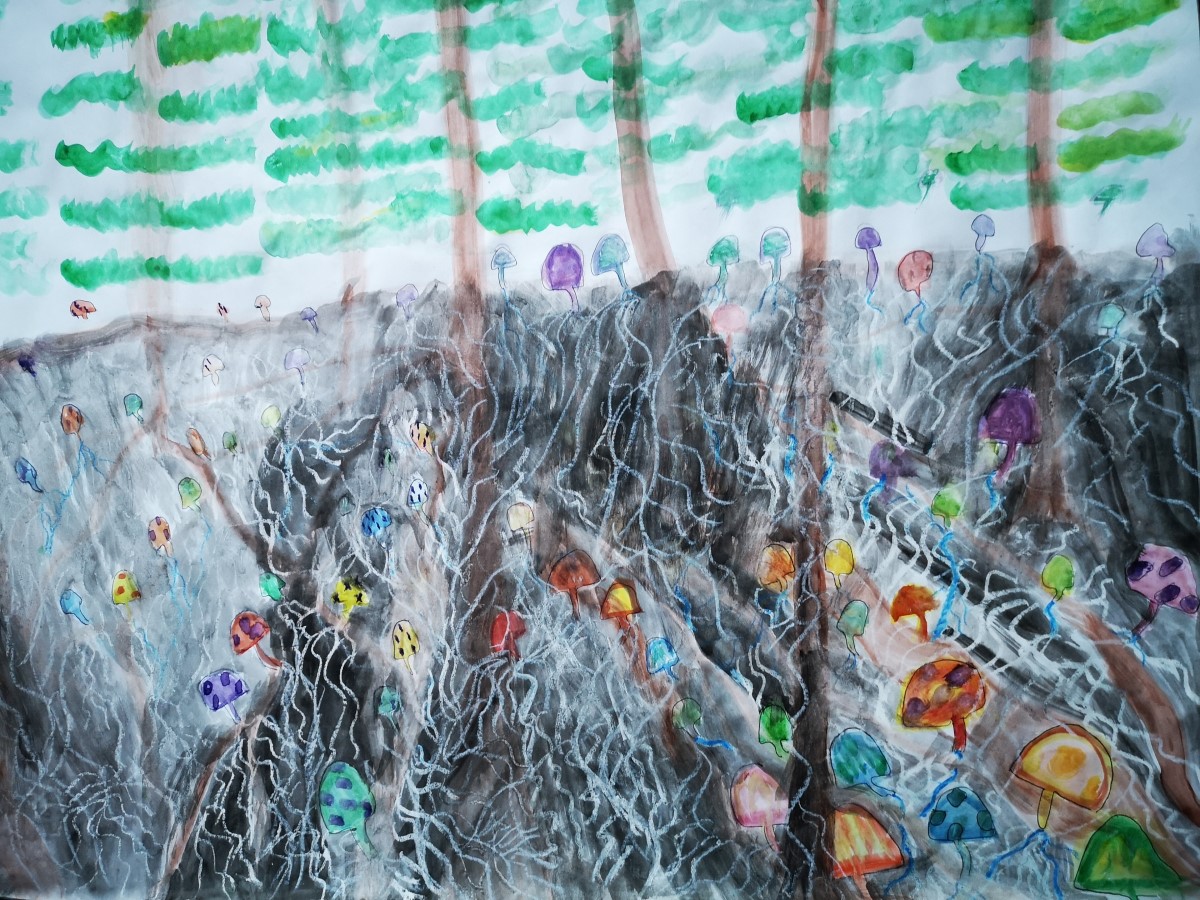
A small imagining, based on the metaphor of mycelium in forests. In this imagining, we are the trees.
Mycelium are fungal material, spread throughout soil and other substrates, which can fruit into mushrooms under the right circumstances. Mycelium can be tiny, or, as the Armillaria in Oregon, vast and ancient. Mycelium not only break down dead matter, they also distribute resources across ecosystems. The mycelium network within a forest can link trees across a vast distance, sharing nutrients from one part of the forest to another.
What is the soil in which you find yourself? (Your social context, your environment.)
Does this soil feel rich and nutrient-dense, or does it feel depleted? (Are you nourished and supported by your social context?)
Do you remember a time when you were in different soil? (Have you ever found yourself in a different social context?)
Who is in this soil with you? Who is in your forest? (Who is alongside you? Perhaps these are cherished companions, perhaps they are not. Forests are places of magic, and also danger, after all.)
What else is present in the forest? (Are there birds, squirrels, bears, bees, mosquitoes? What other non-tree / non-human companions are in your forest?)
Who are you connected to across distance? (What companions do you cherish and stay connected to? These may be living or not, they may know you in return or not. The mycelium network is magical because it can connect us in seemingly impossible ways.)
What nourishment is shared across your connection? (What do these connections make possible – what do they offer that you do not receive in your immediate environment?)
What information is shared? (What have you learned from these distant connections?)
What do the mycelium share from you, out to other parts of the network? (What contributions have you made, what has your existence made possible in the lives of others?)
Dear friends,
We (Lindsey and Tiffany) are writing this letter from Calgary, Alberta, in so-called Canada. From Blackfoot Confederacy (Siksika, Kainai, Piikani) and Stoney-Nakoda (Wesley, Chiniki, Bearspaw) and Tsuut’ina land. Métis land. From the place where the Bow meets the Elbow river.
This is beautiful, breathtaking land.
We wonder about the land that you are on.
Are there trees? Rivers? Mountains?
What do you see when you look out the window, when you step out your door? What do you smell? What do you hear?
What is the landscape, and what are the plants and animals that you share space with?
What is your relationship with the land you’re on?
In an Indigenous Counselling and Trauma Work course, Cree/Métis therapist and academic Karlee Fellner taught Tiffany that the land is old enough, strong enough, wise enough to help us hold our pain, no matter how vast that pain is. As we write this letter, we are thinking about the pain that exists following the events of the last years.
The land we write this from, and the Indigenous people on this land, and every marginalized community here, is currently threatened not only by the conservative government in power in this province, but also by Canada’s ongoing commitment to extractive and exploitative relations with land and people.
We’re sharing this context because we want to be clear that we recognize as much racism, as much white supremacy, as much racial capitalism and neoliberalism here in our country, in our province, in our city, as we see happening in the US. We are not writing from a position of distance or superiority, but from a position of shared struggle against these oppressive discourses and systems. And, as white settlers, also from a position of complicity with these discourses and systems.
We planned to write this letter before the results of the 2020 presidential election came in, because we wanted to offer some care to our friends in the US. But we found ourselves, like so many other folks, slowed down by the thick mud of distraction and doomscrolling through our social media feeds. So, instead, we are writing this after Joe Biden has been named president-elect, after the wave of celebration and the deep collective sigh of relief. (We were relieved, too!)
This little document contains some of our hopes for you, and reflects some of our hopes for ourselves. It also contains some art, a little recipe, and a few reflection questions that we have found helpful for ourselves. The document comes out of our work together in the Unexpected Light speculative fiction and narrative therapy course, and we hope that this document can be a tiny invitation to imagine more just, more liberated, more possible futures.
We wonder about what kinds of futures you hope for, and how you learned to hope for them.
What are the systems and structures that you hope will change?
What do you hope will be possible once these systems change?
What are the existing forces that have the power to change these systems – what are the networks working underground to transport nourishment, encouragement, information; what are the histories of collective action, the legacies of resistance?
Do you see a place for yourself in these existing frameworks of resistance and change?
We hope that you can sink your strong roots down into the earth, and feel the mycelium surround you, supporting you and enabling you to support others.
How to Make a London Fog
To start: 2/3 mug of strong Earl Grey tea
Flavouring: Spoonful of vanilla sugar Splash of vanilla extract
To finish: Warmed and frothed milk or milk alternative
London Fogs are one of Tiffany’s most cherished soothing rituals of care, both alone and with friends. This recipe was included in the Unexpected Light course, and has become one of Lindsey’s soothing rituals, too. So, we decided to share it with you, too!
What are some of your rituals of care? Who taught you these skills? Who do you share them with?
We chose mushrooms (or, more accurately, the mycelium network!) because of the way that both hope and oppression can live underground, barely visible for such a long time, sustained by nearly invisible threads sometimes across vast distances and over unimaginable lengths of time, and then, given the right circumstances, the right rain (to quote Tiffany’s beloved Nathan), they spring up again like mushrooms.
We were thinking about how shocking the rise of fascism has been in the US and also in our own province, and yet how unsurprising, how these networks and threads have persisted. Death cap mushrooms. Indistinguishable from harmless button mushrooms when they are just sprouting.
And we were thinking about hope, too. About collective action. About the community care, the mutual aid and networks of support that sprang up in response, and that had always existed. Truffles. Precious, hidden, sustaining the roots of trees and feeding the forest, even when they are deep underground. Protecting ecosystems from drought and making the most of available nutrients in times of scarcity. (May we each be some glorious truffle-hunting animal, seeking out what is delicious and life-giving.)
What are some delicious things in your life right now?
What delights you?
What comforts you?
What brings you joy and ease?
And what are some nourishing things in your life right now?
What sustains you?
What warms you, strengthens you, fortifies you?
What brings you energy to keep working towards change?
We thought about how, in the last four years, many mushrooms have sprung up, and how some of them represent decay, rot, destruction. How the mycelium network can be so sustaining but also how it can be something other. How it can represent “ruptures in our unspoken contract of trust and care” (to quote BK Chan[1]). And also, how even decay (maybe especially decay) offers us the opportunity to take something noxious and turn it into something nourishing.
To quote Paul Stamets[2] (the real-life mycologist that the Star Trek: Discovery character is named after), “fungi are the grand recyclers of our planet, the mycomagicians… Fungi are the interface organisms between life and death.”
If we are, then, between life and death, and with choices about how to navigate this liminal space, perhaps we can learn from the fungi around us.
Have you experienced or witnessed life-affirming transformation?
What made it possible?
What supported the work of transformation
Credit must also be given to adrienne maree brown for identifying a tugging between life and death in her post on unthinkable thoughts[3], which was written specifically for movement organizers in Black and Brown organizations.
We recognize that the nourishment we find in her words was not first meant for us, and parts of it are not ours in any way. Thinking about life and death, cultural urges that sustain life or that threaten it, we must acknowledge how white supremacy, which benefits us, which makes our lives easier, makes the lives of Black and Brown and Indigenous people in both of our colonial nations so much harder to hold onto. As Claudia Rankine and Judith Butler[4] so clearly named, the scripts available to us as white people acting with whiteness lead to the death or incarceration of Black people. Access to life, to systems that support life, is not equal across social location.
And, equally true, we share adrienne maree brown’s hopes when she writes:
“i want us to want to live in this world, in this time, together.
i want us to love this planet and this species, at this time.
i want us to see ourselves as larger than just individuals randomly pinging around in a world that will never care for us.
i want us to see ourselves as a murmuration of creatures who are, as far as we know right now, unique in all the universe. each cell, each individual body, itself a unique part of this unique complexity.”
We thought about the ruptures that interrupt our togetherness and how perhaps hope can be a balm for the ruptures. We thought about hope as a collective practice (to quote Angel Yuen[5]), hope as a discipline (to quote Mariame Kaba[6]), hope as something that we can carry together.
We imagine the network that connects us to you, our friends in the United States of America, whose country has suffered such ruptures – ruptures as deep, as old as the founding of your country, so similar to the ruptures that also fragment so-called Canada. We want to connect, like mycelium. The threads and tendrils that stretch across distance, and that, given the right rain, fruit into mushrooms.
May we grow the medicinal mushrooms, the transformative mushrooms, the mushrooms that rejuvenate and regenerate. And may we also rest sometimes, knowing that this network is vast, our connections are real, and the mycelium can sustain us even in drought, and support us through transformation.
We love you, and we are stretching our roots out to you, with hope for all of us to find the way through, to do the work of decolonizing, of amending the soil, of being part of an ecosystem that is more wildly diverse, chaotic, joyful, and generative.
Lindsey and Tiffany
References
[1] Chan, Karen BK. (2020). In Calling in: Doing social justice with compassion. Webinar.
[3] brown, adrienne maree. (2020). Unthinkable thoughts blog post. http://adriennemareebrown.net/2020/07/17/unthinkable-thoughts-call-out-culture-in-the-age-of-covid-19/
[4] Butler, Judith and Rankine, Claudia. (2020). Visionaries Series: Claudia Rankine in Conversation with Judith Butler. https://vimeo.com/473984783
[5] Yuen, Angel. (2020). Dulwich Centre Meet the Author session.
[6] Kaba, Mariame. (2020). Hope is a discipline. https://towardfreedom.org/story/archives/activism/hope-is-a-discipline/
It was available to contributors and patrons a couple days early, and is now publicly available for today, Wednesday, September 23, Bi+ Visibility Day!!
The PDF is available for free, and you can download it here. If you’d like to purchase a copy they are $12 CAD, and you can order one by emailing me.
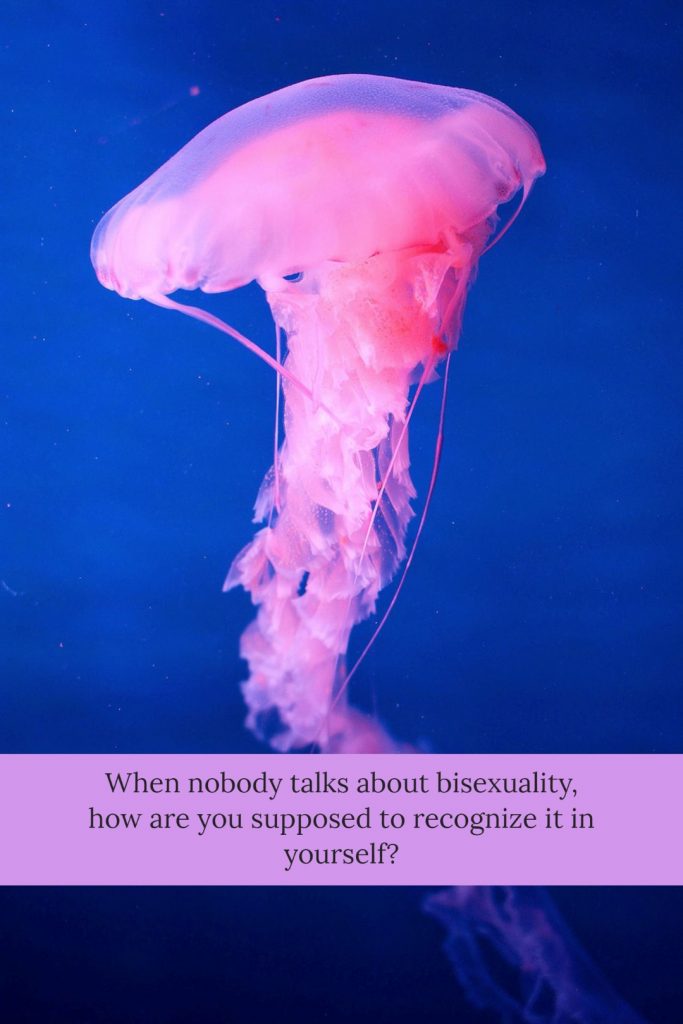
A line from Candice Robinson-Horejsi’s essay Living the Possibilities, “When nobody talks about bisexuality, how are you supposed to recognize it in yourself?”, overlaid on a pink jellyfish. Photo by Pan Da Chuan on Unsplash.
An Ocean of Possibilities is a zine by Tiffany Sostar, with contributions by:
I’m not sure how to introduce these essays, poems, comics, and fiction, and, like everyone else, I am swimming in the cold waters of exhaustion and overwhelm. Bi+ Visibility Day lands 6 months into the novel coronavirus pandemic. Every one of the contributors to this zine, from Aoife in Ireland to the folks in the US and those of us in Canada, are affected by the pandemic.
Search for “bisexual health outcomes” and you’ll find years of studies that demonstrate that, as the HRC puts it, “bisexuals face striking rates of poor health outcomes” (you can read the Health Disparities Among Bisexual People brief here).
And we know that the pandemic has already highlighted multiple systemic health and social inequities. The economic impact, the differential access to health care – none of these fall equally on different communities. Fat folks have faced significant increase in fatphobic discourse during the pandemic. Women are bearing the majority of the increased burden of childcare and at-home education. Black, Indigenous, and brown communities are seeing the pre-existing unequal access to health care and social support escalate.
And it is not just the pandemic that impacts these (and so many other) communities. Overt acts of racist violence are more frequent – white supremacy and colonialism lashing back at those who are protesting. The pandemic arrived in Canada as the invasion of Wet’suwet’en was ongoing, and as the pandemic crosses the half year, more colonial violence is being enacted on Mi’kma’ki – coast to coast, Canada has escalated the violence against Indigenous communities. In the US, police violence (in response to protests against police violence!) has been going on for months.
In Alberta, where I live, Bi Visibility Day comes as disabled Albertans are under increasing and aggressive threat, as our government cuts funding from the most vulnerable.
These issues matter on Bi+ Visibility Day because the bi+ community includes fat folks, women, Black, Indigenous, and brown folks. The bi+ community includes parents, and folks who are living alone. This community includes trans and non-binary folks, disabled folks, poor folks, homeless folks. This community includes folks with difficult relationships to substances, and folks who have experienced trauma, and folks who are experiencing trauma right now.
Every issue of justice is an issue that matters for this community, and when we ignore any part of this community – when we forget that this community includes all of these intersections, includes every intersection! – we just recreate the harms that are already happening.
So, how do I introduce a zine into this context that is so overwhelming?
A line from Osden Nault’s poem ‘habitat: Unravelling substrate-species relationships‘, “a soft and unshakeable belief that we could nourish one another”, overlaid on a photo ofphysarum polycephalum slime mold by Helen Ginger. CC BY-SA 3.0.
I think, first, by acknowledging that it is overwhelming.
And then, perhaps, by also acknowledging that despite these daunting realities, there is also a resilience, a persistence, a revolutionary ongoingness within this community.
It is worth celebrating our lives and our experiences.
It is worth being visible, today and every other day.
The pandemic, the colonial machine, the vice-grip of capitalism, the clenched fist of patriarchy – these things are not more meaningful than this community.
We exist within these hostile waters.
We exist, and we have always existed, and we will continue to exist.
We are jellyfish – you can find us in every ocean, in every part of the ocean.
A line from Marlena Chertock’s poem Water bear body, “I can exist through anything” overlaid on a black and white image of jellyfish. Photo by Greg Ortega on Unsplash.
The pieces of writing in this zine touch on issues of aging, parenting, and navigating relationships (with others, with communities, and with selves). They include poetry, essays, fiction, and art.
Multiple essays address the tensions between bisexual and lesbian spaces, and the questioning of “queer enoughness”.
This zine is not representative of the entire bi+ community. There are so many intersections missing in these 32 pages, so if you read this zine and find it interesting or inspiring or encouraging, I hope that you go out and find more.
We are here in every space.
We are telling our stories.
We are visible, not just today but everyday, if you know how to see us.
“Contributors” on a jellyfish background. Photo by Octavian Rosca on Unsplash.
Jocelyn LaVon is an A++ parent, friend, and community member. (This bio was written by Tiffany, not Jocelyn.)
Candice Robinson-Horejsi (Calgary, Canada). Wife, mother, engineer, NaNoML, writer, runner, knitter, nerd. Candice wears many metaphorical hats. You can find out more here: candicerobinson.ca
Gloria Jackson-Nefertiti is a breast cancer survivor, public speaker, workshop leader, panelist, artist’s model, published poet and soon to be published memoirist. You can find her on Facebook and Instagram as GloriaJacksonNefertiti, and on Twitter as @gloriajn. She lives in Seattle, WA.
Aoife Byrne is an artist living in Dublin, with her Partner and two Pups. She focuses on illustration, photography, animation or a combination in her work. She loves cosplay, choirs and dancing.
Sheri Osden Nault is an artist of Michif and mixed European descent, whose art practice and research are grounded in queer, feminist, and Indigenous world-views. Osden lives in Tkaronto on the traditional territory of the Haudenosaunee, Wendat, and Mississaugas of the Credit First Nations, under the Dish with One Spoon Wampum Belt Covenant, which precedes colonial treaties on this land. Through their work they strive to elicit a sense of social and ecological responsibility to one another on a damaged planet.
Marlena Chertock has two books of poetry, Crumb-sized: Poems (Unnamed Press) and On that one-way trip to Mars (Bottlecap Press). She uses her skeletal dysplasia as a bridge to scientific writing. Marlena is a bisexual writer and serves on the planning committee of OutWrite, Washington, D.C.’s annual LGBTQ literary festival. Her poems and short stories have appeared in Breath & Shadow, The Deaf Poets Society, The Little Patuxent Review, Noble/Gas Quarterly, Paper Darts, Rogue Agent, Stoked Words, Wordgathering, and more. Find her at marlenachertock.com and @mchertock.
Julene Tripp Weaver, a native New Yorker, is a psychotherapist and writer in Seattle. Her book, truth be bold—Serenading Life & Death in the Age of AIDS, was a finalist for a Lambda Literary Award, and won the Bisexual Book Award. www.julenetrippweaver.com. Twitter: @trippweavepoet
Jan Steckel’s latest book Like Flesh Covers Bone (Zeitgeist Press, December 2018) won two Rainbow Awards (for LGBT Poetry and Best Bisexual Book). Her poetry book The Horizontal Poet (Zeitgeist Press, 2011) won a Lambda Literary Award for Bisexual Nonfiction. Her fiction chapbook Mixing Tracks (Gertrude Press, 2009) and poetry chapbook The Underwater Hospital (Zeitgeist Press, 2006) also won awards. Steckel moderates the Facebook group Bi Poets and is an active member of the Bay Area Bi+ and Pan Network. She lives in Oakland, California, USA with her husband Hew Wolff, host of Berkeley BiFriendly.
This zine was initiated and formatted by Tiffany Sostar for Bi+ Visibility Week 2020. Tiffany is a writer, editor, community organizer, tarot reader, course instructor, and narrative therapist. They are bisexual, non-binary, and chronic-pain enhanced. You can find them online at tiffanysostar.com and foxandowltarot.com or email them at sostarselfcare@gmail.com. You can support their work by picking up this zine, enrolling in An Unexpected Light, booking a narrative therapy session or tarot reading, hiring them to facilitate a workshop for your group, or backing their Patreon at patreon.com/sostarselfcare.