
by Tiffany | Jul 11, 2017 | #100loveletters, Identity, Narrative shift, Writing
(This post is part of the #100loveletters challenge, which started June 21. The challenge is open to anyone, at no cost! It’s really easy, and really hard – for 100 days, from June 21 to September 29, or 100 days from whenever you start, write yourself a love letter. It can be short, it can be long, it can be a stick figure or a sonnet or a flower or a song. It can be written down, or it can be an act of love. Share your pictures, comments, thoughts, and stories in the hashtag #100loveletters on Facebook, Twitter, Instagram, or in your blog, and find a community of people practicing a summer of daily self-love, or participate offline. You can also enter to win a hand-written letter by emailing me. I’ll be drawing a random name every twenty days over the course of the challenge. You can also join the email list to receive writing prompts, encouragement, and success stories.)
I interviewed Stasha at the beginning of the 100 Love Letters challenge, since she was the inspiration for the challenge.
Now, three weeks into the challenge, I was lucky enough to interview her again on the topic of writing ourselves love letters when we’re in the middle of feeling shame, anger, fear, or self-hate. This is a topic that has come up again and again for challenge participants, and it’s worth digging into. So, here we go.
Stasha – Question the first?
Tiffany – Yes! Excellent. In our first interview, we talked a lot about the beginnings of the project, and what it offered you in terms of that deep well of self-loving actions and accumulated evidence – I loved the image you shared of having that big stack of love letters to look back on.
We’re into the #100loveletters challenge now, and quite a few people have sent me messages asking about how to write a love letter when you’re hating yourself. My answers have mostly been “just start with whatever you have available, even if it’s just a walk or a post-it note or a mug of tea” but I wondered if you had wisdom about this, since you’ve been through the full 100 days.
How do you write – WHAT do you write – when you’re feeling self-hate?
Stasha – I’m just looking through my letters because I felt a lot of self-hate during the process…
One example, I was feeling really rejected, which is a feeling that I can get easily stuck in. So, I tried to think of the opposite of rejection and wrote those words around my heart. Another time I did the same about interrupting, because I was trying to listen better.
Tiffany – Oh, I like that a lot. That fits with the Dialectical Behaviour Therapy skills I’ve been working on in my own life – looking for opposites, and intentionally choosing an opposite and incompatible word/thought/action.
Stasha – Oooo yes dbt forever! I love the story of dbt creation and I try to fight the professionalization of the system of dbt. (Tiffany’s note: The New York Times recently ran a profile on Marsha Linehan, the creator of DBT. Her work is particularly important because it came out of her own experiences of borderline personality disorder – still such a stigmatized condition – and extreme self-harm. If “nothing about us without us” is your rallying cry, her work is worth exploring.)
Stasha – I externalize things like anger monsters for my coping/healing work all the time, so I used that to try and remind myself of good. Example: I get to be in the same world as this tree. One externalizing technique about love letters is that even if you were really disappointed in someone you loved, you could probably still summon a love letter for them. I kept going because I wanted to show myself the same care.
Tiffany – One thing I’m thinking about, that I’m not sure how to talk about… So, forgive the awkwardness/uncertainty of this.
Stasha – Uncomfortable is required to learn, so I’m ready.
Tiffany – But I have had times in my life when a project like this would have hurt so much, because I just could not summon anything resembling a love letter for myself. I think that some of the people who have been watching the project develop, and have been wanting to participate, may be in that space. Right now, I can do this challenge. I have spent years working on self-compassion and on being able to act with love even when I don’t feel love.
The reason I find this so tough to talk about is because I want this to be a tool that is accessible to everyone – we can all show ourselves care even when we don’t feel it! We can all invest this time in ourselves! – but as I speak with people, and as I think through my own history, I am recognizing that there are times when this really isn’t possible. And I want to acknowledge that, without framing it as failure, and also offer some hope or some alternatives.
Do you have any insight or thoughts for people who maybe want to do this now but are really struggling with it?
Stasha – Yes. This is so important. Me too.
One thing that I do, that many professionals define as a symptom of trauma, is pick up treasure like a crow. Bits of glass or rusty things or worm-eaten wood.
Tiffany – I love that image. Corvids forever.
Stasha – In my love letters the symbol of the crow is recurring and was a way for me to have this as a positive image while I gathered that summer’s treasures together in a copper pot.
Nowadays I get rid of the treasures by giving them to the river in the fall, before I kept them. I knew that I was going to reengage this coping mechanism, even though I had not done it for awhile. So, I summoned my corvid power and listed the pros of crows when I couldn’t list them about myself.
Tiffany – Oh, I really love that. Having something you associate with yourself (like the crow for you, for me it would be fae folk), that you can list beloved or positive traits about even when you can’t list them about yourself.
Using your patronus / alter-ego / animal friends in your love letters
- What do you associate with yourself? If could be an animal, a character, an idea, an object. Think of the Patronus idea from Harry Potter – something powerful, associated with who you are as a person, that can be summoned to protect you.
- What are your favourite things about the animal/object/idea you associate with yourself?
- What makes that creature/concept/thing so cool?
- What is one story or myth or memory associated with that animal/object/idea that you treasure?
Stasha – When I felt broken or as if I had a giant hole in my spirit I would weave paper and fabric into a letter. I learned that one year at Equinox Vigil, a really neat Calgary event about the need for public mourning of grief of all kinds.
Tiffany – That sounds like a valuable tool, too. (And I am thinking a lot about sensory stuff as I build the summer course – registration is still open for one more week! – I love how that practice of weaving a bandaging or healing letter would blend tactile and visual senses with fine motor skills – bridging left and right brain selves, and helping both from a narrative perspective and also from a physical perspective.)
Stasha – Yes to mind melding our own minds!
I used the metaphor of growing A LOT. And home. I wanted to be home and safe when I was with myself. Big difference between with myself and by myself. That meant confronting the shit.
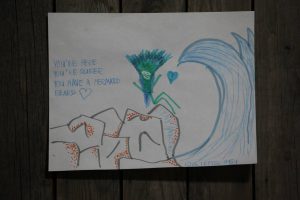
One love letter was a rock with a hole through it from persistent water drops.
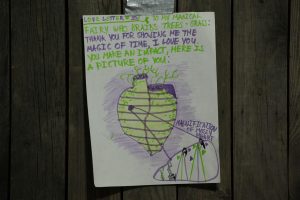
Tiffany – Oh, that is lovely. And I love how fluid and flexible your definition of love letter is. I think that’s something I could definitely improve for myself. Or, maybe to put it more gently, that could be an invitation to more flexibility in my own thinking.
How much time did you spend on this project per day? Did you find the time commitment overwhelming? How did you carve out and protect the space for that?
Stasha – Ha! Gentle is good. I usually would write the love letter in the morning, so it could be based on what I needed for that day, and then at night I wrote 3 things that weren’t terrible about that day. I love structure for my healing, so those bookends really helped me to accomplish my other goals.
Tiffany – I like that idea. I might try that for myself, because the last-thing-at-night love letters don’t feel so good for me – they feel like avoidance and dismissal, you know? And it’s funny – even though I feel that, I haven’t shifted it. But I like your idea of bookends and of the love letter giving you what you need for the day.
Stasha – I showed myself evidence that other people loved me, when I felt less able to do it myself. I drew stick figure me and cut out my name from birthday cards to show myself that I was surrounded by love.
Dear Tiffany, If you need some material for your love letters you can look into concepts such as Radical Hope, which you demonstrate every single day. You could interview someone who loves you about your great qualities, even though it is scary. – Stasha
Tiffany – I love that so much. Thank you!
I have been struggling with that concept of “deserving” all week. I have been avoiding writing my letters – I usually write them ten minutes before bed, long after my brain wants to be done, and if I weren’t running this challenge publicly, I don’t think I would be doing them. They feel indulgent and … “bad” – selfish, ridiculous, foolish, arrogant.
Stasha – So write them to the fairies and fae. Write them to the crows and elf leaders.
Tiffany – Yes. I love that idea! And maybe we can invite others to help us see ourselves through a loving mirror, when we’re not able to do that for ourselves.
Interview Questions to ask someone who loves you when you’re struggling to write your own love letter (you can use this template as-is, or adapt it):
Hi, I would like to ask you some questions. It’s totally okay if you’re not able or don’t have time to answer. This is challenging for me to ask, because I’m struggling with not liking myself a lot right now. I’m asking you because I trust you, and I trust your insight and your ability to see me clearly. I know that you love me. I appreciate you taking the time to answer these for me.
- What comes to mind when you think about me?
- What is your favourite memory involving me?
- Can you think of a time when I did something well?
- Can you share a story that demonstrates something you admire or enjoy about me?
Tiffany – Do you have any other thoughts on the topic of doing this project while experiencing self-hate?
Stasha – I do all my projects while experiencing self-hate. I think a shocking number of us do. I think I drew brick walls 3 times in my letters, not as barriers but as symbols of the cumulative effort required to get that shit voice* to also listen to compassion.
Tiffany – It is so common. So, so common. I think you’re right
Stasha – My 100th letter I painted a life size tree, while naked. I took lots of pictures of that PROCESS, because that was the gift to myself: the wonderful process of fucking up, exhibiting symptoms, lying to myself about my worth, and listing 1-3 non-crap things per day. Otherwise known as messy healing, the most sacred of love spells.
Now this process of seeing other people struggle within this same process, is so validating and healing. Because sometimes I forget how awesome I am or the amazingness of the things that I have tried. Just like you and you and you. It is really nice to try stuff together.
Tiffany – One thing that comes up repeatedly in the narrative therapy training that I’m doing, is the idea that people need to know that their experiences and knowledges can help others. Maybe one motivation for getting through the 100 Love Letters challenge is so that in a year or two years or ten years, when we have someone else in our life struggling, we can draw on these experiences and offer them hope and help.
Just like you are doing now, because you ARE amazing and badass and wise and resilient!
Stasha – Awwww thanks friend. Pulling knowledge out of pain is the original chocolate chips* out of shit! Just like YOU are doing now. Part of my 100 love letters process was to do it for me instead of for other people.
Tiffany – One thing that I did a few years ago was to give myself stickers for every positive or useful thing that happened or I did in the day. I think it was a similar process. It helped me start to see myself as competent and worthy, at a time when I did not experience myself as either of those things. I don’t even know where I got that I idea, but I used it to claw myself up out of one of the darkest holes I’ve been in.
I think that we are often so much more resilient, and so much more wily in our survival strategies, than we give ourselves credit for.
Thank you for sharing your wisdom about this! And for sharing this project. It’s a good one!
Stasha – Wily af! Thank you for building on it, there has been so much learning, and it is early still in the process!!
Tiffany – I know!! We are not even a fifth of the way through, and already so much wisdom and generosity has been shared. I’m excited to see the project continue!
Stasha – Way to grow!

* Stasha’s Chocolate Chip Wisdom (note on this section for discussion of eating shit)
Stasha – Now. Everyone loves chocolate chips.
Ok not everyone, but many do.
I describe this process [of finding self-love in the middle of self-hate] as picking chocolate chips out of a pile of shit.
It has been my direct experience that kids who are coping with abuse from primary caregivers, particularly neglect – are really, really good at picking chocolate chips out of piles of shit.
So we like chocolate. But when you are picking your chocolate out of shit, you are going to also eat a lot of shit.
And this shit will get inside you. And this shit will give you a mean belittling voice that will tell you that you are no good.
Sometimes this shit will destroy you or tell you to destroy yourself. It will always tell you that you are no good. That you don’t deserve 100 love letters.
I think though that I found a loop hole here, because the shit will never tell you not to write 100 love letters, only to not write them to yourself!
It is sad because everyone except us knows that we deserve this love. That shit gets in the way.
(Running the #100loveletters challenge is possible because of the amazing support of my community, especially my Patreon patrons. If you’d like to keep this work going, consider checking out my Patreon, or liking my Facebook page, or following me on Instagram.)

by Tiffany | Jul 8, 2017 | Health, Identity, Plot twist
Jen Donovan lives in Eugene, Oregon, and is a mental health therapist. She posts frequently about her experience with chronic illness (mast cell activation syndrome), and her journey towards wellness. She blogs at Skunk Speaks.
She generously shared her experience and insight as part of the July theme week on the Sostar Self Care Facebook page – System Failure: Self-Care for Sick Days (and weeks, and months).
Tiffany – Can you share (as much as feels comfortable) about your experience with becoming ill and coming to terms with what was happening?
Jen – This was really hard for me because the disease I have is pretty rare and the symptoms are often fairly vague and hard to make sense of. So, for the first six months or so of having acute symptoms, I really thought that I was “going crazy.” Additionally, a symptom of the disease is panic attacks, which further confounded what was physiologically happening to me. I was lucky that I had a doctor at the time who happened to be familiar with the disease and was able to diagnose me. Just having the validation, that I was not just having somatic delusions, was a really important initial step in coming to terms with what was happening.
After that, though, came the second part of “coming to terms” – actually accepting that I have a rare, incurable disease. Again, I was lucky that I had exposure to alternative and holistic healers in my community who helped me realize that although the disease cannot be “cured,” it can be “healed” through major lifestyle and diet changes, among other things. The distinction between “healing” and “curing” has become an important one for me in my process of acceptance.
I acutely remember one day in early February, looking over the four pages of things that an herbalist recommended I start doing to treat my illness, including an extremely stringent diet and major lifestyle changes, and I was just crying and crying and crying. Even being very disciplined with these changes, it can take years to see a significant effect. I had a horrifying moment of realizing my life would never be the same. I felt like I couldn’t do it – it was too much – I would just be sick forever and eventually die. And at that moment of total terror, I had this incredible experience of complete surrender. I felt my “ego” just fade away and I just totally submitted to a journey towards wellness, no matter what it entailed. That was a really important moment in my acceptance.
Tiffany – I wanted to ask a bit more about the idea of surrender – you talk about that as being such an important process, but our culture is so resistant to the idea of surrender. Sickness/illness is something we are supposed to “fight” but in your words, it’s not about fighting illness so much as surrendering to a journey. Can you add to that? It’s just such a narrative shift that I wanted to expand on it.
Jen – Yeah, the idea of surrender has been big for me. I think one idea that has become a major core belief for me is that, generally speaking, the body is infinitely wise. If it’s doing something harmful to itself, it’s because something in the environment is not working for it. It’s not being given the space it needs to take care of itself. Symptoms are messages – our body telling us ‘hey this isn’t working!’ So to “fight” against illness is to disrespect the messages our body is giving us about how to heal. Again, this way of thinking about it isn’t going to work for every person in every situation. But for me what has worked is to accept that the healing is in the wound. That’s a phrase I read from my horoscope by Chani Nicholas at the beginning of the year and I cannot get it out of my head. So instead of rejecting my symptoms I’ve been trying to turn towards them, and accept that my body is doing something important, something meaningful. If I can surrender to the body, work with my symptoms as a partner to investigate why it is struggling and suffering, I’ve made so much more progress than when I was stuffing myself with medications to try to stop the symptoms. This is what surrender has been like for me.
Tiffany – How do you handle the social aspects of chronic illness? Especially the impact of illness on relationships.
Jen – This one is weird and I’m still struggling with it. The first major one was re-navigating my relationship with my primary partner. I realized early on that many of the things we would do together as a couple to bond were no longer accessible for me. I can’t eat at restaurants, I can’t drink alcohol, I can’t do recreational drugs, I can’t go backpacking or even camping for more than a night really, I can’t do super heavy impact play or other s/m activities. I had a couple of weeks where I worried that our relationship would collapse because all these things we had structured our relationship and intimacy around weren’t options anymore. It was scary for awhile. But I eventually recognized that if he decided to leave me because I couldn’t do these activities anymore, then he wasn’t actually dating me for “me,” but for the things I did. And that ended up not being the case. We have had to have a lot of intentional conversations about it, but we have been able to restructure our relationship around activities we can still do. And in some ways our relationship has grown deeper and more intimate because we’ve been forced to do this, and get to know each other in new ways. We have done a lot more things like more spiritual bdsm, tantra exercises, walks and gentle hikes, and we still go out dancing sometimes – I’m just sober now – and we have a great time.
I have found that this illness has given me a strange opportunity to really learn who my true friends are. It was surprising to see who stopped talking to me, or inviting me to events, once I became sick. I think some of it has to do with similar to the above, not being able to do the same things I used to. I also think some people are just really uncomfortable around someone who is chronically struggling. The reality is that even on good days I’m not really “good” – my body is extremely sick! And there are days when I feel very sad and discouraged. I try not to be excessively negative – but I’m also not going to pretend that everything is fine. And I’m learning who can handle that and who can’t, and having to adjust my social connections accordingly. Part of me feels bitter or rejected at times, but part of me sees this as an opportunity to focus my energy on people who can be there for me in a deeper way.
Tiffany – What has been the most helpful strategy you’ve found for keeping yourself moving forward? And, how do you handle those times when you can’t? (I’m asking this one because you always convey so much honest exhaustion and discouragement but you rarely come across as hopeless or despondent – it’s really encouraging and inspiring, and I’m wondering what keeps you tethered to resilience.)
Jen – Honestly, I don’t feel like I have any other option. I think this goes back to that “surrender” moment I had back in February. To give up is to just accept illness, accept death. I have to be real with myself that I will be dealing with this disease for the rest of my life, but that’s where the difference between “healing” and “curing” comes in. I’m not trying to cure myself. I’m just trying to heal. I’m trying to give my body space to take care of itself. And I deeply, deeply believe that bodies know how to take care of themselves if they are given the proper space and environment to do so. So to give up, to not continue to move forward would be to reject this deeply held belief I have and I have just seen too much powerful evidence in the world to do that.
Another thing is that I’ve managed to find some spiritual purpose to the experience, which I think has been essential to me. Here I am, 27, struggling with a rare disease and terribly ill. And yet – I’m sober, I have more fulfilling relationships now than I ever had, I’m eating and taking care of my body better than I ever have before, I’m better at setting boundaries around my health and self-care than I ever have before – my entire life is now centered around wellness and healing. I’ve made these changes because I’ve felt like I’ve had to – and yet… if I hadn’t gotten sick the reality is I probably never would have made these changes. I’ve had visions during meditations recently where it was explained to me that this illness had to happen in order for me to progress in this way in my life journey. I don’t think everyone needs to or can find greater purpose in their illnesses. But it has been a very profound realization for me – that somehow in sickness I have found wellness.
And lastly, there are days when I don’t feel resilient, I don’t feel like I’m moving forward, and that sense of despair and terror sets in. I cry and I wail and I feel like I’m dying and nothing can help me. But that’s part of the process too, in a way. Those fears and feelings are real and to suppress them would be toxic. So, when they come, I really feel them. Just really wallow in them. And usually if I let myself really sob and wallow for awhile, the wave naturally passes and my thoughts naturally start turning to more optimistic thoughts. So I guess that’s a part of what helps me keep moving forward too.
Tiffany – I also wanted to ask more about spirituality, if you want to talk about that. That’s such a difficult and fraught topic for so many people – I know that a lot of folks in my community have come out of harmful fundamentalism, or have rejected religion for one reason or another, but I also know that there are a lot of folks (sometimes the same ones! sometimes others) who are searching for some kind of spiritual connection or process. What has that journey been like for you?
Jen – Well, I’ve come from the opposite situation, lol – my dad is a fundamentalist atheist so it’s been a journey for me to find spirituality rather than get away from it!
(If you appreciate and want to support this work, consider visiting my Patreon page.)

by Tiffany | Jul 3, 2017 | Business, Identity, Online courses, Quizzes
I attempted my first personality-style quiz!
Powered by


by Tiffany | Jun 30, 2017 | #100loveletters, Coaching, Narrative shift, Personal, Writing
(This post is part of the #100loveletters challenge, which started June 21, and is open to anyone, at no charge! The challenge is really easy, and really hard – for 100 days, from June 21 to September 29, write yourself a love letter. It can be short, it can be long, it can be a stick figure or a sonnet or a flower or a song. Share your pictures, comments, thoughts, and stories in the hashtag on Facebook, Twitter, Instagram, or in your blog, and find a community of people practicing a summer of daily self-love.
You can join the email list to receive writing prompts, encouragement, and success stories.)
Yesterday, just a week into the 100 Love Letters Challenge, I didn’t write myself a love letter.
I thought about it. I almost wrote it. I almost wrote about ten different versions of it. There were multiple points in the day where I thought “I did that well, I love that about myself,” or “that was really challenging, I could use some gentleness and love around that issue.”
(Like every day, there were moments of confidence, moments of doubt, moments of anger, moments of joy. Once you start noticing your experience, the complex and varying texture of each day becomes so much more apparent.)
I even pulled out my box of greeting cards* and flipped through, looking for the right card for what I was feeling.
I thought about writing my love letter in another Facebook post – I’ve done that most days so far.
I thought about taking some more pictures and turning one of them into a meme to go with the love letter – I’ve been enjoying the nudge towards more creativity.
I thought about scrawling a stick figure on a post-it note, as midnight approached, and I started to feel more anxious about missing the deadline.
But the stick figure on a post-it note would have been purely performance – that wasn’t the love letter I wanted. It would have just been for show, to prove that I’m doing the challenge successfully. So, I didn’t do it. It didn’t really feel loving.
I’m not sure why I didn’t write myself a letter yesterday. I could have – I had the time, I had the content, I had the motivation. I wasn’t hating myself, or particularly disappointed in myself, or feeling ashamed of myself. I had moments of self-awareness and self-compassion that could easily have become a love letter.
But I also had a significant reluctance to write. To write anything. Anything at all.
My reluctance was both internal and external.
On the one hand, I felt anxious about being visibly self-loving. What if I love myself too much, too openly, too loudly, too visibly? What if it makes people hate me? And, also, what if I love myself visibly, but I do it wrong, and people are disappointed in me? Visibility is risky. That’s the external reluctance – the fear of what people will think about what I write to myself.
But then, the internal resistance.
It’s just hard, my friends.
Writing myself a love letter every day is hard.
I don’t like it.
I like self-care that focuses on my flaws, my anxieties, my failings. I like looking at my failures and then forgiving myself for those. I like paying attention to the sadness, the fear, the wounds that still hurt. It keeps the focus where I’m comfortable.
Love letters are different.
Romance is different.
Different, and hard.
I can do love letters to others, and romance for others, easily. But not so much for myself. I might do it wrong. I might do it wrong.
And so, yesterday I didn’t write.
Because I am running this #100loveletters challenge, that unwritten letter is, in some ways, as visible as any of the written letters. And it’s worth acknowledging the lack of a letter. It’s worth talking about the resistance.
Every one of us in this challenge will run into resistance. There will be so much resistance. And we will get through it, whatever it is. Fear of “doing it wrong,” anger at ourselves, shame, discomfort, embarrassment.
When you hit that wall, if you haven’t hit it yet, know that you’re not alone.
We are here together, floating on the glow of self-love and dragging with the weight of self-hate.
There will be days with no letter, and that doesn’t invalidate your participation in the challenge, and it doesn’t diminish the love you are cultivating for yourself.
We can look into the parts of ourselves that are less comfortable, and we will be okay. That loving abyss is gazing back, and yeah, it’s terrifying, but, you know, it’s also really great. I’m pretty sure it’s really great.
Here we go, onward!
* I have a phenomenal collection of greeting cards, and I’ll be sending a hand written letter to five challenge participants over the course of the hundred days. I’ll be randomly selecting one challenge participant every twenty days of the challenge. To enter, just send me an email and let me know that you’re participating in the challenge and you’d like to be entered for the hand-written letter!

by Tiffany | Jun 23, 2017 | Coaching, Health, Online courses
Registration has been extended to July 16! There are still five spots available as of July 9.
You do not have to be good.
You do not have to walk on your knees
For a hundred miles through the desert, repenting.
You only have to let the soft animal of your body
love what it loves.
Tell me about your despair, yours, and I will tell you mine.
Meanwhile the world goes on.
Meanwhile the sun and the clear pebbles of the rain
are moving across the landscapes,
over the prairies and the deep trees,
the mountains and the rivers.
Meanwhile the wild geese, high in the clean blue air,
are heading home again.
Whoever you are, no matter how lonely,
the world offers itself to your imagination,
calls to you like the wild geese, harsh and exciting —
over and over announcing your place
in the family of things.
– Mary Oliver, “Wild Geese”
What does it mean to have a body, and to accept the body that you have?
To “let the soft animal of your body love what it loves”?
What does it mean to be present in the physical world, as a physical being?
To see that “the sun and the clear pebbles of rain are moving across the landscapes”?
This course, Moving Towards Wholeness: physical self-care and body narratives, is an invitation to ask, and begin to answer, those questions.
Moving Towards Wholeness is a six-week online course designed to encourage gentle, playful exploration and acceptance of ourselves as physical beings in a physical world. We will work on sensory awareness, and even incorporate some elements of sensory integration for emotional regulation.
This course is explicitly welcoming for fat, disabled, trans, racialized, and traumatized bodies and selves. Self-love is not required. Awareness, intention, compassion, and presence will all be cultivated in the course, but the elusive ideal of self-love (so often inaccessible to those of us with histories of trauma or marginalization) will be left on the table for you to pick up or not.
The course will focus on encouraging mindfulness and presence, and physical acts of self-care such as staying hydrated, stretching, moving in accessible ways, mindful breathing, focusing on our senses, and engaging playfully and creatively with our bodies, our senses, and the physical world around us. We will work on recognizing and being present with the physical body, and on recognizing and reframing internalized narratives about what it means to have a body and to be “healthy” or “unhealthy,” gently challenging our internalized ableism, and bringing an intentional awareness to how we move through this world.
Where Writing Towards Wholeness, our spring online course, focused on mental self-care and the act of writing, this summer course will be much more embodied, and we will climb down from our thinking/overthinking cerebral selves and into our seeing/hearing/tasting/smelling/touching physical selves.
Because this course is running over the summer (July 10 – August 20), and the summer is often full of weekend getaways and vacations and schedule disruptions, the course content will be delivered in the form of a PDF package at the beginning of the course, which will include writing by me (Tiffany Sostar), as well as content by special contributor Emily Goss, the author of Go Wild! and blogger at groweatgift.
The package will include a daily physical self-care checklist (modified from the request made by the participants in the spring course!), as well as a sensory scavenger hunt, with an optional photo scavenger hunt.
In addition to the PDF package, there will be regular emails and an optional weekly Google Hangout chat, as well as an opt-in private Facebook group for course participants.
Course Details
July 17 – August 27 / $125*
*$60 for Patreon supporters or returning participants, free for coaching clients, sliding scale available
Space is limited
Email me to register!
