
by Tiffany | Sep 21, 2017 | Identity, Patreon rewards, Writing
This is the first part of a Patreon reward post series for Dylan. At the $10/month support level, I’ll write you a post on the topic of your choice for your birthday, too! Blog posts are available one week early for patrons at any support level.
I met Dylan in one of the first courses I took in my university career. They were smart, insightful, and hella intimidating. It has been an honour to get to know them over the last eight years, and I consider them one of my best friends. We are working on an ongoing project this year – a duoethnography on the topic of the experience of being non-binary in binary-gendered contexts. It’s pretty cool, and we even presenting a paper on one segment of our research at the Society for the Study of Social Problems conference in August! (I’ll be posting the presentation on my Patreon later this month.)
When I asked Dylan what topic they would like me to tackle for their birthday month post this year, this is what they said:
“I’m so tired and stretched thin across multiple projects so I apologize if this is not helpful. It’s kind of hilarious that this is about self-care and I’m not really doing awesome on that front atm. I was thinking about self-care as it relates to quitting because I’ve made a number of difficult changes over the past couple of years that required working through these ideas. I gave up on many hobbies as a kid because I didn’t want to face the horrible anxiety that came with pursuing hobbies: fear of public failure or embarrassment, fear and awkwardness of interacting with new people… I started to think of myself negatively as a quitter and that has nagged at me as an adult such that I have a difficult time quitting or changing directions once I set myself onto a path. But quitting can be such a vital part of self-care because sometimes we do need to change directions or leave to protect ourselves.”
They sent me the topic on August 9th. In the time since, I’ve sent them multiple messages apologizing for the fact that it’s not done yet. We’re now halfway through September, and their birthday month is in August, and the post is still not up.
I started, restarted, outlined, re-outlined, mind-mapped, doodled, wrote, erased, rewrote, gave up on, came back to, gave up on again, and finally sat down to actually write this post in earnest. And then stopped again. And then came back.
It was an interesting intersection of content and context – writing about quitting, and constantly experiencing the overwhelming urge to quit.
There were lessons for me in both the content and the context, and that is one of the most exciting and encouraging things about this process. Even in a topic that I feel deeply familiar with (the concept of quitting and self-care is one I’ve already given a lot of thought to, particularly as it relates to my divorce and to the times when quitting has been the best self-care available to me), I found that there are new layers to explore and new learnings to uncover.
It was also interesting to realize that my own hang-ups about quitting – my fear and shame, the narratives I’ve internalized – are still so real, so visceral, and such strong influences on my behaviour.
And, maybe most interesting for my self-care practice and my work as a self-care coach, I started to learn how to recognize when the urge to quit in one area is actually an indicator of unmet needs in other areas. Although my challenges and new learnings in the area of “quitting and self-care” were real, I have also realized that I just need time for posts to marinate. The pressure I was putting on myself to generate the post in a short amount of time – I didn’t get back from presenting at a conference in Montreal until August 21, and I planned to leave for Costa Rica on the 27th – contributed significantly to my anxiety and my strong desire to quit. I didn’t actually want to quit – I love writing these posts! – but I needed more time. That unmet need was felt as a desire to quit.
As a result of this learning, I’m going to change the wording of this reward tier on Patreon, and have these posts written within six weeks of receiving a patron’s birthday-month topic.
(Image description: ‘Quit’ in the centre of the page.
Text around reads:
Who: ‘quitters’, survivors, boundary-respecters (internal/external), people ready to move on, people forced to change paths, ‘weak’ people
When: ‘too soon’, ‘too late’, just right, when continuing hurts, when pressure builds, when resources are gone, when told
Why: burn out, self-care, lack of resources (internal/external/social), hopelessness, trauma, new opportunities, new knowledges (self/situation)
How: reluctantly, regretfully, joyfully, shamefully, spitefully, with relief, with anger, resignedly, respectfully, resentfully
Why not: shame, fear, resilience, hope, expectations, community, strength, resources, support, obligations)
I initially approached the topic by making a mind-map about quitting. I was interested in who quits, how they quit, what they quit, why they quit, and why they don’t quit. I’ve taken that original work and expanded on it in specific categories. Narratives of Quitting addresses Who and How, Factors Influencing Quitting addresses How and Why and Why Not, The Things We Quit addresses What, and Self-Care for Quitters addresses the self-care part of the post. A final section of Reflections caps it off. Since this post turned into a bit of a monster, I’m breaking it into multiple posts. (Part two, Factors Influencing Quitting, is up on the Patreon today.)
Narratives of Quitting
Who and how blended into a series of Narratives of Quitting. These are foundational stories that help organize our understanding of what it means to quit something, and to be someone who quits something. Which of these narratives fit us at any given time, and regarding any particular act of quitting, can shift and change according to the other narratives we’re working within. For example, it’s hard to maintain a Triumphant Quitter narrative when we’re dealing with depression or ongoing anxiety, even if that narrative would otherwise fit. And we reject some narratives out of fear of the consequences – for example, many of us would deny a Resentful Quitter narrative because of the shame attached to it, even if it more accurately reflects our experience.
Here is my incomplete list of Narratives of Quitting.
The Triumphant Quitter
This is the most acceptable narrative of quitting. In this story, the protagonist (the quitter) realizes that something is not working in their lives – particularly something big, like a relationship, or a career – and they quit. Quitting solves the problem, and after they quit, they are happier, more wholehearted, and more fulfilled.
This doesn’t mean it’s always easy for the Triumphant Quitter. Often the Triumphant Quitter is an Ambivalent Quitter who has made it through to some stability after the transition following whatever they quit. And it often takes time to get to the awareness and confidence to make the choice to quit.
The Repentant Quitter
This narrative is also fairly well-accepted. In this story, the protagonist realizes that something is not working in their lives, but misidentifies the cause. They thought it was the job, or the relationship, but really is was something else – usually themselves. The repentant quitter regrets their decision to quit, and goes through a process of reflection, growth, and learning, often having to make amends (internally or externally) for having quit.
The Repentant Quitter may be performing, rather than actually feeling, repentance – especially in instances where what they’ve quit doesn’t make sense to the people around them. Leaving the “perfect” job (because it was burning them out), leaving the “perfect” relationship (despite toxic dynamics not visible to people outside the relationship) or getting divorced as a religious person, abandoning a “beloved” hobby (that has ceased to be nourishing and has become anxiety-provoking) – all of these instances of quitting can be met with skepticism and criticism, and an “appropriate” amount of repentance and self-blame can mitigate some of that social pressure.
Other times, the Repentant Quitter really does go through a process of reflection, learning, and growth. There is nothing wrong with making mistakes – quitting too soon, quitting the wrong thing – and there is nothing shameful or bad about realizing it and owning that part of our story.
The Ambivalent Quitter
This narrative is much less accepted, even though I think it is the most common. We don’t know what to do with ambivalent quitters, and stories of ambivalent quitting are often silenced and pressured into more acceptable narratives of triumph or repentance. In this story, the protagonist either doesn’t know exactly what’s wrong but quits anyway, or they don’t end up feeling happier, more wholehearted, or fulfilled after they quit.
They quit the relationship, for example, and it was the right choice for them but now they are experiencing financial hardship. They may regret the fallout of their decision without regretting the decision. The ambivalent quitter highlights the ways in which individual choices exist within larger structural frameworks, and their ambivalence challenges the individualist ideals of contemporary neoliberal late capitalism.
They took control of their lives and made a choice to quit, but it didn’t fix everything. Their narrative introduces uncomfortable tension into our understandings of personal agency, self-awareness, even self-care.
The Reluctant Quitter
There are a few different versions of the Reluctant Quitter, and in each of them, the protagonist resists or hesitates before quitting.
In one story, the protagonist is afraid to quit despite their discomfort with the situation. The outcome is unknown, and the protagonist is worried about what will happen if they quit, or they are maintaining hope that the situation will improve and they won’t need to quit. A lot of us spend a lot of time in this story, weighing our options, feeling uncomfortable but not being able to take the step and actually quit.
In another story, the protagonist doesn’t want to quit but does not have the resources to keep going – internal, external, or social.
And in another story of the Reluctant Quitter, the protagonist is doing something that harms or makes someone else uncomfortable but they don’t want to stop it even after being told about the impacts of their actions. Many of us have been in this story, and the shame of it often causes us to reject this story and deny that it happened. We rewrite our stories to either erase our reluctance, or deny the discomfort of the other person.
The Resentful Quitter
In this story, the protagonist is forced to quit. This is often due to a lack of resources – quitting school because of lack of funding, quitting a beloved hobby because of lack of time or money, quitting a relationship because of lack of reciprocity, quitting a job or hobby because of a lack of energy after chronic illness or disability. There are so many different types of resources and any scarcity can force us to quit something we love or are committed to.
Like the Ambivalent Quitter, the Resentful Quitter is not a particularly welcome narrative. The Resentful Quitter challenges the idea that if we think positively, we can manifest the resources we need. The Resentful Quitter challenges the idea that “everything happens for a reason” and that our lives inevitably move in an upward spiral. Resentful Quitters also challenge the idea of the ever-effective bootstrapping out of hardship.
The Resentful Quitter makes people uncomfortable.
There is another Resentful Quitter story, where the protagonist is forced to quit because their actions are causing harm and they are stopped. When they have access to power, they can try (or succeed) in retaliating against the people who forced them to quit what they were doing before. This version of the Resentful Quitter also makes people uncomfortable.
The Preemptive Quitter
This is the story that we socially love to hate. In this story, the protagonist quits before it gets awful. They’re afraid – of failure, of mockery, of pain, of missed chances. They’re lonely, or isolated, or they see the potential for a negative outcome and they bail before it happens. There is a lot of shame attached to this story, and the Preemptive Quitter is rarely praised for having foresight and self-awareness, or comforted and met with empathy for dealing with fear and anxiety. Instead, the Preemptive Quitter is criticized for “giving up too easily.” Find yourself in the Preemptive Quitter story too often (and sometimes once is all it takes) and suddenly your story becomes that of…
The Weak-Willed Quitter
In this story, the protagonist is too “weak” or “lazy” to keep going. I don’t actually believe that this story is often true, because it doesn’t have nearly enough compassion or awareness. In this story, quitting is not a factor of circumstance, or access to resources, or self-awareness – no. In this story, quitting is a personal failing, a character flaw, a punishable offence.
The spectre of the Weak-Willed Quitter looms behind every other quitter narrative. Even the Triumphant Quitter can be tripped up by this narrative. When something goes wrong, even if it’s unrelated to what we quit, there is the temptation to look back at paths we’ve abandoned, imagine them going in more productive directions than where we find ourselves now, and retroactively label ourselves too weak or lazy or foolish for having quit.
Because late capitalism values labour and productivity over everything other than profit, quitting – ceasing our labour and changing our productive focus – is always fraught. Even when it’s the right choice, it’s a choice loaded with the potential to fall off into this hurtful, harmful Weak-Willed Quitter narrative.
Part Two will continue this exploration of quitting, examining the factors that influence when/how/why/whether we quit something.

by Tiffany | Sep 19, 2017 | Coaching, Health, Narrative shift, Online courses
October 23 – December 4
$125 / $60 for Patreon supporters or returning participants (sliding scale available)
Online course – all content delivered in PDF and email format, with an optional weekly Google Hangout and a closed Facebook group for participants.
Email me, comment here, or message me through Facebook to register.
This course is for the heartbroken, the burnt out, the sad and the afraid. It is a course for bruised and bleeding hearts. It was not originally supposed to be – when I mapped out year of content, Autumn was always going to be emotional self-care, but I had intended a more lighthearted course. But the world, in the 10 months between designing the year of courses and running this course, has turned more overtly and explicitly brutal. There are a lot of broken hearts in my community.
We are grieving, collectively, for what feels like the loss of our future. Climate change, far-right ideologies, economic instability, and the chaos that existential dread can create within relationships – so many of us are dealing with so much. Loss, and the loss of hope, and the loss of joy, and the loss of stable ground under our feet.
Six weeks is not long enough to heal a broken heart, transform a trauma into something bearable, refill the cup or relight the candle that’s been burned out. Six weeks is certainly not long enough to address the great grief of climate change, political upheaval, economic collapse. So this course is not about healing our collective, or our individual, grief.
Instead, this course is about feeling our way into the grief, loss, trauma, and heartbreak so that we can do the long work of healing individually and collectively over the next months and years. The goal of this course is to offer tools and skills and a safe space for talking about how we begin to recover. How we find our way back to ourselves, so that we can find our way back to community, so that we can find our way back to hope.
This world needs us.
Those of us who have broken open and broken down in response to the pain in the world and to the losses in our own lives – our empathy and sensitivity is needed. Self-care and community care and deeply linked, and sustainable self-care is only ever the result of awareness, compassion, and intention in our actions. Those of us who feel deeply and who are struggling right now have already been practicing emergency self-care. That’s how we got here, searching for tools and answers and skills. We already have the ability to bring awareness and compassion and intention to the self-care that we practice individually and that we model and share within our communities.
My goal for this course is to help foster that awareness, compassion, and intentionality in your self-care practice. To give you a few new tools and a solid base of support and scaffolding to continue healing, growing, and renewing yourself.
The course has two sections.
In the first three weeks, we will work on mapping out our current emotional state, identifying our emotional needs, and finding the edges of our remaining positive emotions. For many of us, heartbreak, trauma, and burnout cut us off from our feelings of joy, hope, and self-efficacy (our belief that we can make positive changes within our own lives). The first three weeks will focus on connecting back to those feelings, without demanding that we “stay positive” or find the “silver lining.”
In the second three weeks, once we’ve established a thread of connection back to our joy, hope, and self-efficacy, we’ll start working on recognizing and responding to the needs that originate in our feelings of loss, heartbreak, trauma, and grief.
The course will use three core strategies:
Narrative – If you’ve taken any of my previous courses, worked with me one-on-one, attended my workshops, or read my writing, this one won’t come as a shock. Narrative therapy is my jam. I believe that using narrative – understanding our lives through metaphors of story, seeing ourselves as the protagonists of our own stories, and giving ourselves the space to tell our own stories – can be life changing. We will definitely be talking about narratives of loss, grief, heartbreak, and healing in this course.
Mindfulness – The self-awareness and compassion piece of the self-care puzzle requires that we spend some time being present with ourselves, observing what’s happening and what we’re thinking, feeling, and experiencing, without judging ourselves for it. In order to tell our stories effectively, we need to know what we’re trying to tell. That’s the mindfulness piece.
Gamefulness – This one is new to my courses, and I’m excited about it. We’ll be using some of Jane McGonigal’s research into how “living gamefully” can facilitate healing and growth, and trying out some of the games, challenges, and exercises from her book SuperBetter.
Over the six weeks, you’ll develop stronger self-awareness, self-compassion, and self-care skills.
It’s going to be great.

by Tiffany | Sep 2, 2017 | Health, Personal, Writing
(This post was available on my Patreon last week. If you’d like to get access to posts early, consider supporting me!)
In August, I asked my Facebook community – Where do you find hope in media lately?
I asked the question because hope has been on my mind. Or rather, the lack of hope. The need for hope. The challenge and pain of trying to hope in a world that seems so soaked in dystopia and pain and fear and hate.
Hope, hopefulness, hopelessness. What hope is, and what it isn’t, and what it does and doesn’t do for us.
I’ve been thinking about reading Joanna Macy and Chris Johnstone’s Active Hope but so far it remains just a thought. Hope feels like a necessary and dangerous topic, an exposed nerve for so many of us in the current political, social, and economic climate. (On this note, I am considering attending this retreat in October, recommended by the same person who recommended the book to me. I haven’t figured out the finances, but if you have $250 and can be in Alberta and want to attend, let me know and we can do a retreat together!)
For a while now, I have felt deeply hopeless, hopeless down to my bones. I have been swimming in existential dread. I struggle to see a way forward for humanity – at all times, I think we’ve overstepped and overstayed, embraced a political and economic framework that is fundamentally unsustainable, and supported it with a social framework that isolates and harms so many people, and in the dark times, I think there’s no way back. I have felt, for a while now, that the end of the road is close.
I have handled that deep hopelessness by holding onto smaller hopes. I’ve found a metaphor that works for me, based on that idea of the road – I think that there’s value in walking to the end of the road together. Doing it intentionally. Doing it with self-awareness and with compassion. I think that there is something powerful and meaningful and hopeful about the idea that we can offer whatever comfort and self-care and community care and survival strategies we can, despite the end of the road looming. I feel sad for the world and for all our unmeetable potential, crushed under a drive towards hierarchy and violence and exploitation. But I also think that we can do what we can, with what we have, for as long as we are able, and that’s worth continuing on for. That’s the safety net that keeps me from falling off the cliff.
I am also wary of any self-help advice that includes weaponized positivity – the idea that if you aren’t positive enough, don’t look for the positive, don’t find the silver lining, then you’re at fault for your situation – and I think hope falls into that category all too often. I don’t want to contribute to that body of work that constitutes a vast and crushing arsenal of weaponized positivity. I am not here to tell you that you just need to hope – just need to vibe higher, think brighter, seek the light. Nope. In my heart of hearts, I think we’re screwed. And even if we aren’t, the fear and the pain and the hopelessness – it’s real. It’s so real.
And I also believe that when the car is spinning out, it helps to look for the clear road rather than the trees. I think that we will have better luck taking on the role of death doula for a dying species if we find some way to hope within that. If we find some clear road to aim for – some awareness, some intention, some compassion, to bring to this critical work of loving ourselves and each other through this time.
So, I do believe that there is value in curating our thoughts, words, and media intake. Not in demanding that we always ‘think positive’ or find the silver lining, but in recognizing when we need an infusion of hope, joy, humour, or encouragement and when we notice the need, seeking those things out.
And so, for those moments when you need to find some hope, here are a whole bunch of suggestions from fellow travelers, in some cases paraphrased and edited. (With additional links added by me in the brackets, in case you’re like me and like to read reviews before you invest in any media.)
Where do you find hope in media lately?
Jim: Muppet movies. The theme of pretty much all the old Muppet movies is, “we can achieve our dreams, if we work together.”
(I enjoyed this essay from Bitch Media about feminism in the Muppets, and if you’re an academic nerd like me, you might enjoy knowing that Kermit Culture: Critical Perspectives on Jim Henson’s Muppets exists.)
Samantha: Steven Universe. It validates and celebrates everyone. Poly, straight, Bi-Gender, people with trauma…everyone. And everyone gets to be a hero.
Bob’s Burgers. It’s a show about good people and while they’re weird and the world can be cruel to them, they are ultimately resilient because they have each other.
The Unbeatable Squirrel Girl – It’s just madcap fun. With a diverse cast and some serious heart. It’s not a new way forward for the medium but it never fails to make me smile.
Ms Marvel – Teenage Muslim-American gets super powers and then has to balance heroics with family life? It’s basically the end point of the Spider-Man formula. Really, really good.
The Adventure Zone – a D&D podcast about three adventurers. It’s a humour-based show but grows into so much more. And while the early goings can be rough, they get very good at representation and combatting problematic tropes.
Rose Buddies – a Bachelor Fancast. While I will never ever watch The Bachelor family of products, there’s something about two people who love it and love each other that is oddly fulfilling. They engage with the problematic elements and it might not be for everyone but it’s my second favourite podcast.
(There are lots of articles about why Steven Universe is rad, but I like this one from i09, this one from Liverpool Geek Girls, and this very thoughtful essay about POC-coded Pearl from Black Nerd Problems.
There are also lots of articles about why Bob’s Burgers is brilliant, but I love this one from Decider about why Tina, Gene and Louise are the feminist role models we need.
Samantha’s picks are all, honestly, really fantastic and I had a great time finding articles about them.
This one about Squirrel Girl shares the same enthusiasm I had for the comic when I first discovered it.
And G. Willow Wilson, who created the new Ms. Marvel, is my hero. I saw her speak at Mount Royal in Calgary, and her quote “There is not always a way out, but there is always a way forward” became the cornerstone of my coaching practice. This article about Kamala Khan is fantastic.
This post about why Adventure Zone is fantastic is also great, but watch out for spoilers!)
Katie: Not conventional media, but ASMR roleplay videos on YouTube have been an effective way for me to escape the existential dread.
Rick and Morty for helping me laugh through the fear and pain.
(According to The Nerdist, the opening premise of Rick and Morty is “like Sliders but good” and that’s some high praise in my secret Sliders-loving heart.)
Richelle: Dogspotting and We Rate Dogs. So many good doggos, and the fact that there are beings on this planet that are beacons of joy and love and floof who continue to be happy gives me hope. Even if I’m ready to give up on the human race, there are adorable dogs who will never bring about the apocalypse.
(This post about how doggo memes can teach us about consent and inclusion is one of the most hopeful and encouraging I’ve read in a while.)
Jon: Video games can be a source of hope too (depending on the game). Often the stories can be hopeful (like a lot of the Lego games, games about rebuilding after an apocalypse, some of the final fantasy games). Even just the concept of games can build hope, though. You are presented with a challenge. To get over the challenge you have to have hope that it’s possible. You work at it and eventually you make it through.
Video games are often overlooked when it comes to media; they’re written off as a quark of a particular sub-culture that a lot of us shy away from (sometimes for good reason). I’m really glad to see some of the most recent game designers come out to make games important to them (and us), though. They’re definitely artists and sometimes they create truly hope-inspiring pieces.
Seeing the work that some game designers pull off despite the general toxic nature of gamer-culture also gives me a lot of hope.
(Jon suggests Never Alone as one of his favourite examples of hopeful games. And I have been reading SuperBetter by Jane McGonigal, which is all about how game playing can increase resilience. I recommend both the book and the app. I’ve also been tinkering with a blog post about videogames and self-care for about six months, so, someday that’ll happen. Someday. Haha. *headdesk*)
Andrea: Body positive Instagram. Tess Holiday, queenkim_nyakimm, fat women of colour, curvy_curvy_cosplayers, curvycampbell, and gabifresh. I haven’t seen a lot of disability inclusivity in these BUT most are on their game with racial and body shape diversity. Using Instagram for body positivity is a very new thing for me, tbh. It was mostly food, travel, and protesting. Not by any rule but I think mine started with Tess Holiday and I was like “oooohhhh this is such an emotionally productive way to use Instagram.”
And I find hope in radical books that destabilize systems of oppression. I’m currently reading “Mongrel Cities” by Leonie Sandercock. It was written in 2003 so it is dated but it was already addressing the fear and the Othering inspired by 9/11. I’m not that far in but already it’s talking about planning for communities that acknowledge differences as strengths. The author actually says about herself that she remains a hopeful theorist even when our visions of urban Utopia fail endlessly, that she seeks to keep going and try new things. She looks largely at the age of migration in the western world and shares her criticism and hopes of what our cities and societies can be. She’s a professor at UBC who leads the Indigenous planning concentration and she focuses on storytelling and narrative in planning practice. I fangirl over her (this is the planning program I’m trying to get into).
Alexis: The bible. The concept of a higher purpose and God is the only thing that gives me hope.
I’m part of a fundamental religious group. So we adhere to the bible. It’s our source of guidance. And everyone who bashes alternative lifestyles and hides behind the bible to justify their hate – they’re not acting like the Christ I know.
I’m a Jehovah’s Witness. I have gay friends. I have trans friends. I am friends with recovering addicts and people who choose to work in prostitution.
I believe in harm reduction and the freedom to do what you want/need to be happy.
If that includes God/the bible – great.
If not. That’s great too. I aim to imitate Jesus and his love (yup I know that sounds hokey). But he was kind and he showed love and didn’t condemn people.
I can tell you that if I didn’t believe in God, I would be an awful person who was extremely hopeless. Whether what I believe comes true or not, I’m kinder and happier. I feel hope. I’m not overwhelmed by what is in the media. It’s scary out there. But I would rather live and die with hope in my heart than believe that the world is going to implode at any minute.
Michelle: APTN, Aboriginal People’s Television Network – they aren’t perfect but at least give us a voice without colonial talking points
Patricia: Pod Save America. It’s written by Obama’s writers and communications team. I feel like they are intelligent, well informed, experienced voices who are able to read and critique what occurs in the media very logically. Also, they are sweary sometimes, which is necessary and awesome.
(Another) Katie: Not really hopeful per se and definitely not perfect, but I find when I’m overcome with existential dread that revisiting media from my childhood helps calm me down and cradle me. The Harry Potter franchise has been good in that regard – it’s like comfort food in book form for me.
(I have really enjoyed Harry Potter and the Sacred Text, a social justice-informed podcast that explores the Harry Potter books. And there’s research to support Katie’s love of returning to cherished media, as this Mary Sue article outlines. I won’t link to the study directly, because it’s called “The Temporal and Focal Dynamics of Volitional Reconsumption: A Phenomenological Investigation of Repeated Hedonic Experiences” and that sounds pretty dry, even to me. Okay, fine, I will. Here it is.)
Jess: I have songs I wrote to sing to myself when I’m full of existential dread. One of them is actually on soundcloud, I hope it’s helpful to someone else!
Justine: Lately, I’ve been fascinated with Jay Z’s 4:44 roll out and the videos and footnotes he’s released. They’re beautifully made and really fascinating.
It gives me hope because a central theme throughout is that artists need to be in control of the process involving their artwork, which is really cool thinking that Tidal might operate more as an (elite) artist collective and inspire other streaming services to organize along similar lines.
Other than that, comedy is a still big one for me. Political comedy has been really great lately in calling bullshit, which is really validating. Personally, I recommend:
1) Full Frontal with Samantha Bee
2) Late Show with Stephen Colbert
3) The Daily Show with Trevor Noah
4) Late Night with Seth Meyers (Amber’s segments are SUPER good)
Lastly, for a feel good, hope for the future feeling, I recommend “Homecoming King” by Hasan Mihnaj (Netflix). It’s a really well done stand up that talks about his experiences growing up as an Indian American Muslim, and it’s really well done, and I found it really powerful.
(This New Yorker article agrees with Justine’s assessment of Homecoming King.)
Sierra: The Rise: Creativity, the Gift of Failure, and the Search for Mastery, a very interesting book by Sarah Lewis. The author explores pushing past and learning from our mistakes and failures. It is also very well written. Sarah Lewis does an incredible job of highlighting the deeper fiber of perseverance and positive humanity.
Stasha: This page called Just Ravens on here. This lovely lady lives up north and shares photos and stories of her relationships with a group of ravens. Most recent one I liked was a raven waiting on her car for her to get off work, so the raven can hitch a ride on her side mirror and get some snacks. There are some treaty 7 people in the group talking about ravens that I know irl. So, everything about it just gives me hope and joy.
(Ravens are amazing, as GrrlScientist attests.)

by Tiffany | Aug 29, 2017 | Identity, Patreon rewards, Woo
This is a Patreon reward post, though it was a few weeks late. Every Patreon supporter at the $10+ level can have a self-care post written for them, on the topic of their choice, during their birthday month. Sound interesting? Head over to my Patreon! All patrons, regardless of support level, get access to posts early and are able to offer feedback and make suggestions.
Rachael’s requested topic was “mindfulness and self-care.”
I was inspired by Rachael’s ability to successfully inhabit multiple roles, which gave me the idea of integrating various selves through different mindfulness practices. I’m really drawn to narratives and frames that incorporate the elements as metaphors for and aspects of the self – I use elemental interpretations of my tarot spreads really frequently, and I find that it’s helpful for viewing myself and my situations as parts within a whole. By explicitly pulling the mental, physical, emotional, and creative/spiritual selves out, I’m better able to see how the different parts of me influence the whole.
I used this framing to build the structure for my online courses, and leaned on it again for this post. (And on the topic of the online courses, keep your eyes open for the fall course, on emotional self-care, launching soon!)
One reason I wanted to use the elements in this prompt is because mindfulness so often so often, the idea of “mindfulness” is connected exclusively to ideas of meditation or deep breathing. It doesn’t always show up in how we understand other aspects of ourselves, and it can seem out of place in our emotional or creative lives. Although meditation and deep breathing are valid (and important) mindfulness practices, they aren’t the only ways to bring mindfulness into your self-care routine. So, here is my woo-influenced four-part mindfulness and self-care post. You can ignore the woo and just go for the self-care strategies if that’s a better fit for you.
Air
The air element (the sword suit in tarot) is all about the mental self.
We’re starting with the air element and the mental self because “mindfulness” is all about being present, but that’s tricky when we’re talking about our mental selves. For so many of us, being present in our minds looks more like over-thinking, over-analyzing, and over-intellectualizing than anything else. The mind overtakes, and mindfulness takes on a new meaning – full of mind, full of thoughts and thinking. The swords are sometimes called the “suit of sorrow” and it’s not hard to figure out why.
Swords are not just about the mind, they’re also about the truth. They’re about insight, knowledge, and awareness.
They’re double-edged. The truth hurts, indeed.
So how do we practice mindful self-care when it comes to our mental selves, especially when we often find so much pain in our minds?
My favourite tarot blogger, Beth Maiden at Little Red Tarot, says this about the swords – “Don’t let your mind be your own worst enemy. Laugh at it when you can – the swords and all the insecurity and strife they represent can be helpful, even when you think you don’t want to know… Seek the truth. Face the truth. Accept the truth…or change it.”
Based on that insight, here are a couple mindfulness exercises for mental self-care:
Laugh at it when you can.
“Comedy is defiance. It’s a snort of contempt in the face of fear and anxiety. And it’s the laughter that allows hope to creep back in on the inhale.” – Will Durst
Many of us (I would venture to say most of us, in this current political and social climate) are operating under persistent, pervasive, chronic stress, anxiety, and existential dread. We are definitely living in the swords – the painful edges of the truth are cutting so many of us as we realize (or re-realize) how hateful and cruel our fellow humans can be, and are.
Laughter feels challenging in this context.
It can feel disrespectful to laugh in the face of so much danger, violence, and hate. And it’s a fact that too much comedy has become disrespectful, leans too hard on punching down.
But laughter itself is powerful medicine. And, although mindfulness often brings connotations of Very Serious Business, mindful laughter is a real thing, and can be really helpful!
So, find a way to be present with your current experience, and, if you can, find some way to laugh – at it, about it, despite it.
If you need tarot inspiration, turn to the Nine and Ten of Swords. In these cards, everything is so awful that sometimes you just have to laugh. These are the nightmare cards, but together they become mockable. Is it really so bad, they ask? Yes! Yes. And still, it’s possible to laugh at them, at ourselves within them, at the situation that calls them out.
Make a list of all the things that are wrong and horrible in your life and in the world right now. How many of them are so wrong and horrible that even five years ago they would have seemed like a parody?
Find a way to frame them as being as ridiculous as they truly are.
Draw them as a cartoon.
Write a story that highlights the what-the-fuckery of the situation.
Or even just look at the situation all around us, see it, and laugh.
Find a way to laugh – for yourself, in a way that is healing and mindful for you. Use laughter as a tool to pull yourself out of the dread, and to allow yourself to be more fully present with your experience.
(Laughter can also be used as an avoidance tool, and that would be counter to this exercise. It can also be used as a weapon against people more vulnerable than we are, and that, too, would be counter to this exercise.)
Tell the Story
If you can’t stop yourself from overthinking – and seriously, welcome, join me, this is where I live – then stop trying to stop yourself and simply observe yourself. Rather than rejecting and shaming your overthinking mind, start watching and narrating what it’s doing. You might find that you’re overthinking a specific issue because your mind is (wisely) trying to get to the root of it, or find a new way out. You may discover that the overthinking is triggered because the current situation mirrors a situation from your past, and by making the links explicit, you can start to see the differences between the two situations.
So, when you start overthinking, just take a small step back, and start narrating the story of your brain in its activity.
Imagine yourself narrating what’s happening in your own mind (picture Morgan Freeman or Ron Howard’s voice, if it helps). Be gentle and honest.
Your initial narration might look like – “Right now, I am thinking about what happened three years ago. The story I am telling myself is that this situation is the same as that situation. I can’t stop thinking about how it felt. I am worried I’ll feel the same way again.”
Once you know what’s happening, you can make choices from a place of compassionate self-awareness.
Earth
The earth element (pentacles/coins in tarot) is all about the physical self.
Mindfulness and the physical self is the entire focus of my summer online course, so this has been my life for the last 6 weeks! (It’s also, by far, the most challenging element for me – dissociation has saved me so many times in so many trauma responses, and I spend time in this body only reluctantly and hesitantly. I’m working on it, but it’s still tough. For my other trauma bbs out there, who use dissociation as a valid and effective coping strategy, solidarity. It may not be where we want to stay, but it’s where we are sometimes.)
Despite all of the work I’ve done to bring mindfulness to my physical self-care, and even the many successes over the last year of focus on this, I still find that my favourite mindfulness exercise when it comes to my physical state is an old one. The new skills I’ve learned – breathing exercises, grounding exercises, body scan meditations – are useful and valuable, but this simple three-step process is still the one that is most accessible to me in difficult moments.
Breath, Posture, Grounding
A couple years ago, I went through an extended period of depression, anxiety, and general Life Suck. My friend, Jim Tait, would send me regular messages – “breath, posture, grounding” – whenever I seemed to be spiraling. It was a gentle, non-judgmental reminder to come back to my body, and I found it easier to engage with than more elaborate mindfulness exercises.
I would sit up a bit taller, let my shoulders drop down from my ears, and gently coax my spine back from its question-mark hunch.
I would take a breath and feel the air fill my lungs. Sitting up opens up so much space in my lungs, and I would feel the tightness across my clavicle as the air filled me up (or tried to, anyway).
I would feel myself on the earth – either my feet on the ground, or my hip bones on my seat. Grounding is always the hardest for me, especially when I’m spiraling in anxiety or lost in depression, but finding a way to connect back down to the physical world and to my physical body within that physical world is always so valuable.
So, that’s the exercise I leave you with as well.
Just a gentle nudge to be present with your physical self, even more a moment – breath, posture, grounding.
Touch the Earth
Emily Goss (from groweatgift) suggested this additional exercise, and I love it.
“Dig your hands into the soil in a forest. Trees are all connected through the wood wide web. Feel the connection with something larger than yourself by joining the conversation. When you return home, plant a seed (perhaps a tree seed you’ve collected) and nurture it into growth.”
Water
The water element (cups in tarot) is all about the emotional self.
It is incredibly difficult to bring mindfulness to our emotional selves. When we’re angry or afraid, we lose connection to our mindful selves when the fight/flight/freeze sympathetic nervous system kicks in. When we’re embarrassed, ashamed, or humiliated, we disconnect not only from ourselves but also from anyone around us. When we’re having a trauma response, dissociation is an incredibly common reaction. And even when we’re joyful, we often get caught in what Brene Brown calls “fearful joy” and anticipate the loss of our joy.
So, how do we bring mindfulness to our emotional selves, and how do we do it in a way that is compassionate, intentional, and self-aware? How can we practice mindfulness in our emotional lives without completely letting go of the necessary coping strategies that get us through difficult emotions?
It takes practice. And it takes an awful lot of gentleness and patience, because it isn’t easy.
Emotional Mindfulness (in five not-always-easy steps)
1 – Pause. Notice that you are having an emotional reaction (good or bad or awful) and take a moment before proceeding. It can be helpful to practice this when you’re having positive emotional reactions at least as often as you practice it when you’re having negative emotional reactions. It’s often easier to bring mindfulness to our fear, anger, or sadness because we notice them more easily. But bringing mindfulness to joy, happiness, and calm can help us recognize those feelings in our body and practice accepting positive emotions when they come (which is surprisingly difficult for a lot of us!)
2 – Name the emotion. Give words to the experience. Not only does this help you understand the experience, it also acts as a reminder that you are the expert in your own experience, and you are at the centre of your own story. You are the narrator. You have the knowledge and insight to be able to name and know your emotional self.
3 – Accept the emotion. For me, this one is hard. It is helpful for me to remember that acceptance is in this moment. If I am afraid, I can name it (“I am afraid”) and accept it (“I am allowed to be afraid, my fear is acceptable”) without committing to it as a permanent state. Accepting that I am feeling what I’m feeling doesn’t mean I have failed or that I will be caught in this feeling forever. And, if the feeling is joyful, accepting it doesn’t “jinx” it. Acceptance just means intentionally and compassionately allowing the emotion to be what it is.
4 – Remember that the emotion is temporary. Whatever it is, it will pass. This is where all of the ubiquitous river imagery comes in – life flows along, and our emotions flow with it. Nothing is permanent. Nothing stays the same forever. This can be an impossible truth to hold when the emotions are overwhelming us, or when we are terrified to lose the feeling, but it is true, and once we accept it, we can allow the emotion to flow through us without getting stuck. Imagine yourself on the shore of the river, the emotion flowing past you. If it is a joyful emotion, let it continue to flow without trying to trap it, because the act of trying to hold it changes it and often stifles it. If it is a fearful, angry, or shameful emotion, also let it continue to flow. It will pass, and you will still be here.
5 – Once you have noticed, named, accepted, and allowed the emotion to flow, take a deep breath and consider your response. What, if anything, do you need to do with this true and temporary emotion? Allow yourself to act, with awareness, compassion, and intention. Trust yourself. You are the expert, and you know what you need.
Have a Bath
Another suggestion from Emily, that bridges the physical and emotional selves, and ties more directly to the element of water.
“Have a bath with oils that feel right to you. Slough or scrub your skin while imagining your frustrations being shed with your old skin. Make your own toiletries from sea salt and oats, or other natural products to reduce the strain on the planet. We are all part of the same world and respecting the planet shows self respect. After your bath, use the water to water plants – your dead skin sells can provide nutrients for the plants (and it avoids water waste).”
Fire
The fire element (wands in tarot) is all about the spiritual and creative self.
This element is all about passion – fiery energy that fuels creativity and connection. Not everyone has a spiritual self, and not everyone identifies as creative, but we each experience passion. This part of ourselves shows up in unique and beautiful ways.
Because creativity and spirituality are both so individual (and come weighted with so much narrative baggage – who is allowed to be creative, what spiritual experiences are valid), I found it difficult to choose a mindfulness exercise for this element. But because this element is so important to my own experience, and because I associate Rachael so much with this element, it felt important. So, you get two.
Creative Mindfulness
Pick a creative activity. Pick anything – drawing, writing, painting, dancing, singing, baking, origami, game design, coding, songwriting, guitar strummin’, flute whistlin’, knitting, crochet, etching, woodcutting, Lego, gardening, science experiments, beadwork, jewelry-making – any activity that feels creative for you. If you’re really stuck and this pokes you in some vulnerabilities, pick something ridiculous. Macaroni art, for example.
Clear some space.
Get your materials out.
Take a deep breath.
Set your timer for 15 minutes.
And then just keep breathing and doing your creative work. Stay focused on how it feels to be creating something, whatever that something is.
When your judging mind leans over your shoulder and says “Really? Rotini? I thought we were going for more of a impressionistic rigatoni look here,” just lean back in your chair, look that judgey self right in the metaphorical eye and say “Inner critic, it’s okay. I know that you are afraid someone’s going to laugh at this, but it’s okay. We’re creative and we’re doing this. I appreciate the penne for your thoughts, but I’m going to re-fusilli to respond with anger.” (And then laugh at those sharp swords of self-doubt dulled to dry spaghetti by your wit and self-awareness. Look, we’re back at Air!)
Keep doing your work. Feel the materials you’re working with, look at what you’re making, be present with your creative self. Keep coming back to that creative self. Whenever you get pulled away into judgement, or fear of the future, or remembering failures of the past, just come back to this moment of creativity.
When the timer goes off, take another deep breath. Assess. Are you done? If not, keep going. If you are, that’s awesome. You did it!
Spiritual Mindfulness
I struggle so much with this myself, as a former evangelical Christian, former capital-a Atheist, current pagan-of-some-flavour, tarot-reading, here-for-the-queer-witches something-or-other.
But after many weeks of thinking about it, I landed on this:
Pay attention to the moments when you feel connected to something bigger and deeper than your normal everyday self. You may perceive this as a spiritual experience, or not. What you’re listening for, watching for, feeling for is a sense of connectedness.
(This is not a “do it for five minutes” exercise – this is a “watch for it throughout the next week” exercise.)
When you feel it, note it.
Just give it a little nod of acknowledgment. Maybe even take a note of what was happening that helped you feel connected. Were you outdoors? Were you with people? Were you doing something ritualized (often ritual allows us to drop into that connected space more easily) or were you trying something new?
Note it, acknowledge it, and keep going.
The more we learn to see these moments of connection, the less alone we feel throughout the rest of our days.
And this is not necessarily a spiritual practice – secular ritual is something I’ve been researching for almost a year now. So, although I am calling it spiritual because I experience it as spiritual, you can dip your toe in this exercise even if you are a staunch atheist.
Build a Fire
Another suggestion from Emily.
“Make a fire by hand and use your breath to turn embers into flames (being careful not to burn yourself – sparks can fly!) There’s something magical about making a fire happen from scratch (but don’t feel ashamed if you need to use a lighter/matches instead of a flint).”
Integration: One Last Mindfulness Self-Care Exercise
Because our selves all co-exist and are each integrated (to various degrees) within a single bodymind, a final mindfulness self-care exercise focused on integration.
This exercise is one that I use when various selves are flipping out – when my inner trauma child is frightened or angry, or when my shame gremlins are on the prowl, or when my Gender Feels are making some noise.
Mindfulness is, after all, nothing more (or less) than being present in the moment. Bringing awareness and non-judgement to the present moment, and accepting that it is what it is. In my own practice, mindfulness extends into intentional compassion, to the acts that weave together into sustainable self-care.
So, in the moments of dis-integration, disassociation, dysfunction, distress – be present. As much as you can, take that steadying breath, take a look across your inner selfscape, recognize the fractures and bends and the negative spaces where parts of yourself have gone into hiding. Let yourself see the disintegrated self, and accept the disintegration, and extend compassion to it.
I don’t believe that mindful integration requires us to heal all the wounds, fill all the gaps, join all the points of disjuncture. I believe that all we have to do is be present with ourselves, accept ourselves in whatever state we are in, and in that process of gentle acceptance we will start to make space for those wounds to heal, for those selves to slowly slide back into the negative spaces they left when they bolted.
So many of us who have trauma in our past have so many of these gaps in our experience of self.
It’s okay.
We can be present with ourselves as we are now, because we are still good, now. We have everything we need. The small childself hiding in the closet in the dark corner of our mind is still there – they just need some gentle safety to come back out. We are whole, even when we are broken. We are good enough.
We can breathe and be present with ourselves, however we are, whatever that looks like, and bring ourselves through the experience of distress.
A Tarot Bonus
This is the spread I use most often, and I find it helpful when I’m trying to decide what sort of self-care I need.
I shuffle my cards, cut the deck, lay the cards out (centre card first, then air, water, earth, fire) and then flip them over. Whatever card shows up in each position, I take as an indicator of what I might need in that area, or as an invitation to think about the narrative I’m investing in when it comes to those elements.

by Tiffany | Aug 13, 2017 | Health, Neurodivergence, Patreon rewards, Personal
This is a Patreon reward post, and the first draft of this post was available to patrons last week. At the $10 support level, I’ll write a self-care post on the topic of your choice during your birthday month. And at any level of support, you’ll get access to these (and other) posts early.
This post is for Shannon, who is one of the strongest and most courageous people I know. She deals with chronic anxiety and other health issues, and yet is always doing as much as she can with the tools and resources she has available. She is an inspiration to me. Her requested topic was sensory overwhelm – what it is and how to handle it.
I decided to take this prompt in a different direction than my usual, and drew a comic for her rather than writing a post. There’s a longer post on the Patreon in the first draft, so if you want my long and slightly incoherent ramblings about what sensory overwhelm feels like for me, you can check that out as a patron.
After thinking about it, though, I think the comic is better without the explanations. I realized that one of the ways I try to process and mitigate sensory overwhelm is by over-thinking it, analyzing it into the ground, intellectualizing it, because being present with it is just so effing uncomfortable. But that over-analyzing, over-thinking, over-intellectualizing gets in the way of getting through the experience.
When I lose myself in sensory overwhelm, it’s often in those moments of trying to think myself out of my body. Sometimes it works better to just try to stay grounded while the overwhelm overwhelms, to let it happen and trust that there’s another side to come out on, to breathe even when the sound of the breathe is too much, to push my shoulders down from my ears even when the movement is too much, to close my eyes and know that I am alive, I am okay, I will be okay, even when everything is coming at me amplified and awful.
So, here’s my comic. This is how I experience sensory overwhelm.
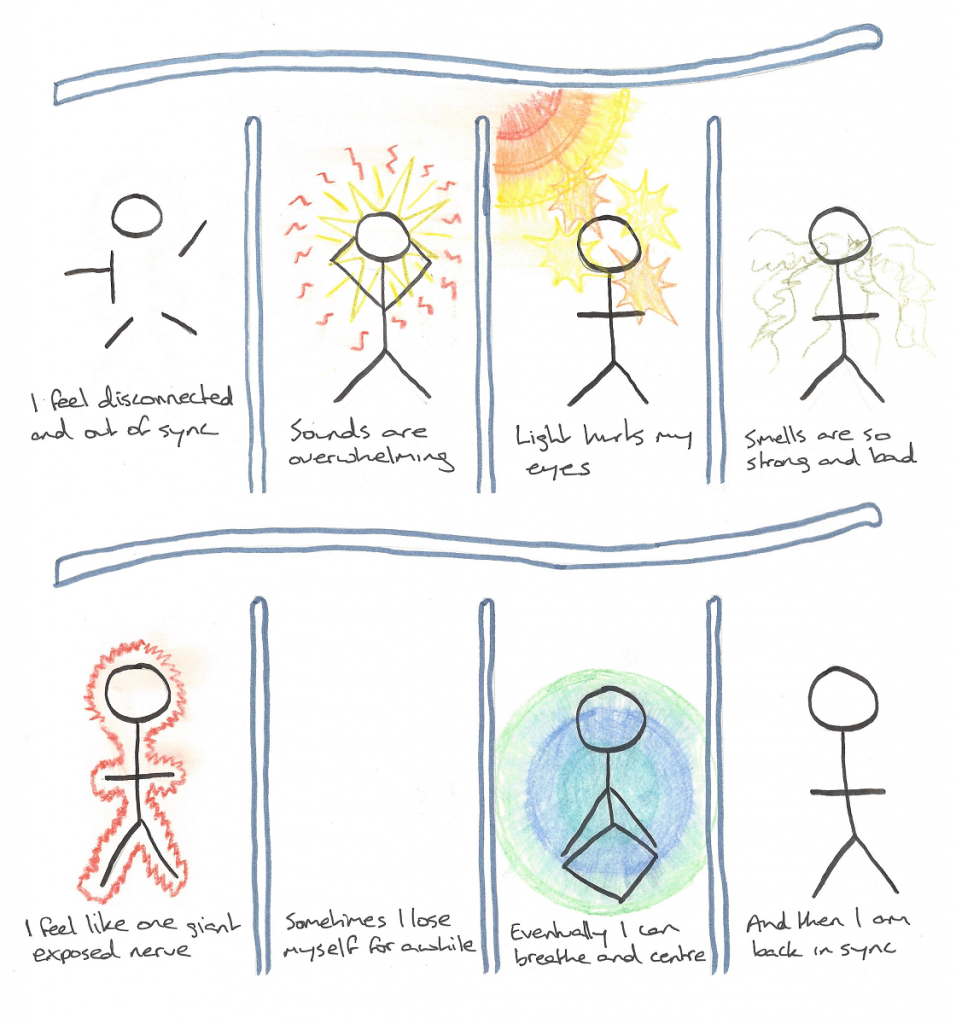
Image description:
Panel One: A disjointed stick figure, with none of the limbs connected. “I feel disconnected and out of sync.”
Panel Two: A stick figure stands and covers their ears. Yellow and red lines and wiggles surround their head. “Sound are overwhelming.”
Panel Three: A stick figure stands. The sun is in the top left corner of the panel. Red and yellow starbursts cover the stick figure’s head. “Light hurts my eyes.”
Panel Four: A stick figure stands. Green wiggly lines surround them. “Smells are so strong and bad.”
Panel Five: A stick figure stands, surrounded by a spiky red field. “I feel like one giant exposed nerve.”
Panel Six: No image. “Sometimes I lose myself for a while.”
Panel Seven: A stick figure sits cross-legged. Blue and green concentric circles radiate out from their torso. “Eventually I can breathe and centre.”
Panel Eight: A stick figure stands. “And then I am back in sync.”
