
by Tiffany | Oct 7, 2017 | Coaching, Patreon rewards
(Image description: In the lower left the cover of Avery Alder’s brilliant RPG Monsterhearts 2 is visible. In the upper right another RPG book is partially visible. There is a character creation sheet between the two books, and a pile of various sizes, shapes, colours, and types of dice. Photo credit to Scott Foster, who inspired this post.)
This is a Patreon reward post for Scott. At the $10/month support level, I’ll write a post on the topic of your choice for your birthday, too. My Patreon supporters allow me to continue this work, and I appreciate them so much. You can join that small (but growing!) community, if you want!
Scott requested a post on self-care and new projects. They asked me to focus on projects that you’re not excited about, or that you’re afraid of.
Scott is a consummate gamer – when we started dating, they told me that they needed to have one whole evening to do nothing other than gaming at least once every few days, because that’s how they recharge and decompress. I have learned a lot about the value of gaming from Scott! They have also DM’d multiple tabletop roleplaying games, including D&D, Apocalypse World, Monsterhearts, Mouse Guard, Goblin Quest, and more. When they game, they’re in their element. And they do a great job of making gaming spaces safe and accessible for the people they game with. (Someday I’ll interview them about that process for this blog.)
So, this post focuses on approaching new projects gamefully – not only because that’s a good idea in general, but also because of who I’m writing this post for.
For this post, I really appreciated Jane McGonigal’s work on gameful living, which I’ve been deep-diving into for the upcoming Gaming and Self-Care series that I’ll be launching on the Facebook page next month.
In the introduction to her book SuperBetter, Jane McGonigal writes:
You are stronger than you know.
You are surrounded by potential allies.
You are the hero of your own story.
She says, “This book is…about learning how to be gameful in the face of extreme stress and personal challenge. Being gameful means bringing the psychological strengths you naturally display when you play games – such as optimism, creativity, courage, and determination – to your real life. It means having curiosity and openness to play with different strategies to discover what works best. It means building up the resilience to tackle tougher and tougher challenges with greater and greater success.”
New projects are all about challenge. Whether it’s an exciting project, a terrifying project, a project you chose or a project you’ve been dropped into, it’s almost guaranteed to be a challenge of some sort. And gamefulness is all about stepping up to challenges.
So You’re Starting A New Project: A Brief Guide to Being The Boss of Your Project (and Practicing Sustainable and Gameful Self-Care While You’re At It)
Okay, so you have a new project about to launch. You want to make sure you get through the planning, launching, and in-process phases of the project without burning out, crashing into a wall of self-doubt, or losing track of your own needs in the process.
Start with some assessment
Take a minute, take a breath.
Close your eyes and picture that project on your inner horizon. Think about what the project will look like, feel like, and how much of your life will be wrapped up in the project. Imagine yourself beginning the project, working through the project, and completing the project. Picture yourself right in the thick of it, and picture yourself surveying the final result.
How do you feel? (You can check multiple.)
a) I feel amazing! This project is gonna be so good!
b) I feel hopeful. This project has a lot of potential!
c) I feel anxious. This project is gonna be a lot of work.
d) I feel terrified. This project is gonna be a disaster.
e) I feel something else.
Whatever you feel is okay.
Projects that make you catch your breath in excitement and anticipation are awesome. But not every project is one that we want, or that we would have chosen. Projects that you find yourself thrown into unexpectedly, projects you would never have chosen for yourself, and projects that terrify you can also be approached with self-awareness, compassion, and intentional self-care and you can get through them.
You might even end up gaining valuable skills, insight, and experience in the process.
Knowing how you feel about a project, and being honest with yourself about that, can help you plan for the project and for the self-care you’ll need to focus on in order to get through it. In this moment of assessment, try to let go of your expectations for yourself, and other people’s expectations for you. You may be embarking on a project that you ‘should’ be really excited about, and you might actually be terrified. You might be starting a project that you ‘should’ be terrified about, but you know you’re going to rock it. You know yourself better than anyone else, and you know how you feel. Trust that knowledge. You are the protagonist of this story. You are the narrator. This is your story to tell.
And it’s also okay if you don’t really know how you feel, or if your feelings change over the course of the project!
Once you’ve given some thought to how you’re feeling about the project, it’s time to…
Identify your available resources
Think about resources in a broad and inclusive way.
This isn’t just the money, time, and space that you’ll need for the project. It’s also the social resources – that friend who is always available to tell you that you’ve got this who adds to your resource list, or the family member whose skepticism is always lurking at every family gathering who is a drain on your resources. It’s the internal resources – your sense of resilience, hopefulness, and self-efficacy (your belief in your ability to take action and to have your actions positively influence the outcome).
Sometimes it’s also domestic resources – help with laundry and the dishes, or the ability to order in when the project gets heavy, or the knowledge that you’re on your own to carry your own weight or the weight of the family, and needing to plan accordingly.
It can help to make a list of all the resources you have available, and to let that list be expansive and even silly.
Do you have an inner Elf Commander who can marshal your internal troops for a big productivity push? List that as a resource!
Do you have a family member or friend who will be your cheerleader? List that!
Are you creative, curious, compassionate, or committed? List them all!
Let yourself sit with this for a while, because often new resources will float up to the top of your mind the longer you let yourself look at yourself and your life through that lens. Keep the list open for at least a few days, and just keep adding to it as you think of things to add.
It can also help to make a list of the resources you might need. Are you going to need money, time, or energy that you don’t currently have? Be honest with yourself about that.
Finally, it can help to make a list of the things that will drain your available resources. This list is important because it can help you decide where to set boundaries and how to protect yourself as you move through the project.
If you end up adding a lot of the people in your life to that list of things that will drain your resources, chances are, you feel bad about it. Take a deep breath. It’s going to be okay. You are not a bad person for recognizing the way that some relationships and some social interactions drain you. And that drain does not mean that you’ll cut those people out of your life or stop being a support to them. It just means that you’re recognizing your own needs.
Assessing our resources, and being honest about what we have, what we need, and what drains us is always an exercise in vulnerability. It’s tough! And it’s also really valuable.
Once you’ve assessed your feelings and your resources, it’s time to get your hands onto that project!
Find The Challenge
Jane McGonigal writes, “A challenge is anything that provokes our desire to test our strengths and abilities and that gives us the opportunity to improve them. Crucially, a challenge must be accepted. No one can force you to tackle it. You have to choose to rise to the occasion.”
Regardless of how you feel about your project, you can choose to accept the challenge and to meet the project on your own terms. That’s the first step in turning the project from a threat into a challenge. Any project can be a challenge that you choose to tackle, even if (especially if) it’s a project that you don’t want to start, are afraid of, or don’t have a choice about. Gamefulness will help you avoid the hopelessness and the feeling of powerlessness that can accompany a project that we don’t want and don’t have a choice about.
What you’re doing when you find the challenge is switching from a threat mindset to a challenge mindset, and the reason that’s valuable is because it shifts the narrative and opens up new ways of engaging with the project. Threat mindsets focus on the risks, the potential losses, and the potential harms. It’s important to recognize those things, but when you’re about to tackle a project (or you’ve been dropped headfirst into a project), a threat mindset can get in your way.
(And, at this point, I want to make a super important point. Many of us are habitually in a threat mindset because we have consistently faced loss, risk, and danger. It makes sense to view everything as a threat when everything is scary! Shifting your mindset is not about blaming yourself for seeing everything as a threat, and it also isn’t about gaslighting or victim-blaming yourself. If you struggle with this, that is okay. It takes practice! And it works best when we start with shifting our mindset in areas that are low-threat, rather than trying to shift something that feels like it’s life-or-death.)
In contrast to a threat mindset, a challenge mindset focuses on the opportunity for growth, and brings realistic optimism to the table.
From SuperBetter, “In a threat mindset, your fight-or-flight instinct kicks in, which activates your sympathetic nervous system. If your sympathetic nervous system is engaged continuously for hours, days, weeks, or longer, your immune system can become compromised, and you may experience more illness. With a challenge mindset, however, your nervous system finds a better balance between the sympathetic (fight-or-flight) and the parasympathetic (calm-and-connect) responses. This balance helps you avoid nervous exhaustion and burnout.”
McGonigal also says, and this is really critical, “a challenge mindset does not mean living in denial of potential negative outcomes. It simply means paying more attention, and devoting more effort, to the possibility of positive outcomes or personal growth.”
So, how do you do it?
One way is to frame your project as something you’re moving towards, rather than away from. Find a potential positive outcome, and use this project as a way to get to it.
These potential positive outcomes might be increased resilience, increased independence, increased creativity, increased health. However, these potential positive outcomes are not always apparent or available. When that’s the case, another way to find the challenge is to identify (or create) “the unnecessary obstacle.”
From SuperBetter, “The key is to identify an obstacle that you feel capable of tackling within the larger obstacle, an obstacle that other people might not choose to tackle.
Use your imagination to answer this question: What would be the worst possible, least helpful reaction that you – or anyone else in your shoes – could have to [this project]? You don’t have to be completely realistic here. Let your mind go to extremes for a moment.
Now: What is the opposite of that worst reaction?
Whatever the opposite of your “worst possible, least helpful reaction” is, consider adopting that as your unnecessary obstacle. Challenge yourself to do something that requires more strength and determination than what someone else might do in your shoes.
Why it works: When you imagine the worst possible reaction you could have to the adversity, you highlight your agency in the situation. You do have options. And as long as you’re not doing that worst possible, least helpful thing, you can challenge yourself to do something better. It may not feel like total agency and choice, but it involves some agency and choice – and that’s enough to activate a challenge mindset.”
Once you’ve found the challenge and decided to tackle it, it’s time to…
Break Your Project Down Into Steps
Set yourself small, achievable goals along the way to your big end goal. Think of ways to reward yourself along the way, and consider how you can find the challenge in each of the smaller steps of the project.
When you feel overwhelmed by the enormity of your project, take a breath (again! Gosh, so much breathing in this process!) and find a smaller goal to accomplish within the larger goal. You have choices about how this project gets done!
And finally…
Design Your Self-Care Plan
Lean on all of the work you’ve done leading up to this.
Take a look at your resource list, especially the parts of it that are vulnerable – the places where there’s lack, or where there are significant drains on your resources. Think of self-care tools or activities that can help recharge you in those areas.
Remember that community care is a big part of self-care. Build social self-care into your plan! Ask a friend to be your cheerleader, or find a professional cheerleader in the form of a coach or counsellor.
Write a list of self-care tools that you know work for you most of the time. Put the list somewhere accessible, so that when you get tired or discouraged, you don’t have to think too hard before you can implement some self-care.
Turn self-care into a game, by setting yourself self-care goals and giving yourself points or rewards along the way.
Make a list of “power ups” – drinking a glass of water, texting a friend, walking around the block, whatever works for you! – and try to power up at least once a day.
And now…
Fill in the blanks!
What’s missing from this post?
What kind of self-care do you find helpful when you’re starting a new project?
What other advice would be helpful here?
by Tiffany | Oct 3, 2017 | Health, Interviews, Neurodivergence
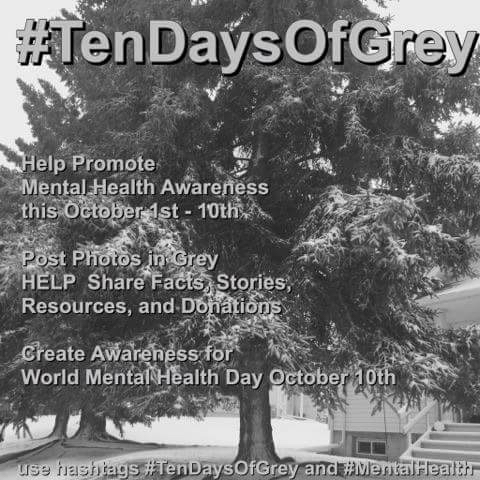
(Image description: A large tree in front of a house, the image is in black and white. Text reads: #TenDaysOfGrey Help promote Mental Health Awareness this October 1st-0th. Post Photos in Grey HELP Share Facts, Stories, Resources, and Donations. Create Awareness for World Mental Health Day October 10th. Use hashtags #TenDaysOfGrey and #MentalHealth)
This October, I’m participating in a new project to increase mental health awareness. The project was launched on Instagram this year by Bryan J. McLean, a Canadian multimedia artist. His music, poetry, fiction, paintings, and web published works include writing such as poetry from The Syndrome Papers, and (1)ne Night Stand, and more recently a Tumblr scifi-poetry project titled, #100days The Open Air : a dark urban fantasy about the light.
His newest project is Ten Days of Grey, which starts on October 1st and runs until World Mental Health Day on October 10th. You can find posts for the project under #TenDaysOfGrey, and you can participate by posting a black and white picture with the hashtags #TenDaysOfGrey and #MentalHealth. If you use these posts to share stories, resources, or support about mental health, you’ll make Bryan’s day.
I saw Bryan’s posts about the project in the days before October 1, and decided to participate. Mental health is such a complex and stigmatized subject, and there is a huge amount of victim-blaming and differential access to resources that complicated how and whether people can access supports.
Bryan generously agreed to an interview about the project.
Tiffany – What inspired the project?
Bryan – You know, I never thought that hard about it. I was upset with some recent career failures and was struggling with health and depression (yet again) this past summer, and then I saw World Mental Health Day was coming up. I started thinking “what can I do to bring awareness with the least amount of effort.” It’s funny to say that, I know, but I had a break down and it takes too much energy right now to pump out creative-anything.
Tiffany – Ableism in activism is so real, and so prevalent. I’m glad you gave yourself permission to do what you could with the resources you have available. I think that self-awareness about limited energy is such a critical part of self-care.
Bryan – I wanted to find something people do every day to share stories and facts. Clearly, the easiest answer was social media, memes, and picture-filters on phone apps. Selfies, food, cat or dog photos, whatever, wherever we are. We’re all addicted, but it’s such a beautiful way sometimes to share how you see the world. And then I considered how much of how I feel just turns to grey when I’m going through a depressive episode. It becomes the lens I see through. I ‘know’ all the good things are over there in the colour, but I’m cold and wet, trapped here in the grey. It’s all you see sometimes, it’s out of your control. (If you’ve ever seen the movie Pleasantville, it feels a lot like being trapped in the ignorant b&w.)
To explain how I got to this point – I’ve been trying to gain a specific full-time professional role for five years, and I’ve been maintaining two skillsets at my job and I’ve essentially been two people at work for five years. It finally caught up with me as I had pushed too long, and ended up essentially in adrenal fatigue. This exacerbated the depression & anxiety that I’ve been managing my whole adult life. I found that the self-care tools I’d developed were no longer working for me.
I collapsed emotionally. It’s embarrassing to say it out loud. It’s embarrassing to say that I was trying so hard & so long that I was exhausted, slept on breaks & at lunchtime, literally crying from exhaustion at work some days, overwhelmed after several months of living like this daily, I finally broke. I mean my brain did. I couldn’t multitask. I couldn’t wash dishes and have a conversation at the same time for months, the focus I required would just break. I couldn’t do complex math / excel formulas in my head any more, which used to be like making a sandwich for me. I couldn’t remember a conversation that just happened… or even what groceries I was supposed to pick up. Things you take for granted just remembering them. And it was very much like I was locked in a room full of doors and I knew the information I needed was just on the other side and I couldn’t get there. It was out of reach.
I’m slowly leaving my current career to restart my undergraduate & Masters work in fine arts (painting) with a minor in psychology, so I can move to work in art therapy. It’s hard, but not as much as the pain I realized I would feel spending another twenty-five something years doing something that isn’t going to help people the way I need to help them. I have the gifts (creativity & compassion) and I should use them to help adult learners.
Tiffany – Congratulations on making the choice to change your career. That’s hard (speaking from personal experience!) The experience of your burnout sounds so difficult. I know that losing executive function was one of the most challenging things about my early fibromyalgia journey – it felt like such a personal failing. And it definitely pushed me into a depressive episode that was resistant to all of my previously-effective tools. Since then, or even before then, what has your mental health journey looked like?
Bryan – I’ll try to sum that up. It’s difficult to condense the ups and downs. Since I was a teenager, I was melancholy. Just sad, not suicidal. I didn’t know it was depression. People get sad, they have regrets, lament over things, feel lonely. It didn’t feel special. I moved away for college so I spent a lot of time just alone in a new city where I knew very few people. You get lonely, but I’ve always been introverted, I like my own company. But, I’d be irrationality sad for days… a down feeling that wouldn’t leave.
Over time, I moved cities & provinces, had relationships & friendships, breakups, makeups. All the while, I just had dark days. It wasn’t like the world was ending, but I’d feel heavy or in pain. I’d keep going though, it’s what you do. Everyone feels like this, right? Also, I used to think I had insomnia but it’s actually something called bi-modal (sleep a few hours, wake up for 2-4 hours, and go back to sleep). So, I’d struggle with sleeping, overthinking, but usually I’d feel rested. I’d say my depression grew overtime though. I got more tired.
One time I set my kitchen on fire, overthinking & distracted, I’d left the plastic kettle on the stove burner. It wasn’t all that dramatic but prompted me to see my physician and I went on meds for a year, because of anxiety, depression and cognitive issues. Side effects were the worst sometimes, but it helped me get focused and back on track.
I spent a lot of time trying to avoid having to return to medications though; it’s the right thing for some people, but I wanted to do all the right things, if at all possible, to never need them again. I took up mild running, tried yoga, stopped eating a lot of take out and just cooked at home. I studied meditation and things on psychology. I’ve seen several naturopathic doctors and psychologists over the years when I needed direction and a neutral person to talk to. I wanted to stay grounded. It took a lot of work, but it’s help me be balanced. It’s a struggle to act or feel normal sometimes.
I don’t know if all of that really helped the way I thought it would, but I put in the effort of doing the self-care I needed for pretty much my adult life. I’ve been on meds again. Had another rough year. Saw my doctor, my psychologist. Was again diagnosed with anxiety & depression. I’m usually a funny, intelligent, thoughtful, and friendly person. I’m not faking that part of me, however some days it takes a lot out of me to just ‘be myself.’
Tiffany – You’ve taken that struggle and used it as motivation to start this project, which I think has the potential to reach a lot of people. What do you hope the project will inspire or accomplish?
Bryan – The worst thing someone recently said to me was, ‘everyone has anxiety, everyone gets depressed.’
It was the most unkind thing you can possibly say to someone in crisis. It makes me sick to think that is the message being shared by the public. These types of words end lives. We are all people and we all deserve kindness.
Yes, people get sad, people get worried. Yet they don’t get diagnosed with an illness by a physician and feel irrationally worried and suffer prolonged sadness for days on end.
Not everyone has high functioning depression like I have managed; I can mask my symptoms and just ‘deal with it’ but sucking it up for years, is like watching a plane that you’re flying slowly head into a mountain. You will crash, it’s just a question how badly.
So, I guess I am hoping this project will inspire awareness. Most people are lucky and don’t have to live with being sad or worried too often, or deal with the mania that bipolar people experience, or deal with schizophrenia, Alzheimer’s, dementia, or other cognitive issues that plague their quality of life. Yet these issues happen. Almost no one is trained to deal with the situation when mental health issues arise, especially when they happen to us personally, or in our close relationships.
No one really wants to talk about it, because what is there to say? Often mental health is a silent kind of disease, the myth is that it is ‘best ignored and left for doctors to decide how to deal with it.’ Issues like this though, they fester when ignored. Patience, kindness, compassion, are skills that many people don’t have, and no one really knows what to say. They don’t see it is a part of your health, they don’t see it like a broken arm – they act like you are weak or lazy, they don’t believe you… Yet those are the moments we need to be listening to each other more compassionately, not less. We need to be open to solutions. Sometimes it’s a matter of talking to the right counsellor or health professional.
Not everyone needs help, but no one should go through these things alone, and there are so many local resources & people out there that can help and are properly trained to help.
If you don’t know what to say,
be kind.
If you don’t know what to do,
find a professional.
Hopefully sharing facts and sharing stories will keep giving some exposure to mental health. Even just knowing that one in three Canadians will be diagnosed with mental health problems in their lifetime, will maybe ease the pressures of doing things all alone, and seeking help.
Tiffany – That’s great. You’ve talked about different groups of people – the people who experience mental health issues, the people who don’t (and often don’t know what to say), and the professionals who might be able to help. Who do you hope will get involved in the project?
Bryan – I don’t really want to ‘own’ this idea, it’s meant for others to pick it up, so even if it’s small, I’m hoping it speaks to people to slow down and know it’s okay to seek help. Dealing with mental health is not something you have to do alone.
I was really just doing this thing for myself, it’s something I needed to hear so many times in my life, I forget sometimes that even if a small voice speaks out, maybe that idea can help others understand or seek help.
You don’t have to be in a massive crisis to talk something out. We get to being in a crisis by not talking about and not listening/believing, not finding the right professional to connect with, not having that one person say, ‘hey why don’t we talk this through.’ No one wants to be a burden, but problems like these don’t go away. They almost get stronger if you set out to ignore them.
Tiffany – What else feels important about the project?
Bryan – The simplicity. Just imagining the world in Grey for a few days might help people find a way back to the colour.
Tiffany – You talked about the tools that you used to use suddenly not working when you experienced burn out and depression. Have you found new tools that work?
Bryan – It’s been a long journey, so I want people to know, I didn’t wake up one day and have it all figured out. I’m saying that because I think it’s important to know that you will struggle trying to find out what works best for you and what fits your lifestyle; you will grow and change, and growth always hurts in some way.
I studied a lot of things, experimented a lot, talked to a lot of people & professionals. I sought help and I didn’t expect someone to magically ‘fix me.’ Sometimes I felt I was doing this workout / yoga wrong… eating the wrong vegan things… or doing that spiritual technique badly… felt confused about certain concepts… but the truth of the matter is that it was (and continues to be) a journey of the internal self.
What helps me:
- Ask for help. Ask anyone. It’s so hard when you don’t know what you need. But talk about it with a trusted advisor/friend and then a professional.
- Learn to sit quietly, to sit with yourself, and to quiet the noisy mind. Don’t worry. This takes practice, but every bit helps. So, doing Zazen (seated meditation) at minimum five minutes a day, but best 20mins when you wake up & 20mins before bed. Rhythmic breathing.
- Studying Shamanic meditation helped me. Learning to see different perspectives and ‘journey’ to discover goals, problem solving, and energetic healing.
- Studying Buddhism & Quantum Physics. I love complex patterns and how things connect, quantum mechanics tells that story. I wanted to study the nature of things, understand myself or my place in the universe or something like that, so I was looking at ethics & science. I guess I was trying to stay grounded, because spiritually is the inner path, the self… It seemed very selfish to only look inside knowing there is an outside world to experience. You can get a big head full of delusions when looking at the true nature of what being a person means, thinking you know all the answers, how everything is connected… so, I guess I wanted follow a good base set of rules of investigation. Science is a quest for truth and testing those facts. And then I read this book, The Quantum & the Lotus. It’s a conversation worth having and it took a good look at where Buddhism & Science meet. They are both the quest for truth and testing that truth, incorporating new findings and accepting that maybe what we think is true can change. It’s important to be open when you’re on any kind of journey, so these were good lessons to learn.
- Free Weights. Yoga. Spin. Dance. Being active with intent is meditative – it distracts the mind. It’s ironic when depression hits, it becomes this huge wet blanket in your life, stopping the desire to be active. Literally everything is harder & heavier. You shouldn’t force it if you need a rest day, but I try really hard to be active at least once a week, preferably five times a week. (Recent research supports this.) But even 15 mins of workout is literally better than nothing. I am an introverted person, I don’t like exercising in public or classes, but finding that sport or workout thing that makes you motivated can help a lot.
- If I can’t sleep, I do pushups or planks, downward facing dog, until I am tired, which frankly won’t take long. You can also look up breathing techniques for helping sleep, like the 7 second method.
- If something is stopping my brain from getting sleep, I get up and deal with it. I try not to lay there grinding my brain. Get up, clean the house, write down the issue, and try to come up solutions. You’ll never get to sleep just lying awake. It only gets worse. You might not solve a problem but it’s better than lying in the dark hating yourself or others. I try to take action the next day on those problems to solve by making a list and making deadlines to fix what is bothering me.
- I cook for myself. I reduced / stopped eating take out, and reduced my salt & sugar intake, and my alcohol intake (it’s also sugar). Learning nutrition from a Naturopathic Doctor, Nutritionist, or your personal doctor can also help – getting help to make a plan for your physiological needs. Single. Person. Is. Different.We all have different needs. For me, it was important to move towards being vegan/vegetarian. Requiring animal protein is a myth, it’s not the only way to get protein, not the only thing a body needs, and there are healthy ways to incorporate both your current lifestyle and what your body needs together. Listen to your body. Listen to a real doctor, not what the internet thinks you should do. Drink water, your body needs it.
- Camping, Hiking, Canoe/Kayak, & Sit with Nature. Turn off the noise. Sit at a river. Stare at some trees. Walk your dog or someone else’s dog, but be outside without your headphones in. Listen to the tress talking. Mindfully acknowledge the Now that is all around you. This helps me a lot.
- Write poetry or short stories. Paint. Draw. Craft. Bake. Sing. Make music, make things, and share them. It doesn’t matter if it’s bad, it doesn’t matter if no one ever sees it. The act of expression is the most important exercise, because there are things that words cannot express and stories that need telling.
- I also use a sleeping mask all the time, and a full-spectrum light panel in the winter.
Bryan’s Recommended Resources:
- Zazen (Seated meditation) I have studied soto zen Buddhism for a long time, the best resource you can find is a very very short book called Buddha in Blue Jeans by Tai Sheridan
- My top two fave books on Buddhism are
- Sit Down and Shut Up by punkrock buddhist Brad Warner
- Peace is Every Breath by Thich Nhat Hahn, an activist and Vietnamese Buddhist Master
- Shamanic Studies: Secrets of Shamanism by Jose Stevens, a practical guide to journeying & goal setting
- Finding Ultra & Plant Powered Way by Rich Roll, on athleticism & become vegan with his researched cookbook
- Wil Wheaton’s video about his mental health
- This video is really helpful – I had a Black Dog, his name was Depression
Tiffany’s Further Reading List:
- For folks who want to explore shamanism but are concerned about cultural appropriation, this article goes into quite a bit of depth.
- Accessing professional care can be difficult for people of colour, but this list of podcasts by therapists of colour is a small step towards meeting that need.
- Rest for Resistance is another great resource written by QTPOC.
- 7 Cups is a free therapy resource for folks who can’t afford professional help.
- Exercise and physical activity can be challenging if you’re dealing with chronic pain, and chronic pain can exacerbate mental health issues. This post includes some tips (and also cute cat gifs).
by Tiffany | Oct 1, 2017 | Health, Identity, Neurodivergence, Patreon rewards
This is the second part of a Patreon reward post series for Dylan. At the $10/month support level, I’ll write you a post on the topic of your choice for your birthday, too! Consider heading over to my Patreon and signing up if you want to support this work!
You can also read Part One – Narratives of Quitting.
This series of posts attempts to address the topic Dylan posed. They said, “I’m so tired and stretched thin across multiple projects so I apologize if this is not helpful. It’s kind of hilarious that this is about self-care and I’m not really doing awesome on that front atm. I was thinking about self-care as it relates to quitting because I’ve made a number of difficult changes over the past couple of years that required working through these ideas. I gave up on many hobbies as a kid because I didn’t want to face the horrible anxiety that came with pursuing hobbies: fear of public failure or embarrassment, fear and awkwardness of interacting with new people… I started to think of myself negatively as a quitter and that has nagged at me as an adult such that I have a difficult time quitting or changing directions once I set myself onto a path. But quitting can be such a vital part of self-care because sometimes we do need to change directions or leave to protect ourselves.”
This second part of the series looks at the factors that influence when/whether/how/what we might quit (or not quit).
Factors That Influence Quitting
There are so many factors that can influence whether or not someone decides to (or is forced to) quit something, or, equally complex and common, factors that influence whether someone decides not to (or is unable to) quit something. I narrowed these factors down to a core set, with the understanding that this list is incomplete and that these factors blend together into a nearly infinite range of potential influences.
Trauma Histories
I don’t think it’s possible to talk about the factors that influence quitting without addressing the way that trauma impacts, long-term, our response to threat situations (and to situations that look like they might be threatening, whether or not they actually are threatening). It’s too easy to approach the topic of quitting and self-care from a rationalist perspective, distanced from personal histories of trauma, and when we talk about quitting only in terms of the “rational” or “reasonable” response to influences or situations, we end up contributing to the stigma and shame that already weighs heavy on trauma survivors.
When we quit, how we quit, why we quit, whether we quit – our histories inform these actions in a major way. (And each of our histories influences this – family histories, success and failure histories, and trauma histories. But this section is about trauma histories.)
These trauma histories (which include any Adverse Childhood Experiences or ACEs, such as abandonment, abuse, childhood poverty, or watching a caretaker struggle with addiction, abuse, or financial/emotional/mental instability or illness) echo through the rest of our lives, and although I sincerely believe that we are both the protagonists and the narrators of our own stories, I also recognize that our stories happen in contexts that we do not, and cannot, control.
So, how do these histories inform how/when/why/whether we quit?
I mean… how do they not? But for the sake of this post, we’ll look at four common responses to threat, how they can be influenced by trauma histories, and how they can influence a decision to quit.
Fight, flight, freeze, or fawn are four common responses to threat.
When you’re making a decision about whether/when/how to quit, if you’re responding to a (real or perceived, internal or external) threat, and if you have a trauma history (as so many of us do), then your ability to access each of these responses will be impacted. In lots of ways.
Fight – When we feel threatened, one response is to fight.
Making decisions about quitting outside of a trauma history, the story of fighting might be one of the protagonist recognizing an injustice or other problem, assessing their available skills and resources or determining that the situation is untenable and has to be challenged, and fighting it. These stories are the stories of people who didn’t “just” quit, and they are often among the most highly praised stories.
However, the story of a trauma-infused fight response might look more like the protagonist “lashing out” and “making the situation worse” – these stories are often far less acceptable, and when the person fighting is marginalized – a woman, femme, disabled, fat, poor, neurodivergent, racialized, addicted, or otherwise marginalized person (whether they’re fighting from a place of trauma or not) – the fight response is often used to blame them for any harm that they experience.
Trauma-informed fight responses can also be hard to control, and the flood of adrenaline can make it difficult to explain why we’re doing what we’re doing. It is hard to fit trauma-informed quitting decisions into an acceptable Narrative of Quitting, and this is particularly true when the response is a fight.
Flight – Another response to threat is to run away.
Outside of a trauma response, flight stories are often easily understood and accepted, because flight is non-confrontational and clearly acts to end a threatening situation. These stories can even sometimes be retroactively rescued into a Triumphant Quitter narrative, especially if the protagonist is marginalized. (Marginalized folks are expected to flee and punished for fighting against a threat, and vice versa when the person is not marginalized. This means that someone with privilege – a white, male, abled, cisgender, straight, wealthy, educated, or otherwise privileged person – will often feel a significant amount of shame for fleeing rather than fighting. Fleeing is often perceived as a sign of weakness, and groups that are already considered weak can flee without challenging the dominant narrative of who they are, but they can’t fight. And people who are perceived as strong can fight, but they can’t flee without challenging that dominant narrative of strength.)
When flight is a trauma-informed response, and is a panicked cut-and-run that seems, to an outside eye, disproportionate to the situation, there is a lot of shame attached to the flight response (even though it is often a very reasonable response to threat!).
Trauma histories that push us towards flight can make it difficult to stay in situations even when staying might be a better choice.
Freeze – Another response to threat is to freeze. For trauma survivors, this might look like dissociating, disconnecting, or mentally checking out. In a moment of freezing, we are unable to quit and unable to move forward. Being stuck in a freeze response can end up making the choice for us by default, either because we keep moving forward on the energy of our inertia, or because we’re forced to quit when we’ve stopped taking productive actions.
Freezing fits tidily into the Weak-Willed Quitter narrative, and into cultural narratives that lean hard on victim-blaming to explain away the long-term and pervasive impacts of our violently racist, sexist, classist, ableist and otherwise oppressive culture. According to bootstrapping ideology, doing something is always preferable to doing nothing, and freezing is, in many ways, the least validated response and the hardest to rescue into an acceptable narrative.
Fawn – A final possible response to the threat is to fawn, or try to appease the threatening person. This is often the safest space for someone who is under threat to stay, but it can feel corrosive to be submitting to a threat and appeasing rather than escaping harm. When we have used this coping strategy to keep ourselves safe, it can be challenging to change the pattern and we can feel a huge amount of shame whenever we slip back into submission-for-survival. This coping strategy also gets slammed in self-care and psychology settings, framed as codependence, anxious attachment, and other problems that frame this as an unreasonable and dysfunctional strategy. Although it’s true that this can become a maladaptive strategy, especially once we’re in safe relationships, the blaming doesn’t help. If this is how you cope – if you submit to other people’s needs, act as a “people pleaser” and make your choices about whether or not to quit based on what other people with power want, it’s okay. Like every trauma-informed decision, it can be hard to explain and hard to understand, but it is also a valid survival strategy. And if you want to learn how to relate in other ways, that can happen without blaming and shaming yourself for what you needed when you needed it.
Fear
We have a lot of cultural narratives around fear, and they’re everything from Frank Herbert’s famous “fear is the mindkiller” to Gavin de Becker’s “the gift of fear.” Everything we want, according to the platitude, “is on the other side of fear” and we are admonished to “choose love, not fear.”
And fear is a huge influence when it comes to our decisions about when/why/whether to quit.
We might be afraid of success (or failure), and quit to avoid getting the dreaded answer to the question “do I have what it takes?”
We might be afraid of what it will take to keep going, and quit.
We might be afraid of being seen as a quitter, and not quit.
We might be afraid of disappointing ourselves, our partners, our friends, our professors, our communities, our parents, and not allow ourselves to quit.
We might be afraid of burning out, and quit.
Some fears tell us we’re in danger, and listening to those fears, and quitting before we get hurt, is wise. Allowing ourselves to identify, understand, and act on those fears is an incredibly difficult and valuable self-preservation skill.
Some fears tell us that we’re running low on resources and we need to quit before we run out entirely – the fear of failure, for example, can seem like a fear that should always be “overcome” or pushed through, but there are times when the cost of failure is too high, and listening to the fear is the wisest choice we can make.
Fear can also be an indicator that it’s time to keep pushing – there are times when we feel fear and it’s the fear that accompanies a challenge, rather than a threat. This fear says “this is scary but keep going! We’re on the right path!”
How do you tell the difference?
How do you tell the difference if you deal with anxiety?! (One definition of the difference between fear and anxiety is that fear is a response to a situation you are currently experiencing, and anxiety is a response to a situation you are anticipating. Anxiety is about the possible-but-theoretical future, and fear is about the present and immediate future. This is obviously not a perfect definition, because wouldn’t that mean we feel anxiety, rather than fear, about failure or success? I would say that if the feeling is stopping you from starting a project, it’s anxiety – reacting to a theoretical. If it’s impacting whether you continue or quit a project, it’s fear – reacting to an ongoing situation. I also think that it doesn’t really matter what words we use, as long as we know what we mean, and these hairs might not always need to be split. Another definition, which I personally find very helpful, is that fear is situational and passes when the situation changes, and anxiety is pervasive and lingers even after the situation changes.)
Y’all… I do not have any easy answers for this one.
I know that I feel fear and anxiety on a nearly daily basis, and panic less often but still regularly, and that my fear has become an excellent and reliable (if irritating and painful) guide. The fear that tells me to keep going feels different in my body – it’s not the hollowed out fear related to threat that tells me to stop, go home, turn back. It’s a crackling electric fear related to challenge, and it has the power to generate change and growth.
I only know the difference sometimes, and often only retrospectively, and I only know it after years of practice (and years of failure – pushing into the wrong fear and staying in damaging relationships, for example, because I thought the fear was wrong, or giving up at the first flutter of fear without giving myself time to learn which flavor it was).
Fear of failure, and the equally stifling fear of success, are two that dog me constantly. These are the fears that influence my decision to quit working on a writing project before I submit it, or to create marketing plans and not act on them, or to look into Masters programs and not apply. These fears are so real.
Dylan’s original question included references to “fear of public failure or embarrassment, fear and awkwardness of interacting with new people” and those fears are also so real, and can push so many of us out of hobbies, jobs, communities, and even relationships that we might sincerely enjoy and want to engage with. Sometimes it is true that what we want is on the other side of fear, but when we’re looking at fear as an influence in our decisions to quit, we need to be compassionate with ourselves. We are not fearful for no reason, and we are not fearful because we’re broken, weak, or foolish. Our fears come from somewhere, and we can’t just set them up as enemies to be overcome – often we need to sit down with that voice of fear, pour a cup of tea, and really listen.
What are we afraid of?
Can we address that fear compassionately and intentionally?
Once we’ve listened and understood our fears, we can make better decisions about whether to quit.
Shame
Oh, shame.
There is so much shame associated with being a quitter. You didn’t have enough guts. You weren’t smart enough. You weren’t strong enough. You weren’t tough enough. You just weren’t enough. If you had been, you could have stuck it out.
Even when we quit for the best reasons, and even when quitting is the right choice for us (as it often is – none of us can continue in every venture we begin indefinitely, there isn’t enough time and energy for that! And we grow, we change, we quit so that we can start something new) still, shame is always waiting to pounce.
And fear of that shame often stops us from quitting when we need to quit.
Shame is a silencer, distancer, suppressor – not only does it keep us tied to things we want to quit, and distant from things we want to embrace, but it also keeps us quiet about the experience.
Access to Resources
Access to resources is, in some ways, the most challenging and frustrating influence over decisions to quit. When we have to quit because we don’t have enough money to continue, or we don’t have enough energy to continue, or we don’t have enough support to continue – it sucks.
It sucks a lot. And it happens a lot. It happens to a lot of people for a lot of different reasons.
For folks who are disabled or chronically ill, sometimes we lack energy and that can fuel a lot of shame, but often we also lack finances because of un- or under-employment, and we lack support because of pervasive ableism.
For poor folks, particularly people who are dealing with generational poverty (which disproportionately impacts Black and Indigenous communities), there is often not only a lack of money, but also a lack of time and energy because poverty often means working multiple jobs, or working long hours for low pay. Poverty is also a significant social determinant of health, which means that folks living in poverty are also often dealing with health issues that sap time and energy and money. And poverty, particularly childhood poverty, can result in long-term trauma. Despite all the bootstrapping mythology in our cultural narratives, poverty forces so many people to quit so many things that they love and excel at, and it’s not because they are weak-willed or lack determination and stick-to-itiveness.
For trans, queer, racialized, or otherwise marginalized folks, that same intersection of frequent un- or under-employment, plus lack of social supports and a lot of stigma and pervasive oppression (especially in the form of microaggressions in work and play spaces) results in quitting things that they might otherwise enjoy and excel at.
On the other hand, gaining access to resources – through scholarships, living wages, more equitable distribution of domestic and emotional labour, supportive social spaces, and thriving communities – can enable people to not quit, or to quit in ways that feel right for them.
Gaining access to social supports and employment opportunities might allow someone to quit a job that isn’t right for them but that they’re staying in for the financial security. Gaining access to scholarships, housing opportunities, or food security may allow people to continue in post-secondary educations that otherwise would be out of reach.
We can collectively make a difference when it comes to this – we can vote for politicians who support living wages, daycare programs, and other social supports. We can put our money directly into the hands of people who need it, through crowdfunding and platforms like Patreon. We can advocate for accessibility and inclusivity in our spaces – particularly if we have privilege and our voices are more easily heard by people in power.
Access to resources also intersects with harm reduction, since a lack of resources can make it nearly impossible for folks to quit habits, addictions, or subsistence work even if they want to, and even if they would be happier and more fulfilled if they were able to. But, again, our bootstrapping narratives conveniently ignore the way that lack of access to social and material resources places barriers in front of people.
It’s easy to feel hopeless when it comes to access to resources. And I fully reject an individualist narrative that says this issue can be solved at the level of the individual – in order to make a real difference when it comes to access to resources, we need to fundamentally alter the social structures that uphold inequality. But just because it will take policy changes, doesn’t mean we are powerless.
We can push on this one, so that more people can keep doing what they love, and more people can quit doing what hurts them.
Hope
We hope things will get better.
We hope that they’ll get better if we quit, and hope influences us to quit. To seek something new.
We hope that they’ll get better if we stay, and hope influences us to not quit. To try and improve the situation from within it.
When we quit from a place of hope, often it feels liberating. Doing anything from a place of hope feels better than doing the same thing from a place of hopelessness or fear. (Now, if only hope weren’t so intimately tied up with access to resources, trauma histories, and social inequality…)
Self-Efficacy
Self-efficacy is our belief in our own ability to successfully meet our goals or challenges and to generate a positive outcome as a result of our actions.
We can build self-efficacy through mastery experiences (having the personal experience of attempting something and succeeding at it), vicarious experiences (witnessing someone like us attempt something and succeed at it – this is why representation is so critical!), verbal persuasion (encouragement and support from influential people in our lives), and imaginal experiences (visualizing yourself attempting something and succeeding at it – there is interesting new research into increasing self-efficacy using VR and witnessing a personalized avatar succeed at a task).
Physical, emotional, and psychological states also impact self-efficacy.
If you’re interested in building your own self-efficacy, you might be interested in the gamification series of posts that I’ll be running weekly starting in October.
Self-efficacy impacts whether/when/how/why we quit because believing that our actions have the ability to result in a positive outcome is a huge factor in whether we feel empowered to keep going, or to quit when it’s right for us. Feeling helpless and ineffective often means we are more likely to quit out of despair and discouragement, and also more likely to not quit for the same reasons.
Social Pressure
Want to be a writer?
Artist?
Musician?
Other creative?
Want to start your own business?
Change the world?
First of all, good luck. I think you’re amazing, and I count myself as one of you. Idealism and stubborn hope and the desire to make positive change in the world is beautiful.
And also, how are you going to pay your rent?
When are you going to get a real job?
What qualifications do you have?
Who gave you permission?
Who gives you permission?
The social pressure to get a “real job” is huge, and it intersects with issues of fear, access to resources, shame, and trauma histories. But outside of those intersections, the social element, and the social narratives around what types of work are valid is so huge.
Social pressure can keep us stuck when we want to quit – can keep us in marriages, in jobs, in degrees, and in communities that no longer serve us. And social pressure can force us out when we want to stay, from all those same places.
We are not supposed to “waste” our talent, and so if we’ve ever done something well, we should keep doing it.
And we are supposed to grow up and get a real job, and so if we dream of alternative jobs we meet a significant amount of skepticism (internal and external).
“Don’t quit your day job” is excellent advice, and horrible advice.
“Chasing our dreams” is also idealized and vilified, and it can be great advice when someone tells you to keep going, and it can be terrible advice when they tell you to keep going.
Social pressure and social support are also often linked. When we’ve received social support, we often feel indebted to our communities and their desires or expectations or fears can put a lot of pressure on us.
And, while it is true that this is your story and you are both the protagonist and the narrator of your story, it is also true that we live within families (chosen and given), communities, and societies that influence and are influenced by our choices.
Part Three of this series – The Things We Quit and Self-Care for Quitters – will be going up on my Patreon later this week, and will be available publicly a week after that.

by Tiffany | Sep 29, 2017 | #100loveletters, #tenderyear, Identity, Intersectionality, Narrative shift, Woo, Writing
(Image description: A cloudy sky with reflecting sunrise light is seen through tall trees. Photo was taken by Stasha Huntingford.)
A Year of Sacred Attendance #tenderyear
Question.
We are nearing the end of #100loveletters.
Would you like to do another thing after that?
This was the question Nathan Fawaz posed to me, and the answer was an easy and enthusiastic “yes!”
The 100 Love Letters project has been transformative for me – it has been a thread of connection back to myself during a summer that included too much travel, too much stress, too much emotional upheaval, too much existential dread. The love letters were a daily reminder to sit down and breathe into a space of compassionate self-awareness. The letters were permission to take time, even five minutes at the end of the day, to love myself in the middle of the hard weeks and the bad weeks and the overwhelming weeks. They built space into my day, and gave me new tools for self-care and new methods for engaging my narrative. (You can find the posts related to this project here, and the PDF will be added to this section as well.)
The 100 Love Letters project was also an opportunity to build community, and I have appreciated the new friends I’ve made as a result of the project, the connections that have grown and strengthened as we witness and support and encourage each other through the process.
The 100 Love Letters project will continue on in various iterations – Nathan will be presenting their 101st letter at an event on October 14 (you can find out more about that event here), and I will be putting together a PDF that will be available for free download on my website, with prompts, encouragement, and a “how-to” section. (I’ll still be available to support anyone who started the project on a different day, too. You can always email me or find me on Facebook or Instagram!) I’m even working on a book proposal about the project!
But the 100 Love Letters project, in its original form, is coming to an end today, September 29. It’s 100 days since we launched at the beginning of the summer, and it has been a beautiful journey. It’s time for those of us who started our 100 days a season ago to shift into something else.
If you want to shift with me, consider this an invitation to a Year of Sacred Attendance.
This project, co-created by Nathan, Stasha, and myself, is that ‘other thing’ that was gestured into being with Nathan’s question. I think it will be amazing.
We started from another of Nathan’s ideas. They had said, “One thing that is coming up for me is the idea of attention, attendance.”
It resonated.
Being present with ourselves, attending, bringing attention, and tending to ourselves – that’s one of the most powerful elements of the love letter project. We each wanted to maintain that spacious, gracious sense of intentional, compassionate attendance. And we wanted to push gently against the edges of other aspects of our lives that could benefit from this kind of compassionate, intentional, regular tending.
Around Stasha’s kitchen table, the framework for a yearlong project coalesced. It was, and is, a collaborative project generated by the powerful narrative spellwork of the three of us, but we remain individuals within the project and we are so excited to share the project with as many of you as want to join.
The Year of Sacred Attendance will run from October 1, 2017 to September 30, 2018.
Each day of the week has a unique focus. You can participate in all of them, or pick and choose the ones that resonate for you. We will be using #tenderyear for every post related to the project, with daily tags as well (to make it easier for folks to find each other on Facebook, Instagram, and Twitter).
Sunday
Meditation to Challenge the Binaries. #challengethebinary
Meditation is a flexible form here – the goal of this day is to invite participants to think about binaries, opposites, exceptions, and subversions. Think of Venn Diagrams, exceptions that subvert the rule, grey areas that provide productive space for expanding and exploring our narratives. On Sundays, we look at The Normal and The Other, and we grapple with that. We look at The Thing and The Opposite of The Thing. You can engage with this focus through art, writing, or any other method that helps you dig into the topic.
Monday
Attending to the Questions. #questioneverything
A significant focus of this project is inviting and facilitating compassionate self-awareness. You can ask yourself whatever questions feel right for you – the focus of Monday is simply to take time to ask yourself how things are going. If you’re not sure what to ask, here are some sample questions, and you can answer whichever feel right for you. Not everyone participating in this project will be working on creative projects, and not everyone will feel comfortable with a goal of presence – trauma is a real factor in many of our lives, and can make presence a real challenge. These are just a place to start:
What are you creating?
What do you need?
Do you feel present?
Could you try something different?
What are you wondering about?
Tuesday
Love Letter #100loveletters
We wanted to keep the focus on self-compassion, self-acceptance, self-care, and self-love. The 100 Love Letters project continues on in the Tuesday focus.
Wednesday
Drop Into A Moment #wednesdaymoments
Find a moment to fully experience. This focus is about sensory awareness, mindfulness, presence, and about paying attention to our lives. You can participate in this through art, writing, photography, or simply pausing to observe yourself as a physical being within a physical world.
Thursday
As Above So Below #fiveelements
Thursday’s focus builds on the physical presence of Wednesday, and is about connecting to the world around you.
Friday
Reflection #fridayreflections
Friday’s focus can take so many forms. Reflect on your week, reflect on your relationships, post a selfie, take a picture of a reflective surface – the beautiful thing about reflection is the many ways it can be interpreted.
Saturday
Affirmation #saturdayaffirmations
Affirmations for yourself, for your communities, for the world. What do you need to hear? What do you need to affirm for yourself or for your people?
The #tenderyear project is open to anyone to participate, and participation can happen online or offline. Participating online can happen privately in messages or between friends, or publicly. We will be using the #dailypractices and #tenderyear hashtags throughout the posts.
There is an email list, similar to the one that was available for the #100loveletters project. You can sign up here. I’ll be sending out mostly-weekly emails with prompts, links to blog posts, interviews with participants, and encouragement and support. There will also probably be give-aways, like the handwritten letters that were sent out to Love Letters participants.
To give you a sense of the what and why and who behind this project, here is a mini roundtable with the co-creators.
How did this project start?
Stasha – For me the 100 love letters made sense as resistance to oppression, and as a lifesaving intervention. When Nathan and Tiffany also participated in the 100 love letters, it opened up a space in my heart. I was able to cheer on their resistance and to witness them both weaving powerful magic in inspiring their communities. I think after feeling that daily magic, all of us knew that sharing and sustaining this magic is vital. Loving ourselves is a revolutionary act, supporting each other with this even more so. I spent so much of my life stigmatizing parts of me that had been shamed by society, I didn’t survive 37 years to live in shame. I survived by transforming my pain into empathy and learning. This project assists me in that alchemy, a most sacred healing magic.
Nathan – Somewhere between letter sixty and letter seventy-five, I noticed this sensation within me… the sensation had been there since the very first letter, really, but it took me a while before I could identify it… anyway, I noticed this sense of space. That’s the best word I have to describe it. This sense of space. And, at the same time, I really began enjoying in the community that was emerging as part of #100loveletters. As I got closer and closer to letter 100, I found myself wondering what I could do to help support the spaciousness I was just starting to find for myself. And how can I help nourish this connectedness I was observing.
Tiffany – Just like the #100loveletters project started with a “Yes! Can I do that too?” in response to Stasha’s original post about her project, this new project starts, for me, with a “Yes! Can I do that too?” in response to Nathan’s “Would you like to do another thing?” In both cases, I felt like I was being gifted a new tool to expand my self-care practice, my community care practice, and to share with the individuals and groups that I work with.
Stasha said, “Loving ourselves is a revolutionary act, supporting each other even more so,” and Nathan said, “[What can I] do to help support the spaciousness I was just starting to find for myself, and how can I help nourish this connectedness I was observing.”
These two origin stories for the project echo and overlap with my own – this project, for me, starts with trying to open up space for self-love and self-compassion, for myself and for the people around me, and to support and foster connectedness and love within my communities. It fits so perfectly with the work I want to do as a self-care and narrative coach, it feels like a gift. Two gifts! (Which is totes a double entendre because I am referring both to the two projects AND the two people. Clever!)
What do you find exciting about this project?
Stasha – Everything. The sacred belonging and acceptance that I already feel is amazing. I love working with people who understand how tenderness can bring down oppressive systems. What could be more radical than tending love in this world? Already we have done so much by creating a public space where we celebrate insanity as necessary for problem solving and community building. We have made a place that includes our hearts, our fears, our bodies, our chronic illnesses, our genders, our minds, our ptsd, our communities, our joy, and our pain. One of the most painful things about participating in groups, is that often parts of me are not welcome. This project allows me to participate as a whole person, which helps me nurture love.
Nathan – Everything. I am excited by its potential for compassion, and self-compassion. I am excited about its accessibility. I am excited to make this commitment in community, both online and in person. I’m excited for the container of this project. And I am curious to see what it will hold.
Tiffany – I am excited by the idea of making space for ritual and for the sacred in my life. I think it’s possible to engage with this project without ever engaging with any kind of spirituality or sense of the sacred, and that would be totally valid, but for me… I have been writing about, talking about, thinking about, and longing for a sense of ritual and connection for a long time. But I haven’t done the work to create space for ritual in my life – I’m always too busy, I’m always too scared of doing it wrong. I love that this project is flexible, expansive, and that it offers opportunities for sacred ritual but also for goofiness and lightness. And, a year is a long time. I’m excited about the opportunity to go through the first exciting month or two, and then the drudgery when it gets old and weighs more, and then the renewal when I find the excitement again. A year is long enough to cycle through a few times, and I’m really looking forward to that. I’m looking forward to helping others through that cycling, too. That’s been one of the most rewarding things for me about the love letters project.
Who would you like to see participating in this project?
Stasha – Honestly, I think we all need this kind of love in our lives. I hope to model a year long spell of mindful intent, and learn from others as I go.
Nathan – I am interested in anyone participating in this project who is drawn to participation. There is no outcome. No certificate. It’s a process. Mostly gentle and generative and sometimes takes the long way to get to gentle.
I am most interested to see who will find themselves a small home in the space of this project. Who will tend toward it.
Tiffany – I would really like to see anyone who feels lonely, alienated from their own heart, scared to connect with themselves, struggling with shame and anxiety and fear of failure and fear of success – I would like all the queerdos and weirdos and sad pandas to find this project and find community and support and a way to connect back to themselves, to centre themselves in their stories, to renew themselves through this year of attendance with themselves.
What are you hoping to get out of this project?
Stasha – I am working on the theme of listening for this project. I struggle with interrrupting people, and asking rapid fire questions without listening to the answers. I work on this because I want to be more respectful of other people, and I want to learn from them. I value being listened to, and I want to give others the same gift. This work will help me to survive in an oppressive world. It also improves the world by focusing on connection, and trying to understand the world by changing it. I believe that the focus on how we are part of the earth, is vital in these times where that connection is denied. The practice of tending must be tended, us doing that together is very powerful.
Nathan – I am hoping that through this project, and the gentle tending of it, that my own rhythms, interests, way of dreaming, way of loving, further emerge into the space that they need.
I am curious to see what will happen.
Tiffany – One million new followers. Just kidding! Not totally kidding. I am hoping to build my base with this project, by offering support and resources and encouragement. But I am also hoping to find space for myself within the project. I want to find that sacred ritual.

by Tiffany | Sep 21, 2017 | Identity, Patreon rewards, Writing
This is the first part of a Patreon reward post series for Dylan. At the $10/month support level, I’ll write you a post on the topic of your choice for your birthday, too! Blog posts are available one week early for patrons at any support level.
I met Dylan in one of the first courses I took in my university career. They were smart, insightful, and hella intimidating. It has been an honour to get to know them over the last eight years, and I consider them one of my best friends. We are working on an ongoing project this year – a duoethnography on the topic of the experience of being non-binary in binary-gendered contexts. It’s pretty cool, and we even presenting a paper on one segment of our research at the Society for the Study of Social Problems conference in August! (I’ll be posting the presentation on my Patreon later this month.)
When I asked Dylan what topic they would like me to tackle for their birthday month post this year, this is what they said:
“I’m so tired and stretched thin across multiple projects so I apologize if this is not helpful. It’s kind of hilarious that this is about self-care and I’m not really doing awesome on that front atm. I was thinking about self-care as it relates to quitting because I’ve made a number of difficult changes over the past couple of years that required working through these ideas. I gave up on many hobbies as a kid because I didn’t want to face the horrible anxiety that came with pursuing hobbies: fear of public failure or embarrassment, fear and awkwardness of interacting with new people… I started to think of myself negatively as a quitter and that has nagged at me as an adult such that I have a difficult time quitting or changing directions once I set myself onto a path. But quitting can be such a vital part of self-care because sometimes we do need to change directions or leave to protect ourselves.”
They sent me the topic on August 9th. In the time since, I’ve sent them multiple messages apologizing for the fact that it’s not done yet. We’re now halfway through September, and their birthday month is in August, and the post is still not up.
I started, restarted, outlined, re-outlined, mind-mapped, doodled, wrote, erased, rewrote, gave up on, came back to, gave up on again, and finally sat down to actually write this post in earnest. And then stopped again. And then came back.
It was an interesting intersection of content and context – writing about quitting, and constantly experiencing the overwhelming urge to quit.
There were lessons for me in both the content and the context, and that is one of the most exciting and encouraging things about this process. Even in a topic that I feel deeply familiar with (the concept of quitting and self-care is one I’ve already given a lot of thought to, particularly as it relates to my divorce and to the times when quitting has been the best self-care available to me), I found that there are new layers to explore and new learnings to uncover.
It was also interesting to realize that my own hang-ups about quitting – my fear and shame, the narratives I’ve internalized – are still so real, so visceral, and such strong influences on my behaviour.
And, maybe most interesting for my self-care practice and my work as a self-care coach, I started to learn how to recognize when the urge to quit in one area is actually an indicator of unmet needs in other areas. Although my challenges and new learnings in the area of “quitting and self-care” were real, I have also realized that I just need time for posts to marinate. The pressure I was putting on myself to generate the post in a short amount of time – I didn’t get back from presenting at a conference in Montreal until August 21, and I planned to leave for Costa Rica on the 27th – contributed significantly to my anxiety and my strong desire to quit. I didn’t actually want to quit – I love writing these posts! – but I needed more time. That unmet need was felt as a desire to quit.
As a result of this learning, I’m going to change the wording of this reward tier on Patreon, and have these posts written within six weeks of receiving a patron’s birthday-month topic.
(Image description: ‘Quit’ in the centre of the page.
Text around reads:
Who: ‘quitters’, survivors, boundary-respecters (internal/external), people ready to move on, people forced to change paths, ‘weak’ people
When: ‘too soon’, ‘too late’, just right, when continuing hurts, when pressure builds, when resources are gone, when told
Why: burn out, self-care, lack of resources (internal/external/social), hopelessness, trauma, new opportunities, new knowledges (self/situation)
How: reluctantly, regretfully, joyfully, shamefully, spitefully, with relief, with anger, resignedly, respectfully, resentfully
Why not: shame, fear, resilience, hope, expectations, community, strength, resources, support, obligations)
I initially approached the topic by making a mind-map about quitting. I was interested in who quits, how they quit, what they quit, why they quit, and why they don’t quit. I’ve taken that original work and expanded on it in specific categories. Narratives of Quitting addresses Who and How, Factors Influencing Quitting addresses How and Why and Why Not, The Things We Quit addresses What, and Self-Care for Quitters addresses the self-care part of the post. A final section of Reflections caps it off. Since this post turned into a bit of a monster, I’m breaking it into multiple posts. (Part two, Factors Influencing Quitting, is up on the Patreon today.)
Narratives of Quitting
Who and how blended into a series of Narratives of Quitting. These are foundational stories that help organize our understanding of what it means to quit something, and to be someone who quits something. Which of these narratives fit us at any given time, and regarding any particular act of quitting, can shift and change according to the other narratives we’re working within. For example, it’s hard to maintain a Triumphant Quitter narrative when we’re dealing with depression or ongoing anxiety, even if that narrative would otherwise fit. And we reject some narratives out of fear of the consequences – for example, many of us would deny a Resentful Quitter narrative because of the shame attached to it, even if it more accurately reflects our experience.
Here is my incomplete list of Narratives of Quitting.
The Triumphant Quitter
This is the most acceptable narrative of quitting. In this story, the protagonist (the quitter) realizes that something is not working in their lives – particularly something big, like a relationship, or a career – and they quit. Quitting solves the problem, and after they quit, they are happier, more wholehearted, and more fulfilled.
This doesn’t mean it’s always easy for the Triumphant Quitter. Often the Triumphant Quitter is an Ambivalent Quitter who has made it through to some stability after the transition following whatever they quit. And it often takes time to get to the awareness and confidence to make the choice to quit.
The Repentant Quitter
This narrative is also fairly well-accepted. In this story, the protagonist realizes that something is not working in their lives, but misidentifies the cause. They thought it was the job, or the relationship, but really is was something else – usually themselves. The repentant quitter regrets their decision to quit, and goes through a process of reflection, growth, and learning, often having to make amends (internally or externally) for having quit.
The Repentant Quitter may be performing, rather than actually feeling, repentance – especially in instances where what they’ve quit doesn’t make sense to the people around them. Leaving the “perfect” job (because it was burning them out), leaving the “perfect” relationship (despite toxic dynamics not visible to people outside the relationship) or getting divorced as a religious person, abandoning a “beloved” hobby (that has ceased to be nourishing and has become anxiety-provoking) – all of these instances of quitting can be met with skepticism and criticism, and an “appropriate” amount of repentance and self-blame can mitigate some of that social pressure.
Other times, the Repentant Quitter really does go through a process of reflection, learning, and growth. There is nothing wrong with making mistakes – quitting too soon, quitting the wrong thing – and there is nothing shameful or bad about realizing it and owning that part of our story.
The Ambivalent Quitter
This narrative is much less accepted, even though I think it is the most common. We don’t know what to do with ambivalent quitters, and stories of ambivalent quitting are often silenced and pressured into more acceptable narratives of triumph or repentance. In this story, the protagonist either doesn’t know exactly what’s wrong but quits anyway, or they don’t end up feeling happier, more wholehearted, or fulfilled after they quit.
They quit the relationship, for example, and it was the right choice for them but now they are experiencing financial hardship. They may regret the fallout of their decision without regretting the decision. The ambivalent quitter highlights the ways in which individual choices exist within larger structural frameworks, and their ambivalence challenges the individualist ideals of contemporary neoliberal late capitalism.
They took control of their lives and made a choice to quit, but it didn’t fix everything. Their narrative introduces uncomfortable tension into our understandings of personal agency, self-awareness, even self-care.
The Reluctant Quitter
There are a few different versions of the Reluctant Quitter, and in each of them, the protagonist resists or hesitates before quitting.
In one story, the protagonist is afraid to quit despite their discomfort with the situation. The outcome is unknown, and the protagonist is worried about what will happen if they quit, or they are maintaining hope that the situation will improve and they won’t need to quit. A lot of us spend a lot of time in this story, weighing our options, feeling uncomfortable but not being able to take the step and actually quit.
In another story, the protagonist doesn’t want to quit but does not have the resources to keep going – internal, external, or social.
And in another story of the Reluctant Quitter, the protagonist is doing something that harms or makes someone else uncomfortable but they don’t want to stop it even after being told about the impacts of their actions. Many of us have been in this story, and the shame of it often causes us to reject this story and deny that it happened. We rewrite our stories to either erase our reluctance, or deny the discomfort of the other person.
The Resentful Quitter
In this story, the protagonist is forced to quit. This is often due to a lack of resources – quitting school because of lack of funding, quitting a beloved hobby because of lack of time or money, quitting a relationship because of lack of reciprocity, quitting a job or hobby because of a lack of energy after chronic illness or disability. There are so many different types of resources and any scarcity can force us to quit something we love or are committed to.
Like the Ambivalent Quitter, the Resentful Quitter is not a particularly welcome narrative. The Resentful Quitter challenges the idea that if we think positively, we can manifest the resources we need. The Resentful Quitter challenges the idea that “everything happens for a reason” and that our lives inevitably move in an upward spiral. Resentful Quitters also challenge the idea of the ever-effective bootstrapping out of hardship.
The Resentful Quitter makes people uncomfortable.
There is another Resentful Quitter story, where the protagonist is forced to quit because their actions are causing harm and they are stopped. When they have access to power, they can try (or succeed) in retaliating against the people who forced them to quit what they were doing before. This version of the Resentful Quitter also makes people uncomfortable.
The Preemptive Quitter
This is the story that we socially love to hate. In this story, the protagonist quits before it gets awful. They’re afraid – of failure, of mockery, of pain, of missed chances. They’re lonely, or isolated, or they see the potential for a negative outcome and they bail before it happens. There is a lot of shame attached to this story, and the Preemptive Quitter is rarely praised for having foresight and self-awareness, or comforted and met with empathy for dealing with fear and anxiety. Instead, the Preemptive Quitter is criticized for “giving up too easily.” Find yourself in the Preemptive Quitter story too often (and sometimes once is all it takes) and suddenly your story becomes that of…
The Weak-Willed Quitter
In this story, the protagonist is too “weak” or “lazy” to keep going. I don’t actually believe that this story is often true, because it doesn’t have nearly enough compassion or awareness. In this story, quitting is not a factor of circumstance, or access to resources, or self-awareness – no. In this story, quitting is a personal failing, a character flaw, a punishable offence.
The spectre of the Weak-Willed Quitter looms behind every other quitter narrative. Even the Triumphant Quitter can be tripped up by this narrative. When something goes wrong, even if it’s unrelated to what we quit, there is the temptation to look back at paths we’ve abandoned, imagine them going in more productive directions than where we find ourselves now, and retroactively label ourselves too weak or lazy or foolish for having quit.
Because late capitalism values labour and productivity over everything other than profit, quitting – ceasing our labour and changing our productive focus – is always fraught. Even when it’s the right choice, it’s a choice loaded with the potential to fall off into this hurtful, harmful Weak-Willed Quitter narrative.
Part Two will continue this exploration of quitting, examining the factors that influence when/how/why/whether we quit something.
