by Tiffany | Apr 17, 2017 | Coaching, Identity, Intersectionality, Narrative shift, Woo
This is a companion post to last week’s Tarot, oracle cards, and other woo. This writing is supported by the amazing people on my Patreon, and access to these posts is a week early for patrons. If you enjoy my work, please consider supporting it!
Last week’s post was about how I developed an interest in tarot, and how I used it as a self-care and survival strategy during a difficult time in my life, and have continued to use it since.
Today’s post is about how you can use tarot (or oracle cards, or runes, or whatever other visual or tangible or guiding woo you’re into) to help you understand and heal your inner narratives.
This is also something I offer coaching clients, so if it interests you and you want some help with it, that’s a thing that can happen! Send me an email if that’s a think you want to arrange.
But this post is about how to do it yourself.
First, and critically – it doesn’t matter if you believe the cards are magic or not. This exercise isn’t about telling the future or anything supernatural – it’s about using cards as prompt generators to help you tell your own stories, and creative lenses to help you view your own experiences.
I am not going to judge you either way – you can see this process as connecting to something mystical and spiritual, or you can see it as connecting to your own subconscious, or you can see it as some kind of blend or blur between the two, and that’s between you and the cards (or runes, or whatever. I’m going to keep saying cards for the sake of simplicity, and also because tarot is the most easily accessible method for most folks).
This is an introduction to some exercises focused on claiming your narrative, and centering yourself within your story.
It’s all about you, the author. You, the protagonist. You, the hero.
So often, we do not see ourselves as the main characters in our own stories and we do not hear our own voice within the story. Especially if we are marginalized and subjected to a constant stream of stereotypes and toxic narratives, it can be very difficult to find our way back to the centre of our own stories.
This is one narrative tool that can help centre you in your own story.
So, choose your deck.
If you don’t want to spend any money on it, and don’t have a deck already, there are tarot apps (I had the Golden Thread app on my phone for a while but I like physical cards better), and there are lots of random tarot card generator websites.
If you’re buying a deck, spend some time in a bookstore or online shop (I love Little Red Tarot‘s shop, myself). Pay attention to how the artwork feels. Read a little bit (or a lot) about what the deck creator was hoping to accomplish. The artwork has a strong influence on how the deck feels, and a steampunk deck tells different stories than a manga deck, and they both tell different stories than a high-concept art deck. Try to find a deck that feels comfortable, with artwork that feels welcoming.
My own personal advice would be to find a deck whose creator has politics you agree with. For me, that means I want decks that are, if not explicitly queer, then definitely queer-friendly. Knowing that the deck’s creator is queer and/or feminist, and aware of issues of cultural appropriation, is really important to me.
Gender is also a big deal. There’s a lot of gender essentialism in a lot of woo spaces, and if that bothers you, or if that will trip you up by hooking into some toxic internalized narratives you’re struggling to clear, keep it in mind.
This is why you’ll never find a Rider-Waite deck in my hands, because I struggle too much with cis and heteronormativity in my own life, and that extra step of reinterpreting the cards outside of their normative origins is just too much for me. (The exception might be for Trung Nguyen’s reinterpretation of the Rider-Waite, but I don’t own that deck yet.)
Although there are a lot of people doing amazing work around queering the tarot, it’s an active and ongoing process. Make it easy for yourself.
Similarly, a lot of tarot decks are full of people who are very white, and very thin. Racism and cultural appropriation and normative beauty standards and ableism, just like gender essentialism and sexism, are all over the damn place. This is meant to be a practice that centres you, not one that further marginalizes you.
There are some great tarot blogs written by QTPOC tarot folks, and they are worth seeking out. I particularly love Brownstargirl Tarot and Asali Earthwork.
Whatever you need to see in your deck, seek it out. You do not need to force yourself to tell stories with a deck that doesn’t represent you, and this is a practice of self-storying. Be demanding. Take up space.
And keep in mind that your deck doesn’t have to be full of humans. The Wild Unknown is one of my favourite decks because it’s all animals. Sometimes we’re able to see stories more clearly when we get a little bit outside of our anthropocentric framing.
Think of your deck as a collaborative coauthor in the stories you’re going to tell for yourself, to yourself, about yourself.
Find a coauthor whose voice you enjoy.
(There have been decks I thought I would absolutely love to tell stories with, and then just couldn’t. The most notable, and in my opinion tragic, example is Egypt Urnash’s Tarot of the Silicon Dawn, which is amazingly and delightfully queer and trans and full of delicious diversity, but for some reason it just never resonated for me. I gave that deck away to my sister, and they sass-talk each other regularly.)
Once you have your deck, start flipping through the cards. Which ones really appeal to you? Pull them out, and read up on them.
I’m pretty picky about where I get my tarot interpretations from. I have a couple books I really enjoy, but mostly I head over to Little Red Tarot, or I read the guidebooks that come with the cards, and offer the deck creator’s own spin on things. (The exception to this is for my Wild Unknown deck – I prefer Carrie Mallon’s interpretations over the guidebook.)
Google around, and again, be picky. You don’t have to settle for anything less than decks and interpretations that fully and clearly acknowledge your relevance and presence.
Trust your intuition, too. This is your story. If there’s something in the imagery of a card that really jumps out at you, that’s worth noting, even if no other blog or book confirms your interpretation.
Once you’ve found the cards that really sing for you, try arranging them. Can you tell a story with those cards? Do they connect to memories or experiences or feelings?
Think of the cards as doorways into your own personal library, recommendations for which of your personal books to read next. They don’t tell new stories, but they might suggest taking a look at things from a new angle. And what you see in the cards can tell you a lot about what you’re focused on, worried about, or needing to process right now.
Play around with various spreads.
Try pulling a card a day for a week or two, and see how it feels. You can either do a random draw, or you can flip through the deck and pick the card you like best for the day, or some combination, depending on your mood. Do you notice a theme? Do you have a strong emotional reaction to any of the cards?
Try a simple two card spread – the situation, and the commentary.
Try my favourite three card spread – the situation in the centre, the right path on the right, and the wrong path on the left. How does that feel?
If you want a book of spreads, I highly recommend Beth Maiden’s PDF, available in the shop linked above. One of the spreads in there (the complete circle spread) was actually designed for me when I commissioned a reading from her. It’s really lovely.
Once you’re familiar with your cards, and with yourself as a reader, start telling (and exploring) your stories.
Think of a question you want to answer for yourself, or a situation you want to explore.
Shuffle your cards, and start laying them out.
You can do a past-present-future spread for the situation, and see how it feels. Are those the right cards for you? Spend some time with it. How does it feel? How do you react to the cards?
Does the future position reflect your fear? Your hope? Neither? Can you use that card as a prompt to write a vision statement for your hopes, dreams, fears, or anxieties about the future?
Does the past position reflect your pain? Your joy? Neither? Can it be used as a prompt to jog your memory, and help you reframe experiences?
Pull more cards if you need to, switch cards around, and engage in the conversation.
What do you need to know?
What does your reaction to the cards tell you about yourself in this moment, thinking about this situation?
Keep a little tarot journal to document your process.
There are two pieces of advice I would recommend, whether you approach the tarot as magical or metaphorical –
First, try to stay focused on a single question or theme at a time. You can follow that theme down a rabbit hole of related questions, and that can be very productive (ask a question, then realize the card has piqued your interest in another question, etc.) but don’t ask ten questions at once. It gets overwhelming and confusing, and, often, when we are trying to ask a whole bunch all at once it’s because we are frustrated, feeling out of control, and uncertain of ourselves.
Use the cards as a way to narrow your focus and gain a sense of self-direction. This is your story. You are the protagonist of this story. You don’t have to do it all at once.
If you’re really struggling with finding a single question because you don’t know how to narrow your focus, do a single card draw and then just sit with that for a few minutes. Make yourself a mug of tea and think. Is there a single question that card could connect to?
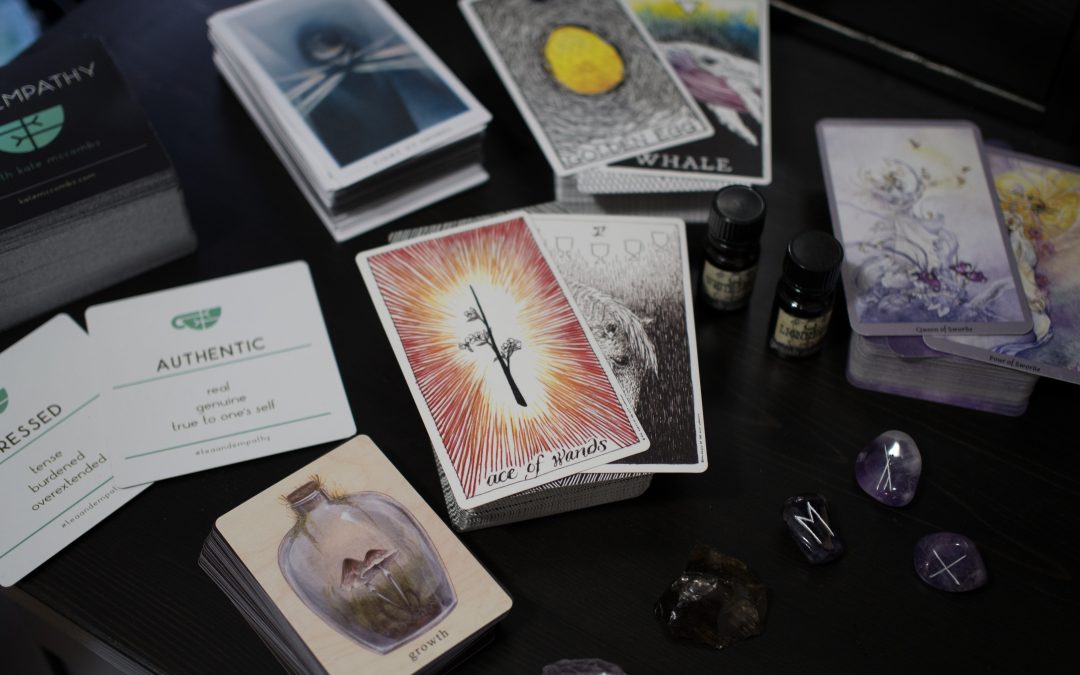
And second, pay attention to how the process feels for you, and make sure that it is bracketed in ways that help you feel safe and stable. Bracketing is a practice of having some sort of ritual that starts the process and ends the process – for me, with tarot, it’s the shuffling. I shuffle when I start, and I shuffle again when I’m finished. I also keep each deck in some kind of container – a purple cloth for my Shadowscapes deck, the boxes they came in for most of my other decks, and a little plexi case for my Tea and Empathy cards. Taking them out and putting them back brackets the process for me.
I have noticed in my own tarot-enhanced narrative practice that, at certain times, the cards feel less like a coauthor of my story and more like a dictator of my fate. Particularly when I’m feeling out of control and anxious, my superstitions get in the way, and I start scanning the cards for some magical truth and a message from the future. Rather than feeling centered in my own story in those moments, I feel completely separate and silent – waiting for some supernatural hand to author my story for me. In those moments, pulling random tarot cards is not the most effective or holistic self-storying tool. Recognizing that I no longer feel centered in my story, and that I no longer feel like it is my story, is important (but difficult!) It requires a lot of self-awareness to notice our superstitions taking over. It is more effective, and gives me back a sense of agency over my narrative, to draw cards intentionally rather than randomly, or even to use other methods (like free-writing in the my journal, or talking things through with a friend or counselor). Using tarot as a narrative tool doesn’t mean you can only use tarot. You have many stories, and they can be told in many ways.
Good luck, my friends! Go forth and tell yourself your own stories.
Resources for further reading:
Tarot Reading For Skeptics, Cynics, Nonbelievers And Side-Eyers – this post by Lesley Kinzel explores the history of tarot, answers some common questions, and offers a few suggestions for decks (including the Gummi Bear Tarot, which sounds hilarious and adorable).
Beth Maiden’s Favourite Tarot Decks – My favourite tarot blogger talking about her favourite tarot decks.
#TarotSoWhite: A Conversation about Diversity in Our Cards – Another Little Red Tarot post, introducing and beginning to explore the #tarotsowhite hashtag and the important conversations happening around the issue of diversity in tarot.
Gender Essentialism in the Pagan Community – A short but insightful Tumblr post that highlights some of the gender essentialism that shows up in a lot of woo spaces.
Everyone’s Spirit Animal Should be Cultural Sensitivity – This post by Samantha Gross is a brief intro into cultural appropriation and respectful alternatives. It’s written by a white person for white people, which is important because people with privilege need to take responsibility for educating other people with privilege. However, if it’s a topic you want to learn more about (which I highly recommend), it’s worth seeking out Indigenous writers sharing their wisdom and experience. Native Appropriations is a great place to start.
Autostraddle’s Tarot tag is full of great posts by queer writers.
What Makes a ‘Feminist’ Tarot? – this post from Autostraddle is a great introduction to recognizing and finding feminist tarot decks. (And it’s by Beth from Little Red Tarot!)
by Tiffany | Apr 10, 2017 | Identity, Intersectionality, Personal, Woo
This post is part of the Spring series! You can read about the Spring theme in this public post on my Patreon. This post was available a week early to patrons, so if you want to read more, and sooner, consider supporting me!
I have always loved metaphors. And ritual. And things that are slightly mystical and shrouded in secrecy and specialness.
How badly did I want to be Morgaine in The Mists of Avalon?
Prettttttty badly, lemme tell ya.
Badly enough that I dressed as Morgaine every Halloween for six years in a row (possibly contributing to my lack of popularity in junior high), and I reread that book every year for more years than that, and when I decided to Go Goth or Go Home in grade 10 (a story of self-definition for another day), Morgaine was my template.
And so, of course, it is a pagan sort of woo that draws me.

(Did I once embroider an assortment of mystical symbols into a black cloak I had made for myself, because I was both Gother Than Thou and crafty af, and maybe also just desperately wanted to be magical? Yes. I did.)
But when it comes to self-care, tarot is more than just another iteration on a lifelong theme.
I came to tarot (or tarot came to me) at one of the lowest points in my life.
I felt like I was dying. Not to be dramatic, but I am pretty dramatic, so… I felt like I was dying.
I was desperate for hope.
I was desperate for another story.
A friend offered me a tarot reading. I said yes.
They pulled some cards for me from the Wildwood Tarot (a deck I still don’t own, and would very much like to someday) and they told a story that resonated for me (because my friend does tarot like I do tarot – conversationally).
The story was hopeful.
The story was about survival, and about persistence.
The story was exactly what I needed.
(Fun fact, every single story a tarot spread tells can be about survival and persistence. Tarot is, after all, the story of journeying through many stages of selfhood.)
After my friend read my cards and gave me back a shimmer of hope, I bought my own deck.
I landed on Stephanie Pui-Mun Law’s Shadowscapes Tarot , and it’s still my favourite deck. I love the colours, I love the art, I love the stories that the cards tell me and that I tell with the cards. It’s a gentle deck. It’s a little bit sassy. It’s soft, and welcoming. All fae creatures are genderqueer, in my imagination, so the deck feels welcoming for me as a genderqueer reader, too. (That’s important. That’s why I don’t own and probably never will own any of the standard decks. I want my metaphor magic to be queer and genderbendy.)
Then I found Little Red Tarot and got my second deck, The Wild Unknown . It’s sharper. A little more stark. Less sass, more ‘sit down and listen.’
I started reading tarot almost every day.
It was a hard time in my life.
I was seeing my therapist every week, and after every session, I would sit in the park by her office and read my cards. I bought a whole bunch of tarot books (that’s how I roll) and learned about card interactions and about the tarot suits and about intuitive and conversational reading. I did Little Red Tarot’s Alternative Tarot Course and found a space that welcomed my non-religious woo.
I bought the Fountain Tarot, which is beautiful and cold and I only use it rarely. It’s not nearly as welcoming or intuitive for me – it speaks a language I’m not as fluent in.

I bought more books.
 I added crystals, because if you’re going to survive on the strength of your woo, you just may as well. I bought a whole bunch of oils from Twilight Alchemy Lab.
I used tarot to get me through some very dark, very long, very desperate days. And nights. And weeks.
“Can I keep going?” I asked the cards.
The answer was always, always yes.
Every card in the tarot deck can say yes.
Every story can be a story of survival, a story of persistence.
(Every card can say no. Every story can be a story of ending. We write our own stories.)
Eventually, as the tarot deck promises, the wheel of fortune turned.
My life stopped being so awful.
I stopped reading tarot so often.
Now, I have more decks. I have a couple oracle decks. I read my cards less desperately, clinging to those metaphors a little more loosely. I no longer feel like I’m going to die. My questions are a little less fingernails-digging-into-the-crumbling-edge.
But I still find a lot of comfort in the cards.
In the conversation.
In the answer that is always “yes, you can continue.”
***
When I was in junior high (or, as I like to call it, hell), I had a bit of a mental break.
I took all of the anger and hurt, all of the parts of myself that could not go on any more, and pushed them into a corner, and they clumped up in that corner like some kind of psychic dust bunny of doom, and they developed a personality (which was as sparkly and delightful as you’d imagine) and we had very many conversations through the long nights of asking “can I keep going?”
And unlike my cards, the answer was usually, “no. you should not. give up. stop now.”
I have often wondered what I love so much about tarot, since the woo does still give me twingy little feelings of anxiety (do I really believe in mystical tarot cards? telling me things? I mean… do I believe in mirrors? I guess? I don’t know. These questions are hard.)
I think that at the core of it, what I love about tarot, and oracle cards, and other woo – what I love is that it gives me a chance to have those conversations again, and instead of answering back to myself “no, stop, give up” and then fighting like hell to deny that dark pull, now I have those conversations and the answer is “yes, absolutely, you can keep going. you’ve got this. I believe in you.”
I have always needed those conversations to somehow be externalized. Either in the form of the psychic dust bunny of doom, or the cards.
I like the cards better.
Maybe it’s more that I like myself better, now.
I have better stories to tell.
That dust bunny still lurks in the corners, and even though she’s no longer splintered off away from the “real” me, still, sometimes I sweep her out gently into the light and give her a hug and let her tell me how nobody loves me and I’m stupid and there’s no point and I’m going to die alone and I should just give up now – she’s trying to help, in her own way. All my anxiety and trauma, all bundled up into something I can speak with, instead of something I have to be.
(This is not necessarily the most healthy coping mechanism and I am lucky to have found excellent mental health care, but it is also not something I am willing to disown or feel ashamed of. Externalizing my pain is what allowed me to survive my teen years, and whatever we do to survive, well… fuck it. We’re survivors.)
I love the cards for the way they let me tell my story in new and wholehearted ways. I love how tarot can be queered, and how there is so much power in these metaphors. I love how tarot traces cycles – small cycles through the year, and large cycles through lives, and huge cycles through human nature.
I love how people throughout history have found ways to make our magic, our metaphors, tangible.
I love us. Weird and woeful and wooful creatures that we are. Fae and fantastic. Strong and struggling.
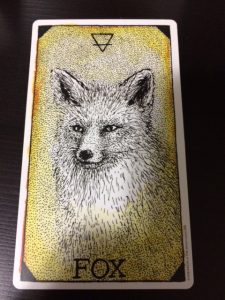
I just got a new deck – an Animal Spirit* deck to go along with my Wild Unknown.
The first card I drew was the Fox.
The little sheet of meanings says, “Smart. Adaptable.”
I look at the card, at the fox, and take a breath.
Smart.
Adaptable.
I think, yes.
Good.
That’s a story I can hold.
*This is not a “spirit animal” deck, and I wouldn’t buy one that was. Cultural appropriation is a serious issue in contemporary woo, and, as this post on The Wild Hunt points out, “At its core appropriation is a form of violence and aggression against brown bodies and brown communities. It is a minstreling, a racist caricature that tells more about the frame of mind of the performer [appropriation is a performative act] then it does about the original practice or cultural significance. Not only does it cause harm through this mimicking of symbols and actions, but it further creates difficulties for seeing real images of brown people and our gods on community altars due to the fear of appropriation.”
Spirit animals, when used by people who are not Indigenous, absolutely are appropriation, and this post by Spiral Nature goes into some depth about how the language we use matters, and how even though animals are present as spiritual guides in many practices, there are relevant nuances. Whether we use our woo as a spiritual or metaphorical or religious or blended practice, we have to work to decolonize our language and our practice. From the post, “We must accept that the reason that the idea of spirit animals exists within occulture is cultural appropriation and the misrecognition of Indigenous beliefs, and had that early appropriation not taken place, there would be no such confusion now. Even if the practitioner does not otherwise engage in sort of pseudo-Indigenous practices as filtered through early spiritual texts, relying on terms like “spirit animal” is still cultural appropriation and should be avoided at all costs.”

by Tiffany | Apr 9, 2017 | Recap
Reflections on fear, vulnerability, and persistence.
Mid-March, I set up a spreadsheet to track my content and make these month-in-review posts easier to generate. Scrolling through March’s spreadsheet, I see “persistence” tagged in post after post.
In this post about how to respond when someone hits you square in your most vulnerable spots.
In this post about self-care when you’re totally overwhelmed.
In this blog post about self-care in post-secondary and professional environments.
In this post about celebrating small successes, and in this post about the drudgery of self-care.
In March, I was trying to survive.
In all these posts about persistence there is a stubborn refusal to give in to the exhaustion and hopelessness of the last (long) while. And there is a recognition that self-care is not always about getting to happy, or about thriving, or about living your best life. Sometimes self-care is just about living this life, despite the fact that you can’t even picture your “best life” at the moment. Sometimes self-care is just about persistence.
Persist.
Keep going.
Do what you need to do to get to tomorrow.
I felt a lot of hopelessness in March – some of the “plot twist” transitions that inspired me to start this work have gotten heavy. Stepparenting is so challenging. Trying to navigate the learning curve, and trying to also integrate my new parental identity (one that does not sit easily or comfortably within my previous narratives).
Our theme week for March was Fear and Vulnerability, inspired by the Ides of March and by my own mental state. I’ll be compiling those seven posts into a longer post later this week, but for now you can read up on them here:
Day 1: Let yourself love what you love. (Yikes!)
Day 2: Trust your gut. (Yiiiiikes!)
Day 3: Sometimes you really are as vulnerable as you feel. How to get through those moments of vulnerability and pain.
Day 4: Invisibility and hypervisibility, and how to hold onto the complex true stories of yourself.
Day 5: Let yourself fail.
Day 6: Recognizing how fear feels in your body, and knowing when fear is disguised as other emotions.
Day 7: Allowing yourself to feel and process fear even when you can’t move past it.
At the end of Fear and Vulnerability week, I did something that felt very vulnerable – I finally announced a seasonal theme (despite having developed themes for every season and totally failing to announce the Winter theme!)
∞ Sharpening the double-edged sword.” The second quarter, from the Spring Equinox to the Summer Solstice in June, will focus on the mental self, and the element of air. Inspiration for this campaign comes from the Tarot suit of swords, particularly the Queen of Swords, with her self-awareness, focus, and melancholy. Posts will explore narratives of mental health and neurodivergence, with a series of posts on cognitive traps and maladaptive thought patterns, and how to shift them. This campaign will also focus on healthier approaches to the “positive thinking” trap, and on skills that help us become aware of how our thoughts shape our interpretation of reality.
I’ve shared the first couple posts that fit directly into the theme, in this post about “double-edged sword” traits and accepting both sides, and in announcing the Spring online course (the first in a series of online courses that will follow the seasonal themes for the rest of this year).
If you would like to register for the Spring course – a 6-week course on the topic of expressive writing for mental self-care, at a cost of $60 with sliding scale available, send me an email!
Looking back over the posts for the month of March, I’m struck by how often I talked about persistence, and survival.
This time of year is often challenging – even though the new growth of full spring is on the horizon, we’re still slogging through the mud. Those of us in post-secondary settings (or with kids in school) are struggling with end of term. Papers are due, grades are coming in, everything seems to critical and so final and so urgent.
Many of us are still struggling with the sticky tentacles of seasonal affective disorder, and although the sun returning brings some relief, we’re tired.
And, this year more than most, we are continuing to watch the world dissolve into chaos.
It is overwhelming.
I see the impact of that in my self-care content, and in all the content that I started to write and never finished – the darker posts written on the darker days.
I hinted at some of the darkness and overwhelm in my own life in this post about taking up space. This continues to be a challenging theme in my own personal life, and although I am not really enjoying the challenge presented by constantly having my identity invalidated and erased, I am using it as an opportunity to expand my self-care repertoire and my understanding of how identity threat, and stereotype threat, influences the resources we have available for self-care.
This work is starting to show up in other spaces, and has informed my approach to the duoethnography I’m co-authoring with Mel Carroll, on the topic of non-binary identity formation and expression in relational contexts (both personal relationships – partnering, parenting, befriending – and professional relationships – service providers, colleagues, employers).
In April, starting this coming week, I will be launching Thinking Through Thursdays, a series of posts that focus on “healthier approaches to the ‘positive thinking’ trap, and on skills that help us become aware of our thoughts shape our interpretation of reality.” This series will run until the end of the season. If there’s a cognitive trap or bias that you’d really like to see on addressed on a Thursday, let me know (and give me a week’s notice). Patreon patron requests will be given priority.
I also shared a bunch of links in March. They’re rounded up below.
Resources for expanding your self-care repertoire, from this post about trying something new:
Keaira LaShae’s workout videos are fun and energizing (and a favourite of my best friend) and this video is multigenerational.
Exercises for chronic pain
Resources on decolonizing yoga
Accessible fitness (this is less “how-to at home” and more “how-to as an instructor” but there is such a pervasive notion that fitness is about losing weight and is primarily for bodies that fit the norm – I like how this article challenges all of that
Writing prompts
Writing prompts focused on healing
Videogames for self-care
At home spa treatments to help with stress
The Awkward Activist on cooking and self-care
This excellent article on how the author is using self-care to survive while waiting to get into a therapy program. The advice is practical, achievable, and specific.
“But self-care is important – especially for those of us whose mental health isn’t 100%.
It’s basically just committing to look after yourself, treat yourself kindly, and make your wellbeing priority.
Self-care is not a substitute for professional help. But for now, it’s the best thing I can do.” – Ellen Scott
This post, titled “Despair is Not a Strategy: 15 principles of hope,” hit me hard in the feels the day I shared it.
“If you’re out there trying to change your neighborhood, community, city, country, or the world then this is for you. In moments when everything seems hopeless, read this to get your hope on.” – Abby Brockman
And this set of links, shared on Trans Day of Visibility, about self-care for trans and non-binary folks.
This post from the Audre Lorde Project includes further resources and a worksheet. This is not trans-specific, but is trans-inclusive.
Teen Vogue’s article is specifically for trans and non-binary students, but the tips are broadly applicable for non-students.
This list of four resources from Colorlines is excellent, and I included the Colorlines link rather than a link to each resource individually because Colorlines is, itself, such a valuable resource. Only one of the listed resources is trans-specific, but because trans people of colour face experience visibility in such a heightened and vulnerable way, each of these resources is worthwhile if that’s the intersection you’re standing at.
This post from Everyday Feminism is specifically about self-caring through dysphoria, which can be triggered hugely by in/visibility.
This is one person’s list of self-care tools as a non-binary trans person.
Onward, through April!
If you would like to support this work, consider visiting and signing up for my Patreon!

by Tiffany | Mar 22, 2017 | Health, Identity, Intersectionality, Patreon rewards, Personal, Plot twist, Possibilities Calgary
Possibilities Calgary is relaunching! Over the next couple weeks, you’ll see the About pages updating on the Facebook, the MeetUp, and Twitter. The posting for the first event will be going up tomorrow, and the event itself will happen in April. The first blog post will be up the first week of April. (You’ll even see a dedicated page on tiffanysostar.com, but not quite yet.)
We’re back!
First, some history. Then, some FAQs (the questions I asked myself most frequently when planning the relaunch).
Some history
Possibilities Calgary was founded in 2010 as the term-project in a Feminist Praxis course. I was in my second year of University, had recently come out as bisexual, and was searching for community. Searching… and searching… and searching…
At the time, there was no cohesive community in Calgary for bisexuals.
This is not unusual, since the bisexual community is chronically under-supported. The lack of support leads to, among other things, increased risk of intimate partner violence, under- and unemployment, significant rates of poverty, and poor mental health outcomes. (For a comprehensive look at the issues, read the 2011 Bisexual Invisibility Report, or, even better, read Shiri Eisner’s fantastic Bi: Notes for a Bisexual Revolution.)
I wanted community, and I couldn’t find it, so I built it. I had support from my Women’s Studies professor, Fiona Nelson. I met with community leaders to learn how to organize queer and feminist community in safe and effective ways. I had an amazing group of people to help me, and the Possibilities board was such a phenomenal support.
Possibilities ran for 5 years.
In that time, we expanded to include the asexual community (zero is not one, and so our ace friends fit under the non-monosexual umbrella comfortably!), and to include the transgender community (particularly the non-binary and transfeminine communities). There are trans members of every orientation – gender identity and sexual or romantic orientation are not the same things – but we found that those folks at the intersection of trans and non-monosexual identities were particularly and uniquely marginalized, and that Possibilities could help. For the last year of Possibilities, we had an offshoot community in Translations, which focused on transfeminine experiences.
We hosted three BiBQs during Calgary’s Pride week, and two Probabilities: Queer and Feminist Gaming Conventions. We also partnered with Calgary Outlink to host a monthly Community Café, which was a gender- and orientation-inclusive space. And, one of my personal highlights, we ran the UnConference series, bringing in speakers for multi-day events (including the hugely successful co-hosting of Courtney Trouble with the University of Calgary’s Institute for Gender Research).
Brittany says, “The BiBq was a super chill thing that I miss!” and Jocelyn confirms, “Get togethers involving food and convo” were a favourite feature.
Sid, a former board member says, “I got the opportunity not just to have my own need for support and community met but that I was also in an environment that gently encouraged me to explore how I related to other axes of oppression. Also, I always appreciated the constant supply of tea.”
Our intersectionality developed and grew over time, and although it was always imperfect, it was sincere. Rachel says, “I felt incredibly safe there.”
Michael, another former board member, says, “I really appreciated the sense of belonging to a community, and the ability to learn and grow from a group of amazing people with diverse life experiences.”
Scott, also a board member and facilitator, says, “I am not a word smith. I don’t have words beyond it was community for me. It felt inclusive and supportive.”
Jonathan, who helped me with the founding of the group, says, “Possibilities helped me learn more about how my newly discovered queer identity fit within a community. It enriched what would otherwise have been a much lonelier journey.”
It was good. It was so good. And it was needed.
But in 2015, a significant percentage of the board had moved on to new cities or new projects, and I burned out hard. Physically, emotionally, financially – I was tapped. The board members who remained continued to work hard, and new volunteers stepped up, but the organization was struggling. We couldn’t keep going. After major soul searching, we admitted the truth. Possibilities was on hiatus.
In 2016, I looked at restarting Possibilities, but realized that I didn’t have the resources to make it sustainable for myself. It hurt, but we stayed on hiatus.
But yesterday was the first day of Spring, 2017, and it was time for this seed to grow again. And so…
Some questions
Why am I relaunching Possibilities now?
Because it’s time. Because not having access to community causes harm, and because I have always believed that if you can do something good, then maybe you should do something good. (That maybe is super important – only you know what you can and can’t, or want to, do.) Because I miss this community. Because I miss being a community organizer. Because it’s time.
How am I going to avoid burning out again?
Friendship and magic? No, but seriously, I am hoping that two years of learning better self-care skills will help. I am also going to make it easier for people to support the work, and am tying it directly to my self-care and narrative work, which leads us to…
What will the relaunch involve?
I am making two commitments in this relaunch effort – one blog post or article per month, and one in-person “self-care for the b+ community” meeting. I don’t know if the BiBQ, or the gaming events, or the UnConference series, or any of the other major projects we were involved with will come back online, but I’m also not going to worry about that yet. By tying the work explicitly and intentionally to my self-care resource creation, this iteration of Possibilities fits beautifully into the work I’m doing for (and with) my Patreon. Which leads to the final question –
How can community members get involved?
If Possibilities is important to you, and you value having this community back up and running, please consider becoming a patron. That is the best way you can support this work, though I know not everyone is able. Possibilities discussion events, and the blog posts and articles, will be free for anyone, and the Patreon is what makes that possible. (Blog posts will also be available a week early for patrons, so, there’s that!) It makes me so happy to have come full circle, to have spiralled around to a new way to approach an old passion, and you can help ensure that the community stays active and vibrant going forward.
by Tiffany | Feb 26, 2017 | Coaching, Health, Identity, Intersectionality, Neurodivergence, Patreon rewards, Personal
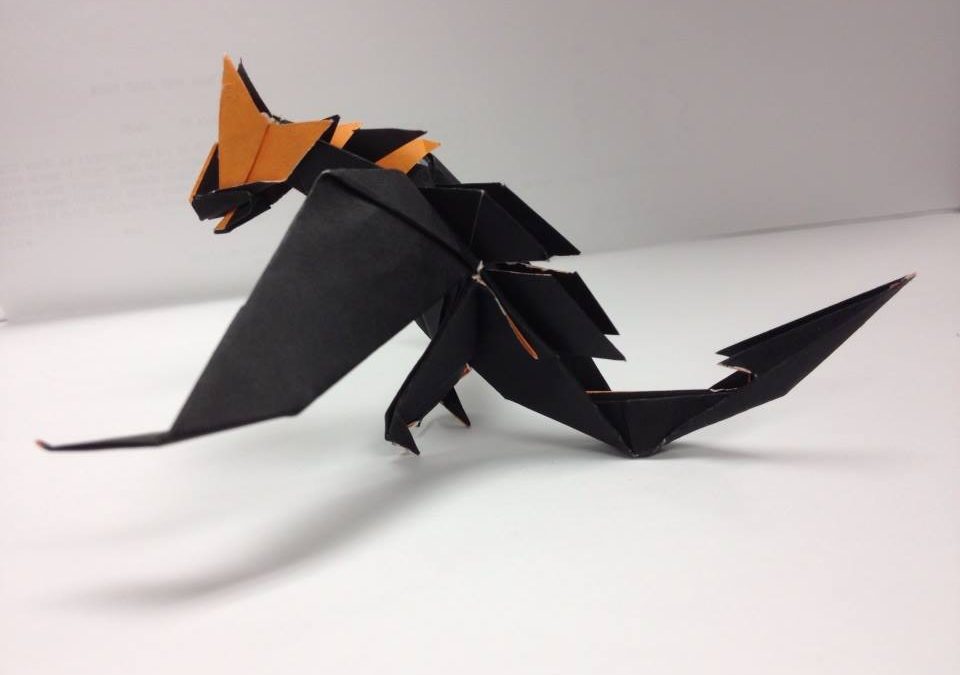
Dressed up as a Gloom Fairy – one of the self-care strategies that got me through university.
This is a Patreon reward post. At $5 per month, you, too, can have a personalized post on the topic of your choice during your birthday month!
Red Davis (one of the first people to back my Patreon! *heart eyes*) is a current student and good friend. He asked for “a post relating to disabilities and mental health disorders within a university, professional, or social context; recurring themes of self-shame, embarrassment, and self-imposed solitude often debilitate many in higher learning or work situations.”
I will admit, I struggled with this post.
I wanted to write it, of course. Helping people navigate these hostile contexts while existing on the margins is exactly what I want to do in my coaching and self-care resource creation. Not only that, but it’s a reward that I’ve committed to providing for someone who is dipping into a tight student budget to support me, and make this work possible.
But, wow.
Every time I sat down to work on the post, my own feelings of shame, embarrassment, and self-imposed isolation flooded through me.
I remembered, specifically, one afternoon in 2012, standing in a hallway at the U of C, probably the Social Sciences building. One of the little ones, too brightly lit, with old computers on white tables, and plastic chairs, and a few students wandering. Wearing my winter jacket, dragging my backpack on wheels because the fibromyalgia no longer let me carry all those books, on my cell with the campus dental office cancelling an appointment because I was having a panic attack.
That panic attack cost me $100 in a late cancellation fee, and I never rebooked. Now, 5 years later, that memory still sparks shame and anger, and an icy-gut feeling of humiliation over the fact that my panic attacks cost me so much money at a time when I had so little, and that they kept me away from necessary healthcare. (And they have continued to do so! That appointment would have been my first visit to a dentist in years, and when I said I never rebooked, I mean that I never rebooked. It’s on my to-do list for this week. Seriously. I’m gonna do it. For real. I swear.)
The memory is about the money, the shame of “wasting” money on a “ridiculous” mental health issue. Sort of. Maybe. I mean, the money is part of it.
But it’s also about the voice on the other end of the phone, the impatience and irritation of the receptionist, and the feeling of shame when I started to cry and she cut me off. “Sorry, no exceptions to the cancellation fee, if you were going to be unable to make it, you should have called yesterday.”
These feelings are deeply physical. Shame, humiliation, fear – these are all visceral reactions, gut feelings. 5 years after that phone call, I still feel the twisting in my belly as the shame winds through me.
And when Red touches on self-imposed solitude, this twisting shame belly is part of that. Shame, after all, is an isolating emotion. It pushes us away from each other, drags us off into dark corners to hide ourselves.
How do we reach out when we are captives of our shame?
But shame is not the only factor.
Time and energy are also factors.
How do we maintain our social circle when disabilities make the work of school or professional life take longer, and take more out of us?
When fibromyalgia arrived on the scene, stealing my energy and my reading comprehension, and for one horrific semester, my ability to write… everything took longer. Everything took longer. Crossing the street took longer! Reading a paper took longer, and took more out of me. I was tired at the end of a page, exhausted at the end of a chapter. I deferred coursework, missed deadlines, spent endless hours in doctors’ offices and at the disability resource centre – hours that were then not available for schoolwork or paying work or socializing.
The anger at no longer being able to operate as I had was immobilizing, and embarrassing. The shame was overwhelming. The exhaustion was beyond comprehension. It triggered a depression… or did the depression precede the pain? Those years are a dark smear of distress across my memory.
How do you make it through post-secondary or professional contexts when dealing with disabilities or mental health issues?
How do you survive?
How do you continue, knowing that your brain and your body are working against your ability to fit into these contexts?
In 2013, I did my first Year of Self-Care.
I needed it. Even through the blur of my distress, I knew that I needed it. I was falling apart. I was a wreck – physically, emotionally, mentally, financially.
I don’t honestly remember much from the beginning of that project.
I know that I was desperate.
When I was 18, at another desperate point in my life, I had done a Year of Independence in an effort to heal some relationship trauma. It was one of the highlights of my youth, remains one of my favourite experiences. I leaned on that, and set out some plans.
It wasn’t easy.
<blockquote class="twitter-tweet" data-lang="en"><p lang="en" dir="ltr">Working on a <a href="https://twitter.com/hashtag/YearofSelfCare?src=hash">#YearofSelfCare</a> mind map. Seeing all of my projects fill up the white space, my anxiety levels make sense. ...</p>— Tiffany Sostar (@academictivist) <a href="https://twitter.com/academictivist/status/345648578791882754">June 14, 2013</a></blockquote><!-- [et_pb_line_break_holder] --><script async src="//platform.twitter.com/widgets.js" charset="utf-8"></script><!-- [et_pb_line_break_holder] -->
But one of my founding principles for that year was compassion for myself. The act of compassion and care, even when the feeling was unattainable.
<blockquote class="twitter-tweet" data-lang="en"><p lang="en" dir="ltr">Thinking about <a href="https://twitter.com/hashtag/YearofSelfCare?src=hash">#YearofSelfCare</a> tools and processes. Thinking about compassion (for self and others) as an active, intentional practice.</p>— Tiffany Sostar (@academictivist) <a href="https://twitter.com/academictivist/status/345202208616361984">June 13, 2013</a></blockquote><!-- [et_pb_line_break_holder] --><script async src="//platform.twitter.com/widgets.js" charset="utf-8"></script><!-- [et_pb_line_break_holder] -->
I needed to start there, because at the time, my body and my brain felt like my enemies. I think that’s a common experience for people dealing with disability or neurodivergence. It’s hard to practice effective and sustainable self-care when you feel like your own enemy.
The Year of Self-Care included a lot of hit-and-miss experimentation.
During that year, I discovered how much I enjoy the ritual of tea, and that’s the year I learned to make London Fogs. I still make amazing London Fogs (though not as often as I used to – I need a new milk frother).
I also experimented much more intentionally with using outfits as armour and as a self-affirming tool. Gloom Fairy, The Pirate King, and Elf Commander all have roots in those Year of Self-Care experiments.
How do you continue, knowing that your brain and your body are working against your ability to fit into these contexts?
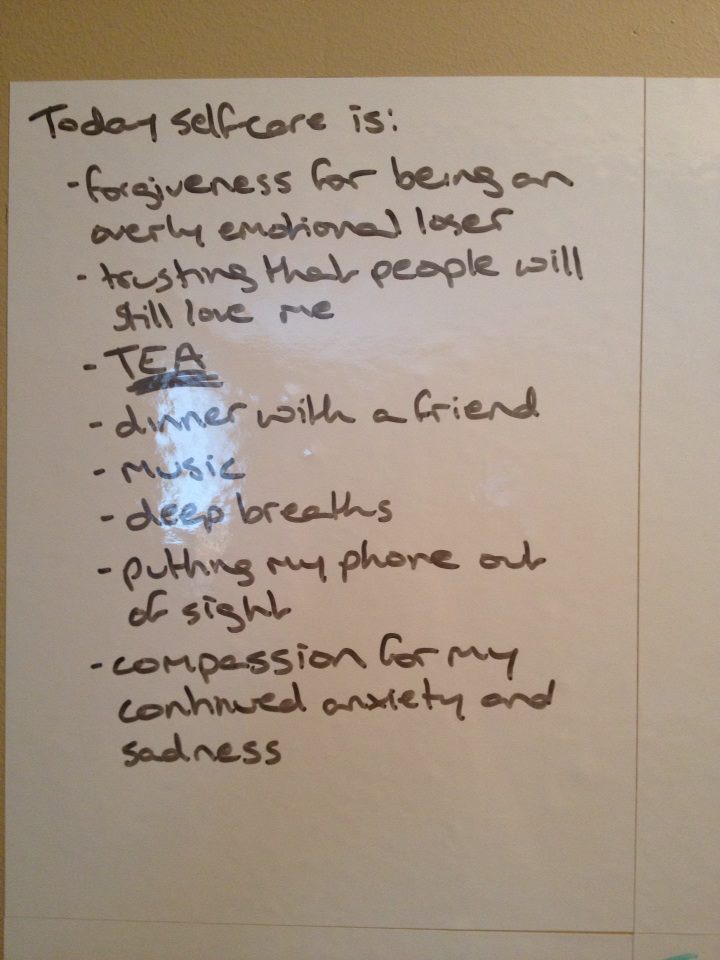
It was the year that the Wall of Self-Care went up, white boards with anxiety bubbles, and self-care lists, and my inspiration board.
It was the year I learned to swim, in order to challenge a phobia, and get my fibromyalgia pain under control, and prove to myself that I could.
It was the year of endless struggle, and I was lucky because it was also the year of infinite support.
It was a hard year. But it was a good year.
A list of self-care to-do items posted on Facebook in 2013 with the comment: This afternoon took a sudden, unexpectedly intense turn for the worse, so I hung up some stick-on white boards (expanding my wall of self-care) and made a list. Intentional self-care! For those of us whose default position is ‘the unfortunate person crying in the stairwell.’ Sigh.
A badge given to me by my friend Patti when I successfully managed to tread water.
A love note from my little niephling.
The biggest lesson from that year was that self-care is fucking hard. It’s hard. Making a cup of tea when you’re exhausted, and ashamed, and embarrassed, and feeling lonely despite your community – it’s hard. Reaching out for help? Holy shit, that is not easy. Doing anything other than wallowing is just really hard.
Making choices intentionally, and choosing compassion and care, it takes effort. And you fuck up, a lot. You fuck up all the time. It took a year and half to complete my Year of Self-Care (my “Year of Whatever”s are almost always a year and a half – either the new year to my birthday the next year, or my birthday to the new year. I like some wiggle room.)
In that year and a half, I made plans and failed to complete them. I made the same plan again and failed. I made a slightly different plan and failed in a different way. I made a totally new plan and still failed. I tried again and failed. I made schedules and failed to stick to them. I set goals and didn’t meet them. I dropped more balls than I kept in the air, and that’s okay.
That’s okay.
It doesn’t feel okay at the time. It feels awful. But that process of failing at self-care is an important part of the journey. Self-care has to involve deep compassion for your broken, aching self. It can’t all be celebrations and successes. It won’t be. If it was, you wouldn’t need it so badly.
In order to get to a place where you have effective and sustainable self-care practices in place, you need to go through the process of pushing against the resistance. The internal resistance, sure. The shame, the fear, the feelings of selfishness and the anxiety over failure. But mostly, mostly, the external resistance.
You have to smash your fist against the cost of self-care. That $100 penalty for a panic attack. The cost of admission to the pool. The cost of white boards. The cost of missed work hours. The cost of healthcare, even here in Canada. The cost of therapy. The cost of nourishing food. These costs that you cannot always afford. You have to run into that wall over and over and over until you find ways under, or through, or around it. And sometimes you don’t. Sometimes you can’t. Self-care cannot belong only to the financially secure. Those of us who are disabled or neurodivergent or otherwise marginalized are much more likely to be dealing with economic insecurity, to be living in poverty, to be stretched too thin, to have ends that not only don’t meet, they don’t even make eye contact. We deserve self-care, too. But it takes time to find those tools, because it’s much quicker and easier when you do have the money for it.
And you have to smash your fist against the unreasonable and inhumane demands of post-secondary and professional institutions. Deadlines and dress codes and disdain. I dropped a course I really loved because handwritten notes were mandatory for a huge percentage of the grade, but my hands hurt too much to write long-hand. More bitterly, I dropped out of the Arts and Sciences Honours Academy because the professor in third year required mandatory attendance, with no more than two exceptions for medical issues. “Breathe deeply and drink a mug of tea” doesn’t wash the salt from those wounds. Getting to sustainable self-care means feeling that sting, doing what you can with the resources that you have, trying to find ways around it. Finding the understanding professors, begging with the disability resource centre, paying the $25 to have a doctor write a letter saying that yes, you really do need these accommodations. It takes time, and it takes energy, and it takes a lot of permission to just be angry and bitter on your way to being calm.
And doctors… another wall, another round of smashing and smashing and smashing until you find the way through. Get the diagnosis, get the prescription, get the help. Or, sometimes, you don’t. Find other ways to cope.
The systems are not built for us.
It hurts to contort ourselves to fit within them.
That pain is real. That injustice is real.
There are ways forward. My Year of Self-Care made a huge difference for me. I’m not meaning to downplay the importance of doing that gritty work of developing more wholehearted self-care and self-storying strategies. But I get frustrated at resources that don’t acknowledge how hard this is, and how much the odds are stacked against anyone who differs from the straight, white, cisgender, able-bodied, neurotypical, class privileged norm.
When I started working on this post, I did what I always do at the beginning of a writing project. I opened a new Chrome window and I googled this shit out of my topic. I started with “self-care for students” and I found dozens of posts. Every post-secondary institution seems to have some kind of self-care guide for students. (Perhaps because post-secondary institutions are set up in such a way that any student who doesn’t have an extremely solid base of socioeconomic stability is pretty much fucked when it comes to mental, emotional, and physical health? Dunno, just a theory.)
These resources place a huge emphasis the individual doing everything possible to maintain their self-care
This resource from the University of Michigan is a perfect example.
“Taking steps to develop a healthier lifestyle can pay enormous dividends by reducing stress and improving your physical health, both of which can improve your mental health as well. Students with mental health disorders are at a higher risk for some unhealthy behaviors. You may find it challenging to make healthy choices and manage your stress effectively while in college. This section of the website will help you find ways to take care of your health, which can help you to feel better and prevent or manage your mental health symptoms.”
Look at that language! You’re at higher risk for unhealthy behaviours. You may find it challenging to make healthy choices. Gross. Gross! There is nothing there about how the structures and systems and expectations and normativity around you are the source of that distress, and put stumbling blocks in front of your movements towards “health.” It pushes the responsibility entirely onto the student who is struggling, and then wipes its hands clean. There’s good advice in that resource, but it comes in bitter packaging.
Even posts like this assume that the identity of “student” is also normatively able-bodied and neurotypical.
“College students’ ability to deny basic needs like sleep can oftentimes seem like a badge of honor proving we are reckless and young. At my school, it can seem like a competition to see who can stay up longer to study, and pulling all-nighters seems like proof we are true UChicago students. One’s talk of working grueling hours in the library is met with solidarity and sympathetic laughter, while taking a break or decreasing course load seems to be associated with weakness.”
College students who can’t meet that expectation are, I guess, not “true students.” When the article concludes that:
“If we want to improve our psychological and emotional health, college students could perhaps benefit from changing their mindsets and relationships to work. Taking breaks and letting our minds rest could be an effective strategy for achieving our goals in the long run, because stress or lack of sleep can hinder productivity. Maybe the next time a friend bemoans having to pull an all-nighter for a class, we can think about how our response may perpetuate a culture that idolizes self-destructive behavior. Perhaps rather than laughing or saying that we understand their struggle, we can gently encourage them to take a break. Or, if it’s you who’s putting in those late-night hours, maybe go home for sleep rather than the campus cafe for coffee. You deserve it. You matter, and your health matters.”
There is still the assumption that this is a choice, and that is not the case for every student.
So, in conclusion, it’s fucking hard. And it’s not your fault. And you can figure it out, but it will take time. And you will continue to run into walls.
<blockquote class="twitter-tweet" data-lang="en"><p lang="en" dir="ltr">More pain = less sleep = more pain = less sleep. The point of the <a href="https://twitter.com/hashtag/yearofselfcare?src=hash">#yearofselfcare</a> is to become my own ally and friend. Not easy!</p>— Tiffany Sostar (@academictivist) <a href="https://twitter.com/academictivist/status/385261628897239040">October 2, 2013</a></blockquote><!-- [et_pb_line_break_holder] --><script async src="//platform.twitter.com/widgets.js" charset="utf-8"></script><!-- [et_pb_line_break_holder] -->
Being your own ally is not easy. It’s even harder when there are complicating factors like disability, pain, depression, anxiety, or other chronic issues that aren’t going away. And it’s even harder when you’re in hostile environments like many post-secondary and professional contexts.
But I believe in you. There is a way forward. There is always a way forward.