by Tiffany | Oct 29, 2017 | #stickfiguresunday
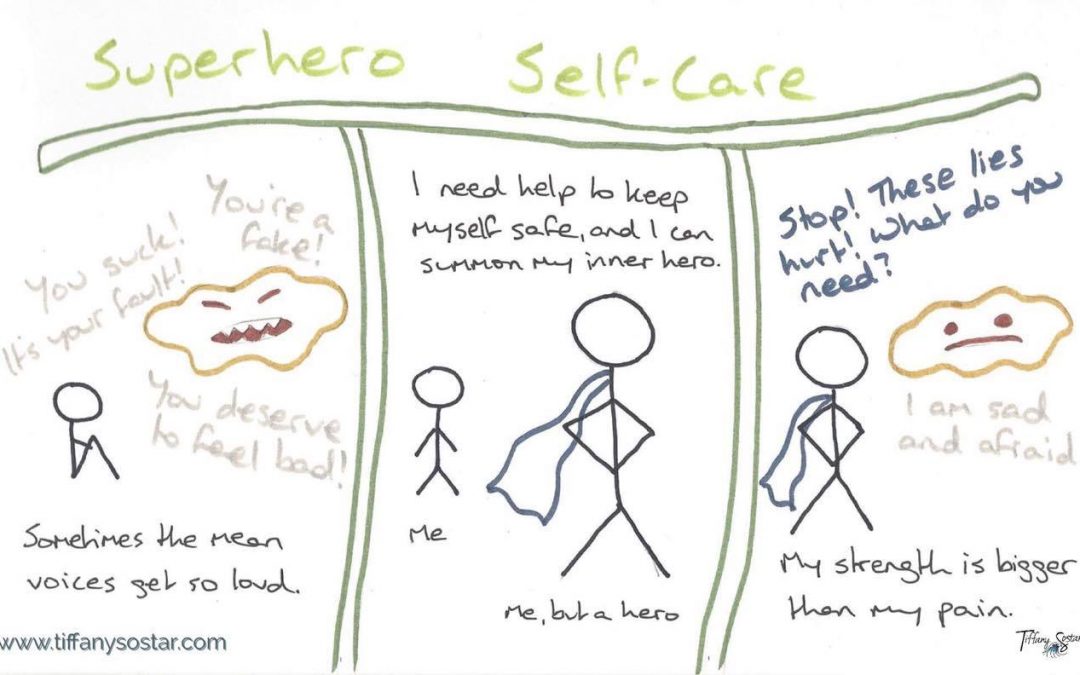
Image description: A 3-panel comic titled Superhero Self-Care.
In the first panel, a stick figure is sitting while an angry cloud yells insults at them. Text reads “Sometimes the mean voices get so loud.”
In the second panel, text at the top reads “I need help to keep myself safe and I can summon my inner hero.” A small stick figure labeled “me” stands beside a larger stick figure with a cape labeled “me, but a hero.”
In the third panel, the hero stick figure says to the cloud, “Stop! These lies hurt! What do you need?” The cloud has wide eyes and a sad mouth in this panel, and says “I am sad and afraid.” Text at the bottom of the panel reads “My strength is bigger than my pain.”
In the bottom right is a link to www.tiffanysostar.com, and in the bottom left is a small Tiffany Sostar logo.
This is part of an ongoing series of stick figure self-care posts.
Today’s post was inspired by the work being done in my Feeling Towards Wholeness course, where we created alter egos for ourselves to help in our healing journeys, and by a post shared by my friend Samantha about her struggles with Depression Guy (a concept she found in the web series People Watching, in this episode, which is pretty emotionally heavy but also pretty awesome).
Creating a superhero self can be a valuable resiliency-building tool.
In the comic, I also wanted to show the superhero stick figure treating the mean inner voices with compassion, because although I do think that sometimes we need to shout our own inner bullies down, much more often we need to make space for the pain and fear that is being redirected into aggression. Holding compassionate space for ourselves, even when we are hurting and lashing inward, is a challenge.
But that’s why we have superheroes to call on!
Who is your inner superhero?
What skills and abilities do they have that makes them such a great ally to you?
Do you have certain times or places when you call on them for help?
Do they have any accessories or tools that help them be the hero you need them to be?
Do you find it easier to call on your inner superhero for yourself, or for others?

by Tiffany | Oct 23, 2017 | #tenderyear
Image description: Two fall leaves are in focus. They are red, yellow, and green. Behind them is out of focus green. Photo credit: Stasha Huntingford.
This is a Year of Sacred Attendance | #tenderyear post. You can read the first in this series here, and you can sign up for the Tender Year email list here.
The Year of Sacred Attendance will run from October 1, 2017 to September 30, 2018.
Each day of the week has a unique focus. You can participate in all of them, or pick and choose the ones that resonate for you. We will be using #tenderyear for every post related to the project, with daily tags as well (to make it easier for folks to find each other on Facebook, Instagram, and Twitter).
Over the next while, I will be sharing a blog post for each day of the week.
You can read the post for Sunday’s Venn diagramming #challengethebinary prompt, and an interview with Stasha, here.
This post is about the Monday focus. In the welcome post about this year, this is how Monday was framed:
Monday
Attending to the Questions. #questioneverything
A significant focus of this project is inviting and facilitating compassionate self-awareness. You can ask yourself whatever questions feel right for you – the focus of Monday is simply to take time to ask yourself how things are going. If you’re not sure what to ask, here are some sample questions, and you can answer whichever feel right for you. Not everyone participating in this project will be working on creative projects, and not everyone will feel comfortable with a goal of presence – trauma is a real factor in many of our lives, and can make presence a real challenge. These are just a place to start:
What are you creating?
What do you need?
Do you feel present?
Could you try something different?
What are you wondering about?
Now that we are three weeks into the Year of Sacred Attendance, it is abundantly clear that Mondays (like every day in this Tender Year) are open to a wide range of potential interpretations.
This post is meant to be a brief introduction to some of the ways you can use this focus.
Choose a theme:
Do you feel like you’re disconnected? Maybe focusing on presence would help. Try questions like –
Have you felt present with yourself this week?
Do you feel present with yourself now?
What would help you feel present with yourself?
Or maybe you feel curious, and focusing on discovery would the right fit for you. Try questions like –
What do I want to know more about?
What have I learned in the last week?
What can I find in my environment that I’ve never noticed before?
Choose a type:
What would a series of “what” questions look like?
How would you structure a series of “how” questions?
Why* would you be interested in a series of “why” questions?
Who would benefit from a list of “who” questions?
When would there be value in a set of “when” questions?
Are you excited about hypothetical questions?
Will you find theoretical questions creative and energizing?
* A note on the “why” questions. Nathan Fawaz wisely pointed out that why questions can be harsh and judgemental,
After last week, I shared with the group that “both Mondays so far, I have had a FLOOD of “why” questions. It takes a significant amount of effort to get past the whys and into something more compassionate and generous, and even then, it’s so tight. I feel so much anger at the unfairness and injustice of things. It is getting in the way of feeling any tenderness, or even any true presence, in the moment. I’m not sure what to do about it, but it’s just something I’m noticing.”
Stasha calls this “the ‘anxiety wants to know’ part of my morning and mourning.”
Nathan echoed the experience of “The anxiety of the mo(u)rning.”
I think many of us have felt it.
This wanting to know, to understand the source and reason for the injustice, is such a deeply human and compassionate drive. Although we are grasping at control that isn’t ours to hold, the desire is valid and makes sense. It appears that if we can figure out why, then maybe we can fix it instead of feeling so helpless and in pain.
Quoting Stasha’s brilliance again, “It is about avoiding helplessness, or at least having the illusion that we can help.”
If your why questions are fueled by anxiety, fear, and anger – that is okay. Those are valid questions.
It might bring some additional tenderness to your Monday practice to add something gentler to the questioning, when you’re caught in the mourning why. But you may find that you need space for that grief and anger, and that is okay.
Let it be light:
Nathan suggested the following series of questions:
I would add some of these (with lots of cookies and love for all manner of answer. I think people might feel that the Monday questions have to be really weighty. Sometimes the question is: and what else will I put on my delicious sandwich. And those questions are incredibly important):
In this moment, one of thousands in your day, what questions are arising?
In this moment, what is calling your attention? Something inside? Something outside? What questions are being asked by whatever is calling your attention?
In this moment, maybe your brain is being very loud and possibly unkind. If you could put a silly hat and rollerskates on that voice and interview it, what would be the top three questions you asked it?
In this moment, threaded throughout all of our layers of demand and terror there is a heartstring that asks generous questions of love and openness. What are these questions?
Let yourself follow whatever questioning path feels right for you:
Stasha identified one of the most powerful things about making space to ask questions when she said, “I think there is potential to make space to explore on Mondays. I find this liberating because many of my experiences with oppression have involved my questions being silenced, punished, or redirected.”
Allow yourself to ask the questions without being silenced by the old voices in your past.
You do not have to share the questions publicly, or even write them down. There is power in letting ourselves slide up to the side of an important question and just nudge it before retreating again. There is value in shouting the questions out. There is value in writing the questions down and burning them.
Allowing ourselves to question – to question everything – is a powerful process.
It doesn’t mean we’ll get rid of our old beliefs.
We can question something and still hold on to it. I think that a big part of why we’re afraid of questioning is because we feel that if we question something, we’ll always find out that it’s broken or bad. But this is not true.
You can question your faith, question your relationships, question your life goals, without jeopardizing them. The questions can make these things stronger. And they can empower you to bring your critical, playful, expansive, curious, amazing mind into the dynamic in new and loving ways.
Separate the question from the answer:
Sometimes you’ll want to answer the questions you ask – that’s awesome!
But sometimes we don’t let ourselves ask a question because we don’t have the answer yet, and one of the most delightful and liberating things about the Monday focus is that you have explicit, enthusiastic permission to ask questions that don’t have answers.
Take a leaf from Stasha’s book:
On October 9, Stasha posted –
“Another chance to #questioneverything, joy! Today we explore why leaves turn different colors in the fall. This is a cool question because the chlorophyll green hides the colors underneath, and the red we see in the death of the leaves also appears when the leaves are new. I love how Mondays encourage our curiosity. I think curiosity is sacred. During my doctoral studies I would not have looked this up because I felt that I didn’t have time, now I feel that I don’t have the time to not look it up. What a wonderful #tenderyear so far!”
Or make a fruitful discovery, like Nathan had:
Nathan’s October 9 post was equally playful –
“Question: Can one remove the central sphere of a Concord grape from its delicious membranous sac, without rupturing it?
Answer: Yes. Reliably.
This was not the question I’d originally planned to ask today, but then a compassionate friend invited me to this question and I realized it was exactly the question I needed.
That and it’s follow-up: Wouldn’t this make a great bowl of eyeballs for Hallowe’en?
Somatic and fun. Also delicious.”
May we all have such delight, and such satisfying explorations, on our Tender Year Mondays.

by Tiffany | Oct 15, 2017 | Downloadable resources, Health, Intersectionality, Writing
Image description: A picture of a forest. Text below reads You Are Not Alone Stories, thoughts, and resources after the loss of a pregnancy or child Created for Pregnancy and Infant Loss Awareness Day | 2017
Today is Pregnancy and Infant Loss Awareness Day.
Ten days ago, one of my friends noted that the available resources were incredibly gendered, heteronormative, cisnormative, and overwhelmingly white.
Creating resources that help serve the margins is exactly the goal of my Patreon, and it’s why I do what I do, so we came up with a plan, reached out to contributors, and spent the last week and a half pulling together something that I am really proud of.
This resource is not perfect. It’s a first draft, and it’s not as inclusive as it needs to be. Our goal is to reissue the resource each year with an expanded selection of personal stories, and a refined resources section. If you would like to have your story included in the next issue, let me know.
You Are Not Alone
Stories, thoughts, and resources after the loss of a pregnancy or child
Created for Pregnancy and Infant Loss Awareness Day | 2017
Introduction
This document was created as a response to loss resources that are highly gendered, and that implicitly assume their readers are straight, white, and cisgender. It was also created to try and provide something free and easily accessible.
It is a first draft, and we hope to reissue this document yearly with more and better information and resources.
Although this resource attempts to be intentionally inclusive and anti-oppressive, the two primary collaborators – Tiffany Sostar and Flora – are both English-speaking white settler Canadians, with stable housing and strong social supports. Our privilege means that we are missing nuance, and we do not see what we’re not seeing. We are open to being corrected, and to hearing from people who do not see themselves represented in this document. You can reach Tiffany at sostarselfcare@gmail.com.
This document is designed to be a grief and loss resource, and we have included abortion stories and resources. However, we recognize that not every abortion is experienced as a loss or followed by grief. (This is true for miscarriages, too!) We also recognize that it is possible to feel grieve without feeling regret, and this is true for any pregnancy loss, whether it’s abortion, miscarriage, stillbirth, or adoption.
We are so thankful to the individuals who contributed to this document. Our call for contributors was met with courage and generosity by people who shared their stories despite the pain that telling the story brought up for them.
We are also thankful to Andi Johnson and Randi van Wiltenburg, both full-spectrum doulas in Calgary, Alberta, who contributed not only their personal stories but also a wealth of knowledge and information. Their professional contact information is listed in the resources section.
Parents we want to honour:
- Those who have lost a child to miscarriage
- Those who have lost a child to abortion
- Those who have lost a child to stillbirth
- Those who have lost a child after birth to medical illness
- Those who have lost a child after birth to adoption
- Those who have lost a child after birth to structural violence
This affects:
- People of any gender identity
- People of any sexual orientation
- People of any relationship status and structure
- People of any race or culture
- People of any state of mental or physical health
- People of any religious belief
- People of any socioeconomic status
Download the 60-page PDF here.
by Tiffany | Oct 10, 2017 | Health, Identity, Neurodivergence, Personal, Writing
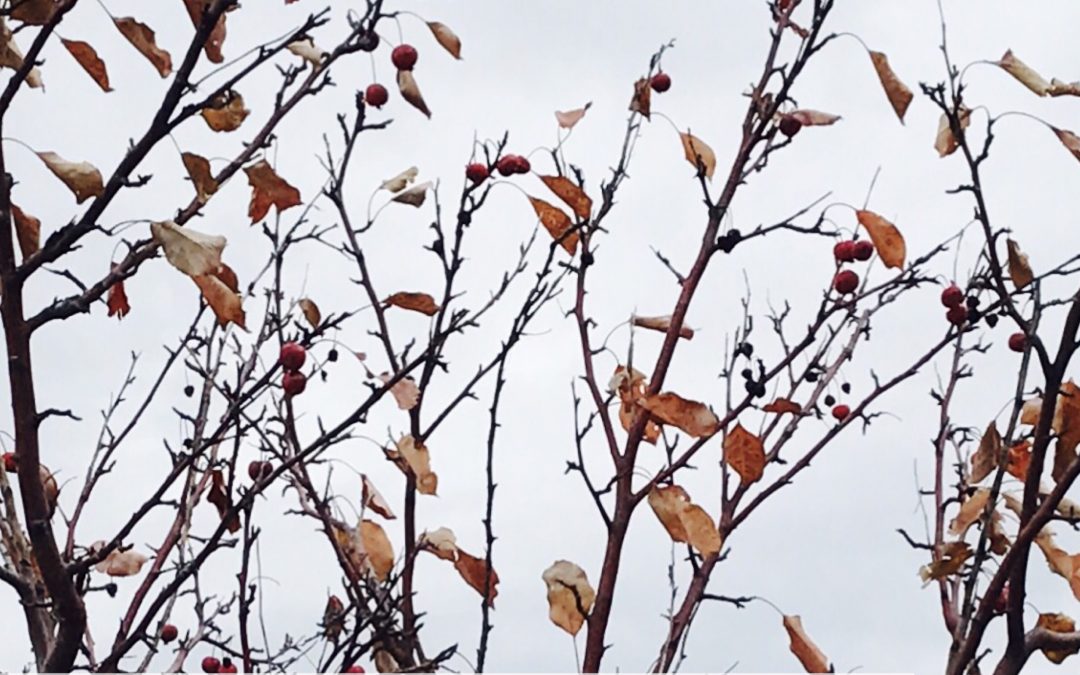
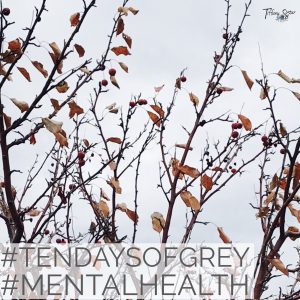
Image description – Autumn leaves and berries on nearly bare twigs against a grey sky. Text reads #TenDaysOfGrey #Mental Health. There is a small Tiffany Sostar logo in the top right.
Content warning for discussion of depression, anxiety, self-harm, suicidality.
Today is World Mental Health Day. This is my final post for Bryan McLean’s #TenDaysOfGrey mental health awareness project. You can read my interview with Bryan here. Rather than writing something new for today, I’m sharing a post I wrote four years ago that detailed my mental health journey up to that point. The reason I’m sharing it at the end of the Ten Days of Grey is because when I wrote this post I was in the grey. I am in the colour now, and I appreciate that.
I wrote the post shared here in 2013. Now I am 36, it’s four years later and many things have changed and many things have stayed the same. I am thankful for my 32 year old self writing this. I am thankful for my 28 year old self making it through, for all those younger selves who made it through. I have spent so many years in the grey.
At 36, I am not depressed. (I am often anxious, I am in the middle of a three-months-and-counting fibro flare, and I am experiencing regular existential dread over the state of the world, but miraculously, I am not depressed. Wow!)
It is sort of amazing to reflect on that, because there is a lot going on in my life that would is difficult, stressful, and overwhelming. I am thankful for the resilience I have developed, and I am also conscious of the truth that these sorts of things are not always “overcomeable” and these monsters will visit again. I’ll make them tea, cry with them, and continue surviving. I am thankful for that confidence.
I am also amazed at how strategies shift. When I wrote this original post, I had a few coping skills that I leaned on daily – my extensive lip balm collection is a testament to that. I used lip balm application as an alternative behaviour to self-harming, and it was life-saving for me. But these days, I have only even felt the urge to self-harm once or twice in the last couple years, and I only use lip balm when my lips are chapped. Self-care is such a responsive process – we are always responding, and the act of self-care is an act of presence and awareness. It becomes habitual, but it can never be only habitual. I love (and hate) that iterative, never-ending process. (I also really miss my Patchwork writers! If I ran another six-week poetry writing course, would you be interested? Let me know!)
Here is my 2013 post, edited to remove some ableism (we are always learning!) and to update links.
I’m sitting in Vendome, one of my favourite cafès in Calgary. I just sent out the writing prompt to my Patchwork writers, posted it on the Facebook page, shared it on my personal Facebook, tweeted it, posted it on the Writing in the Margins blog. Most of the time I respond to writing prompts privately, in a longhand journal. If I share the writing later (which I rarely do, outside of workshops where I read my just-written work with the group), I type it up and polish it a bit.
But the prompt today is to write about mental health.
And I am a mental health advocate. So I am typing this response directly into my “add new post” screen, and I am going to hit “publish” when I’m finished. And then I’ll post a link to it on Facebook and on all of my Twitter accounts, and here’s why –
At 13, I went through my first serious depression. I did not know what was happening to me. (If you suspect that you may be going through a depression or other mental health concern, here is a free screening tool. It’s not perfect, and symptoms are not so cut-and-dried for many people – it is a place to start, but not a final word.)
Suddenly everything was awful. There was a pain in my body/brain/heart/soul. I cried a lot. I self-harmed. I scratched my neck and shoulders and hips and belly until I was cross-hatched, red and scabbing. I smashed my head into walls, sometimes until I was dizzy. I didn’t know who to talk to. The only person who knew I was self-harming, the only person I confided in, was my 9 year old sister. It was terrible for both of us, a weight far too heavy for her small shoulders (or my own).
Writing about this time, I feel my chest tighten and my breath shorten, the muscles in my neck knot up – these are the first physical manifestations of anxiety in my body and I am aware enough now, at 32, to recognize them for what they are. I take a deep breath, roll my shoulders, take a sip of water, continue.
In high school, at around 16 or 17, I went through a second (or perhaps just a worsening of my ongoing) depression. This was complicated by the arrival of Sadisty – a very angry, very vicious voice in my head. I do not seem to have a split or multiple personality disorder – Sadisty was just (“just”) my mind’s way of externalizing the intense self-loathing that I was experiencing. Though I feel a deep shame about what feels, to me, like one of the lowest points in my mental health journey, I am also amazed and grateful for whatever it was in me that did choose to externalize rather than internalize those feelings. Sadisty wanted me to die, and I had many moments of suicidality, but I didn’t want me to die. I put all of that negativity into Sadisty, to get it out of my own head, to make those nasty comments come in a voice that wasn’t my own.
I am lucky to have survived high school, to have survived Sadisty and that second/ongoing depression.
(Breathe again, breathe again.)
At 18, I started volunteering at the Calgary Humane Society. I adopted a dog, my soul mate. Tasha. She had separation anxiety and dog-dog aggression. She was anxious, fearful, aggressive. Helping her helped me. Things got better. Sadisty was gone, and she has never come back.
I got married, I got divorced.
My mental health stayed at a consistently low-grade level of self-loathing. Low self-esteem. An at-that-time undiagnosed anxiety disorder. The impact of early trauma, unacknowledged anxiety and low self-esteem on my sex drive led me to believe I was “sexually dysfunctional” (a whole other thing, related but tangential to this post).
(Breathe, breathe. Roll shoulders, stretch wrists, refill water. In my body right now – tightness, tension. Shame, anxiety, fear.)
After my divorce, I went through a third severe depression. Again, I was self-harming. Again, I was suicidal.
I was 28.
I was ashamed.
I felt foolish – this was supposed to be done, part of the horror of adolescence. How could it follow me into adulthood? How could it threaten to destroy the new life I was trying to build for myself? How could I?! Shame, anxiety, self-loathing – there was a toxic mix of emotions and beliefs at play. Fortunately, I was seeing a counsellor and had her support, and the support of my anchor partner. I had started seeing a counsellor when I was trying to get past the sexual dysfunction, and continued seeing her through my divorce and into the depression that followed it. I still see her, and will continue to do so. I recognize now that my neurodivergence is not something I will ever “overcome” – it is part of who I am. It has taught me invaluable lessons, and has helped me become the advocate that I am. At 32, I recognize the value that this neurodivergence has brought to my life.
But at 28, I climbed halfway over my 28th floor balcony, intending to make strawberry jam on the pavement below.
After that, my counsellor helped me come up with an emergency plan.
I made the painful call to my sister, my mom, my dad.
I said, “I am currently depressed. Sometimes I feel suicidal. I am calling to ask if you would be willing to be part of my emergency plan. What that would mean is that if I call and tell you that I am feeling suicidal, you will be available to come and be with me, or take me to the hospital if necessary.”
I had to euthanize Tasha.
My mom was hit by a truck, she almost died.
I experienced post-traumatic stress disorder. The depression got worse. The self-harming escalated.
My best friend stopped taking my calls. Months later, she told me that it had just gotten to be too much – there was something wrong every time we spoke.
Depression, anxiety, other mental health concerns… they can be like bombs, decimating at the point of impact, shrapnel flying everywhere. Relationships can be fundamentally altered or destroyed. Partnerships suffer. The ripple effects of a mental health issue can make the isolation and loneliness, the shame and fear and pain so much worse. Among the conversations that we do not have regarding mental health, this conversation about self-care for caregivers, and balancing the various and sometimes conflicting needs for support is both absent and necessary. It is possible to remain friends with a depressed person, but because we do not ever have this conversation, many people don’t know how.
I came out of that depression.
I became an activist.
I developed an amazing, diverse, wide-ranging social circle.
I learned new coping skills. I breathe more intentionally now. I pay attention to tension in my body. I rarely allow an anxiety attack to escalate to the point where I feel the urge to self-harm. I use lip balm and apply it when I start to feel anxious – I pay attention to the feel, the smell, the taste. I take supplements and get exercise. I see my counsellor every other week, more frequently when things get bad.
I am 32 now.
I am currently depressed.
I wake up in the morning and I feel sad. I feel hopeless. I feel discouraged.
I haven’t reconciled with the addition of fibromyalgia to my life. I miss my dad. I miss my dogs. I am financially unstable, and frustrated by my ongoing mental health concerns. I am immobilized by anxiety on a regular basis.
But I have help. And I have a purpose. I believe that my weakness is one of my superpowers, that my willingness to speak openly about my struggles is part of my activism.
So I am depressed.
I am waiting for it to be over (for now).
I use all my new coping skills. I lean on my friends, as much as I can allow myself, and I breathe. I stretch. I take my supplements and drink my water and have epsom salt baths to help with the physical pain.
It is World Mental Health Day.
And this is my mental health story.

by Tiffany | Oct 8, 2017 | #challengethebinary, #tenderyear, Interviews
This is a Year of Sacred Attendance | #tenderyear post. You can read the first in this series here, and you can sign up for the Tender Year email list here.
In Staying with the Trouble (2016), Donna Haraway writes:
Trouble is an interesting word. It derives from a thirteenth-century French verb meaning “to stir up,” “to make cloudy,” “to disturb.” We – all of us on Terra – live in disturbing times, mixed-up times, troubling and turbid times. The task is to become capable, with each other in all of our bumptious kinds, of response. Mixed-up times are overflowing with both pain and joy – with vastly unjust patterns of pain and joy, with unnecessary killing of ongoingness but also with necessary resurgence. The task is to make kin in lines of inventive connection as a practice of learning to live and die well with each other in a thick present. Our task is to make trouble, to stir up potent response to devastating events, as well as to settle troubled waters and rebuild quiet places. In urgent times, many of us are tempted to address trouble in terms of making an imagined future safe, of stopping something from happening that looms in the future, of clearing away the present and the past in order to make futures for coming generations. Staying with the trouble not does require such a relationship to times called the future. In fact, staying with the trouble requires learning to be truly present, not as a vanishing pivot between awful or edenic pasts and apocalyptic or salvific futures, but as mortal critters entwined in myriad unfinished configurations of places, times, matters, meanings.
Haraway’s work has been formative for me – her 1984 essay, “Cyborg Manifesto,” (link is to the PDF) was paradigm-shifting for me, and led me to Elizabeth Whitney’s 2008 essay, “Cyborgs Among Us,” which revolutionized my relationship with my bisexuality and opened up whole new worlds of liminality for me. Liminality – the threshold state, the betweenness, the selves and potentials that exist in the overlap, the between-and-beyond, the both/and, the identities that prove the binary wrong, the state that offers hope for new ways forward. Liminality – my heart. Liminality is where I find my way home to myself, and to the world.
Haraway’s writing is dense, thick, complicated and challenging. In Staying with the Trouble she discusses the Anthropocene, Capitalocene, and the Chthulucene – and that tells you a lot about where the book comes from and how it goes. She discusses which stories tell stories and which thoughts think thoughts – which frames we use for generating new knowledge, which stories we use as roadmaps to new narratives. It’s rich work, and I can only read a page or two at a time. It speaks to me, but it speaks to me in ways that are not smooth or easy or comfortable. It is the perfect work to fit with the Sunday theme of the Tender Year.
It feels particularly fitting for this blog post because when I spoke with Stasha Huntingford about Venn Diagrams, her discussion of the rich and troubled/troubling/troublesome space between two binaries reminded me strongly of Haraway’s invitation to stay with the trouble. They are both troublemakers with deep insights.
The Year of Sacred Attendance, the Tender Year, started on a Sunday.
On Sundays, our prompt is to challenge a binary. To explore and expand a binary.
We use Venn Diagrams as a simple and accessible entry point into the prompt.
Venn Diagrams are great for this, because they invite both playful and silly engagement and more serious engagement. You can use this prompt to look for any area of overlap, and even that process of looking for overlap can be exciting and full of potential. You can engage with a Venn Diagram over the whole course of a day, diving deeper and deeper into what exists in either sphere, and what exists in the mingling between (as Nathan so beautifully), or you can approach it quickly, scurry up and scratch it down and then retreat to the rest of your day (like I did), or you can start with the diagram and expand it out into further self-awareness and even an affirmation about what you’re seeking for your life (like Stasha did). Each of these processes brought a different method to the prompt, and I think this will be true for everyone who participates. I am looking forward to that variety, and to the richness in the overlap. (Each of these Venn Diagrams are at the end of this post, to give you a sense of what’s possible and how the three of us have approached the topic so far.)
I think that the Tender Year, for me, will involve a lot of “staying with the trouble” and I appreciate the invitation and the encouragement to be troubled, and to find a way to be, as Haraway says, “truly present, not as a vanishing pivot… but as [a] mortal critter entwined in myriad unfinished configurations.” I have found myself lost in visions of the apocalyptic future lately, and have had trouble staying grounded in the present. This year is an invitation to attend my life as it happens (not as it will happen, or as it has happened), and to tend to the life I am living and the lives I intersect and overlap.
In this presence – this troubled and troubling, binary-challenging, playful and serious, liminal presence, there is so much potential for hope, for change, and for ways to intervene in the trouble.
“If the responsibility for the most vulnerable citizens has been passed to communities, we have a lot of work to do remembering what community means. The idea of community is important because in addition to creating shame, I feel that binary thinking has led us to a fragmented world where we are lonely and isolated from each other. My goal is to put the world back into a coherent whole where we concentrate on how things are interrelated, and brave negotiating the grey instead of falsely compartmentalizing into black/white. The peer model allows us all to be integrated, dynamic and interrelated in our identities rather than being defined by one aspect of ourselves. We should all order a nice veggie burger with bacon—which we can share with someone who is different from us!” – Stasha Huntingford
The Sunday prompt, Venn Diagrams, was Stasha’s idea and came from previous work she had done on binaries and the potential in the middle spaces. We sat down to talk about the process, and about her hopes for this year of Sunday #challengethebinary prompts.
Tiffany – To start with, I wanted to ask you about binaries and the breaking of them – the Sunday theme coalesced out of your discussion of both the “veggie burger with bacon” idea and the intersection of social workers and folks who access social work services. Can you tell me what it is about these two ideas that gets you excited, or that you want to explore in the Sunday “meditation on binaries” theme?
Stasha – Nothing makes me more excited than challenging binaries! Lots of dehumanizing oppression comes from the idea of ‘normal’ and ‘the other’.
This essay is where I explain the veggie burger with bacon concept further. It was written at a time when I was really lonely in the academy. I have used this idea to queer things that are presented as opposites.
Tiffany – How can Venn Diagrams help challenge these dehumanizing binaries?
Stasha – For example, being bisexual is one way that I have been exposed to a binary about being either gay or straight. This also reinforces a gender binary that presents two opposite options. So many people have done great work about challenging these binaries, and exploring what a spectrum view changes about two things that are framed as opposites
Tiffany – Totally. The radical binary-challenging potential within bisexuality is one reason I am so happy to be bisexual.
Stasha – Me too! And why I identify as queer instead of gay.
Binaries cause so much harm to people who exist in the middle of spectrums. I have many ways that I have experienced the tension of being a veggie burger with bacon, and I have been fortunate enough to have other people share some of their examples of the harms caused by binary thinking.
The idea of one way to do things or one truth, is part of the binary thinking, and crushes creativity.
Tiffany – I agree. But it’s also (at least for me) a very tempting way to view the world. If there is a “right” and a “wrong,” with no middle ground, then I can feel more confident about my choices – more confident that I won’t slide too far through that middle space and end up in wrongtown.
Stasha – I use venn diagrams to help me reflect deeply on the grey area between 2 binaries. This helps me to be more aware of my privileges and oppressions. It gives me points of intervention.
Tiffany – Oh, I love that! Can you talk more about points of intervention? How do you mean?
Stasha – I mostly use them to raise more questions
For example, if we explore a venn diagram between environmentalism and working for an oil company, this might help us to identify people who we know who may fit in the grey here and feel isolated from both the environmentalist and oil company employee communities.
Tiffany – Ah, yes. That makes sense. And, framing it like that, and thinking also of bisexuality, it occurs to me that the people in the grey area are often painted as “traitors” to both circles. That isolation is so real.
Stasha – Or if we explore the opposite of sacred in the dictionary, this can help us to understand the messages we may have received about what is sacred and how the opposite of this is defined.
Tiffany – Totally.
We have 52 weeks in this project, and although I am sure some binaries will warrant multiple Sundays of exploration, I am also looking forward to the invitation to look at a wide range. If someone wants to participate and isn’t sure where to start, what are some ideas that you’re excited about?
Stasha – I always say that veggie burgers with bacon are very powerful, and very lonely. In binary thinking, we are traitors because we expose that there are way waaaaaaaaay more than two options or ways to do things. What could be more dangerous and magic and lonely?
Tiffany – Yes. Absolutely.
Stasha – I’m excited to think about new binaries because I think that is difficult and magic. I am thinking about housed/homeless, the opposite of productive, the opposite of justice, rich/poor, the opposite of listening…
The opposite of connected, the opposite of fascism, the opposite of dyke
Tiffany – Those are great. Productivity is one that i want to explore, too. Also rest and whatever the opposite is, and forgiveness and all the circles that might overlap and complicate that.
Stasha – Oh my yes forgiveness, and the resulting diagrams could easily take us through to winter solstice!
Tiffany – Right?!
Stasha – Yes! If not the rest of our lives!
Tiffany – What else would you like someone to know about the Sunday theme?
Stasha – I think this is sacred work.
I think this because we are reclaiming a way of thinking that we used to have.
I cite Hans Christian Anderson’s story about the emperor who had no clothes, to explain the role of challenging binary.
Tiffany – Oooo, lovely! Can you explain how it applies here?
Stasha – We must have the strength to identify ways that we don’t belong in order to see what we are being told.
So it is scary to always be the one ruining social time by saying the emperor has no clothes.
Tiffany – I totally agree about how scary it is. I hope that this project is able to offer some of the social support that will help more of us find ways to speak our awkward truths.
Stasha – What we are being told about ourselves, and who we are. Patricia Collins explains the revolutionary act of black women defining themselves as a way that they resist oppression.
Tiffany – Yes. Narrative healing.
Stasha – Yes, I am so excited because it is something that I don’t want to do by myself. It hurts much less when we start from a space of acceptance. And we can return there when it hurts. And we know that we will connect at the full moon. And we know how many days we have to make it through to get there.
Yes huzzah for narrative healing!!! Sacred work.
I’m doing all my venn diagrams in public because I want people to have so many examples of intervention points.
Tiffany – I love that. The ability for the project to be public is one of my favourite things about it.
Stasha – You and Nathan taught me that/gave me the courage!
I did my 100 love letters privately and then shared them a year later on social media. I loved the exponential generative nature of the love that you two demonstrated.
I noticed that other people felt permission to write themselves love letters after seeing yours. And then they shared theirs, and their friends felt better able to send themselves a love letter.
Tiffany – It has been a pretty amazing collaboration, and I love the way it has invited more people in, and has rippled out into little growing communities of radical self-love. I hope that the same thing happens with the Tender Year.
It is the first day of the #tenderyear! We begin with a venn diagram, that compares ‘opposites’, and helps us reveal the grey in between. Welcome to Sundays, when we #challengethebinary!
For my first venn diagram, I wanted to explore what the opposite of sacred is. I started by looking up definitions, synonyms, and antonyms (words that we use to say the same or opposite things). I did this, keeping in mind that it is very important to inquire what is missing from the dictionary, for example colonialism and other kinds of racism are often reinforced through the appropriation of languages of resistance.
Under the sacred side of the two overlapping circles that I used in this venn diagram, I listed words that mean similar things: hallowed, pure, divine, solemn, guarded, immune, and secure.
Under the non-sacred side I found these words to describe the same concept: open, unprotected, vulnerable, profane, irreligious, ungodly, unholy, unsacred.
I then sat with my feelings with each of these words and concepts. One highlight of this meditation included reflections on my hatred of the concept of pure, since this is often used to oppress me, as a woman living in a patriarchy. I really love the word hallowed because it makes me think of my favorite holiday, the only one where the society that I am part of addresses the concept of death.
I was disappointed that the opposite of sacred is defined mostly as unsacred. I find this so interesting in terms of how we think about what is holy and what is not. I was surprised that sacred is linked with security; because in my life my most sacred moments have been the most perilous and chaotic. I think of sacredness as coming out of shit with your identity intact.
Next, I thought deeply about where the overlap is between sacred and unsacred, especially in how it applies to this project and our intent to practice sacred attention and tending. For me, vulnerability is sacred because you are reclaiming your true self. For me, the security in sacredness comes from being able to return home to yourself. Somberness and solemness are not required for my sacredness, as I think play is how we grow and interact in a genuine love. My sacredness is not guarded, it is found in the messy corners of tending your heart on your sleeve.
Finally, I created a definition of what I seek in terms of the sacred:
I seek the messy security of hallowed profane vulnerability.
Here we are. A beginning.
https://tiffanysostar.com/welcome-tenderyear/
Sunday’s #dailypractice is about challenging binaries. My brain says: this is easy for you NVF, given the nature of your being. But, in truth, I do have a lot of either/or thinking ruling my worldview.
Because today is a beginning, I wanted to focus on parts of life that are working, but not necessarily working together. Things I’ve come to learn how much I need, especially during 100loveletters. But things that feel like they cancel each other out sometimes, in a way that gets in the way of my heart.
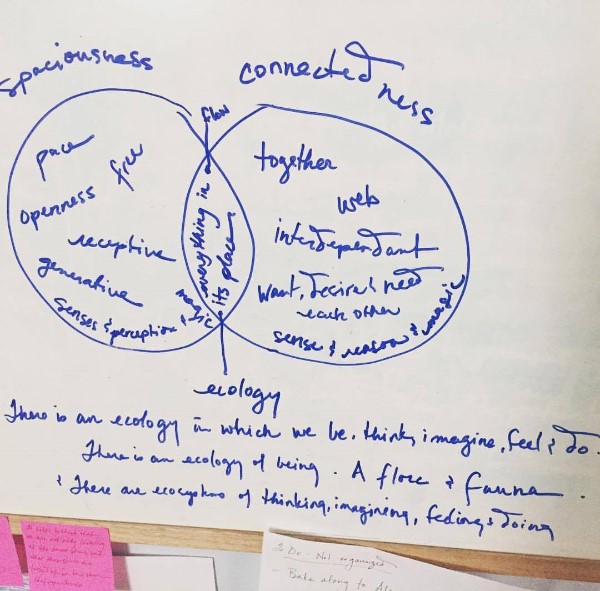
Spaciousness and Connectedness. I need them both in similar measure, but how to have them both at the same time?
I wordsed about each when this download arrived about a place for everyone/thing and everyone/thing in its place.
It got me thinking about ecology, about how we are connected in space and through it. Connected not crowded. Spaciousness not isolation. It got me to thinking about the collaboration that initiated this project. The collaborations that have initiated me and others.
I want to say there is a tender balance. But I think more accurately there is a robust dynamic, that can be disrupted. Keep an eye on the keystone populations. Keep an eye out for overgrowth. The algae bloom. The mineminemine of that.
Read the river. Bring curiosity to flow. There is a magic here to collect and study and work.
It’s good to be back.
A Year of Sacred Attendance
(link in bio)
1/365
#tenderyear
#challengethebinary
#tenderyearfortenderqueers #100loveletters
This is my first post in the
#tenderyear, and my first
#challengethebinary Sunday post. You can read more about the project here –
https://tiffanysostar.com/welcome-tenderyear/
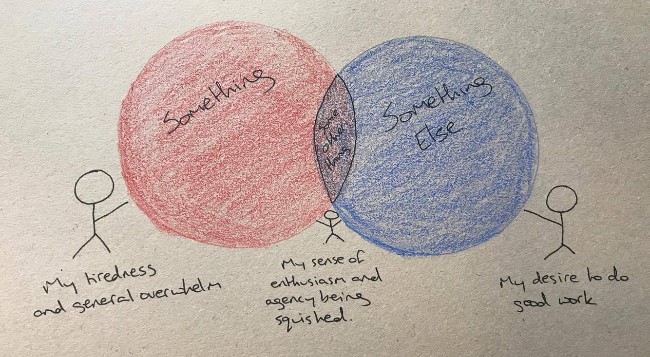
I have a long list of binaries I’d like to explore over this year of Sundays. As I tried to figure out which would be *just right* for this first post, I realized that the pressure I was putting on myself to get it right, to make the right first impression, to say something profound, to make some kind of meaningful art, to have a perfect first post – that pressure was squishing the joy out of the project for me.
I had a busy day, have had a busy weekend, have had a busy week, have had a busy summer. This Tender Year / Year of Attendance work feels so important to me, and I am so excited about it, but my own internalized ideas about what “good work” means is in conflict with my sense of tiredness and general overwhelm, and what happens in the middle is not the productive, profound, generative new space that Venn Diagrams can highlight. It is, instead, a squished, cramped, claustrophobic place.
I think that this is actually a perfect start to this project, because what I need from the Tender Year is not just more work. What I need is better work, more holistic work, more wholehearted work. I need tenderness. I need to attend to the tiredness. I need to find a way to feel less cramped and squished in the creation of project-focused work.
This is a perfect diagram for where I’m at today, and an indication of where I can focus my energy to change this pattern. Or, at least, an indication of the pattern. And identifying the pattern is a great first step.
Even if you’re identifying a pattern you’ve identified a dozen times before, it’s still a good step.
Image description: On the left, a stick figure labeled ‘My tiredness and general overwhelm’ pushes a red ball labeled ‘Something.’ On the right, a stick figure labeled “My desire to do good work’ pushes a blue ball labeled ‘Something Else.’ In the middle, a purple area of overlap is labeled ‘Some other thing’ and a small stick figure it caught between the balls and labeled ‘My sense of enthusiasm and agency being squished.’ There is a text box on the bottom left that says ‘#tenderyear’ and a small Tiffany Sostar logo on the bottom right.
#stickfiguresunday