
by Tiffany | May 15, 2018 | Feminism from the Margins, guest post, Health
Image description: A close up of bright greenery with an out of focus cityscape in the background. Photo credit: Mel Vee. Mel Vee is an aspiring photographer and her guest post series will feature her photography.
This is a guest post by Mel Vee.
Mel Vee mesmerizes, captivates and incites with her spoken word. She is a passionate advocate for the power of narrative to heal and liberate. A general disturber of shit, Mel Vee seeks to blur and disrupt all kinds of distinctions. She is a core member of the Uproot YYC, a grassroots collective for artists of colour dedicated to uprooting systemic barriers in the arts community. She was a member of Calgary’s 2017 slam team, who were semi-finalists at the Canadian Festival of Spoken Word and co-creator of The Unlearning Channel podcast.
This post is the second is a four-part series, one per week for the month of May. Together, this series will comprise the third entry in the Feminism from the Margins series.
Content note for racial violence, intimate partner violence, suicidality, graphic description of self-harm.
I learned from a young age that I was valued less than others. My brown skin, femaleness, queerness, working class family, speech impediment and quiet, thoughtful nature, mistaken for mental slowness, marked me for hardship and struggle. No one told me in those exact words, but no one needed to – that much was obvious.
My mother was the first person to impart this lesson and spell it out for me but she did so from a place of love. “NEVER EVER follow those white kids around; think they’re better than you! Don’t believe them, they are not better or worse than you. They are human, same as us. But they will think they are high and mighty because they’re white,” she warned us.
She was specifically referring to my cousin, who hung around the playground and in class desperately following white kids around for their coveted friendship. It is a painful memory to reflect on now. My cousin with her dark brown skin, boxer braids and almond eyes following around blonde and brown haired, blue and green-eyed girls with impossibly straight hair and pale white skin.
They were the epitome of beauty, goodness and wholesomeness and my cousin desperately wanted to be beautiful and good and whole like them. She followed them around like a shadow. They often shooed her away, cussed her, threw things at her and even made fun of her. One time she came home to her mother in tears after one of the white girls spat on her and called her darkie; tar baby. My mom was quiet, but her knowing eyes said, ‘See, this is what I warned you about.’
Looking back, I cannot blame my cousin for wanting to distance herself from her blackness. All I learned about Black people in school was that we were slaves. Our history began with slavery and ended with Martin Luther King Jr (bear in mind this was taught in a Canadian school – hello Black Loyalists!). The only Black person I remember seeing in an elementary school textbook was a hunched over Black woman, obviously enslaved or a sharecropper, with a filthy black and white handkerchief on her head, glaring into the camera from a cotton field. That was it. We had no history prior to enslavement; there was no mention of Africa prior to European colonialism, the horrors of the Transatlantic slave trade, current and global Black independence struggles and the connection to diasporic Blacks or even Black people during enslavement who resisted, taught, created art or invented.
Our history was reduced to this picture of a tough-looking, stooped over woman with a mean glare.
Although I didn’t realize it at the time, my mom was doing her best to shield us from a tide of white supremacy which would seek or simply by design devalue the lives of her children – which taught and continues to teach that we were nothing more than the descendants of enslaved people who contributed little to history; that we were less than Europeans and non-Black People of Colour. Our skins marked us as inferiors. Her efforts in hindsight were commendable, given the impossible nature of the task. I remember she blasted Peter Tosh’s African as her primary act of Black affirmation and pride regularly. Her favorite lyrics were:
Don’t care where you come from
As long as you’re a black man, you’re an African
No mind your nationality
You have got the identity of an African
She would belt out, “As long as you’re a Black man, you’re an African,” much to my chagrin. In spite of her efforts to instill in us a sense of pride in our Black heritage, her African diasporic consciousness was no match for the cruel reality of the white people around us, who viewed us as novelties at best or troublesome inferiors at worst; nor the pervasiveness of white supremacy in public and private institutions and in social life.
As a result, I had few friends during my formative years. I followed my mother’s stern warning but I couldn’t help but feel a pang of regret when I saw my cousins, who she chided years ago for following white kids around, now had the cool (read white) kids as friends. I realized though that my mother’s words rang true; nearly any Black kid I noticed hanging around with white kids in my junior high and high school would be following along behind them, like a shadow.
The Black kid in the social group always hung out precariously around the edges, as though they never truly belonged. Thankfully once I entered junior high school, we were no longer the only Black family in the neighborhood, but the dynamics remained unchanged. There was an implied subtext of the Black kids being other than or merely tolerated.
The Black kid in the group also always served a chillingly particular purpose – the comedian. If the Black kid was not providing amusement, they were swiftly ostracized as I was. As a nerdy, smart, quiet and thoughtful sort not accustomed to serving up guffaws, I had no purpose to the majority of the white kids around me (with the exception of my small, racially diverse band of merry misfits). Not only did I not entertain the white kids around me, I was also a threat to them academically and intellectually, as I was always at or near the top of my classes in those years.
A Black kid with a brain who refused to debase herself for the entertainment of whites? That was completely intolerable and I suffered the social price. Black kids were allowed to hang out with the white kids, so long as they knew their place.
In spite of myself, loneliness crept in when my merry band of misfits and I parted ways for high school. For the first time in my life, I felt utterly alone. Since I stubbornly refused to sacrifice my stellar grades for the cheap compensation of male attention (which I cared for little as a budding queer), I watched from the sidelines as the white girls who were former friends and acquaintances begin to reach those adolescent milestones and I remained stubbornly inexperienced. Although I sensed a budding attraction to women, I couldn’t shake the sting of being spurned by the mostly white boys around me. My brown skin, chemically relaxed hair (which was never silky straight like the other girls), thin frame and nearly non-existent breasts marked me painfully as the other. The few black boys and boys of other races worshiped the white girls – I was non-existent to them. I had not yet met any queer people or girls who liked girls. I was awkward, out of place and alone.
Unsurprisingly, my mental health deteriorated.
Accustomed as I had become to spending the afternoons alone in my bedroom after finishing my homework, on one particular day I sat down on the floor in silence and stared at my arms. I had already begun self-harming by then as a way to express the rage I felt towards myself and my circumstances but something inside of me snapped.
The last thing I recall thinking that day was how much I hated my brown skin.
It always got in the way; it made me different.
I did not remember how I got the razor but before I knew it, I had a huge slash on my left inner forearm. It was the deepest cut I had ever inflicted on myself. I did not recall wanting to cut that deeply, but in the fury of my self-loathing I simply had no control. I panicked. I had always heard we were the same colour underneath but now seeing the white flesh beneath the brown skin was too much. I became nauseous, and in my panic I did something uncharacteristic of myself – I got help. My mom freaked out when she saw; she didn’t know whether to cry or scold or pray. Instead, she called my aunt who was a nurse’s aide at the time. They both kept talking to each other while my aunt did her best to stitch me up. They both spoke as if I was not there:
“Why would she do something like this?”
“The poor dear…”
“Oh my God, oh my God, oh my God!”
My aunt, finally coming to her senses, said there was no way they were taking me to the hospital.
“They’ll take her away. There’s no way we are going to the hospital.” And that was that. My mother and aunt knew instinctively getting social services involved would be ruinous to the family. My mom and aunt didn’t bet their and my collective well-being on the charity of social services, a fate we had so far escaped.
Unfortunately for me, the lack of intervention (partly due to that understandable resistance) contributed to further decline. The situation grew more dire as I became involved in an abusive, tumultuous relationship with a white girl who exploited my mental health struggles for her personal gain. She was the first person to ever express any interest in me sexually and I was hooked.
Due to her erratic and abusive behaviour, I became estranged from my family for a few months and opted to live with her and a friend of mine where I deteriorated even further. I learned intimately the extent to which a white person would weaponize their race against mine to exploit and cause destruction. My partner continually called services on me, which led to a trip in the back of a police cruiser. Calling the police on a mentally ill Black person can lead to violence and death – I cannot stress this enough. It is an extremely hateful and vile thing to do. Yet when she was confronted about her despicable and nakedly abusive behaviour by various people, the white girl waterworks began and that was the end of the conversation.
Of course, she was well aware of my struggles with race and with mental health – it was why she singled me out of the crowd for her predatory behaviour. Yet it never ceased to astound me how a person who claimed to love me could also attack with such racist vitriol or stay silent when others did. But instead of being furious at her blatant racism, I began to loathe myself and my race more intensely. Not wanting to be victimized further, my desire to identify with the oppressor grew stronger in a mistaken bid to become the abuser instead of the abused.
When that relationship reached its terrifying conclusion, I was thrust into the world of mental health professionals. The mental health professionals I encountered were exclusively white. I never encountered a single mental health care professional of Colour. The mental health professionals I met with expressed puzzlement at my suffering. By appearances, I was raised in an intact family (I did not disclose the volatility of my home life and my father’s explosive rages and violent outbursts), had stellar grades, played sports, worked part time and volunteered regularly.
I never told a single health care professional the real reason I began self-harming – I hated myself. I hated my brown skin, African features and curly hair. I now cursed my dear mother, who so tenderly attempted to prepare me to live in this racist society, for not being white. I was so close to being white and she was the reason I wasn’t. She received specific vitriol for the then-perceived mortal sin of being Black. I internalized the rampant and unabashed racism of the people around me and it was quite literally killing me.
I planned to end this post on some highfalutin note about how considering the impact of race and systemic inequity on mental health is a moral imperative blah blah.
But I believe that would be too simple of an end. That much is obvious.
Instead, I want to stress the importance and deep implications of the fact that the mental health of racialized people in a white supremacist society is not only simply complicated and impacted by race, but rather that being racialized itself can be a cause of mental health trauma.
This is the controversial part.
I am not a psychologist nor do I claim any expertise in the area. However, my lived experience speaks for itself. How does a queer, young, working class Black woman talk to an aging heterosexual middle or upper class white man about her most vulnerable life struggles? How can you possibly be vulnerable with someone who may have no frame of reference for your life experiences or worse may become hostile at the suggestion that race could be a factor in mental illness?
Though I did find understanding mental health practitioners in time, I never discussed race with them. Yet it was and still is vital for my mental health to be able to talk about what was actually near and dear to my heart – the complex stresses of my life being devalued based on who I am and navigating through the compounded effect of trauma on marginalization.
This is the key message that is missing desperately from the mental health conversation. Most people do not know that I have struggled with my mental health for a reason. The mental health profession as a whole is not equipped to deal with race in a way that is clinically significant to racialized people. I believe this is why I am becoming more candid about my mental health struggles – I want people to understand how psychologically scarring racism can be and how redressing justice can be powerful for improving one’s mental health.
I want to end with a thank you to my mother for her ceaseless efforts to affirm our Black heritage and instill racial pride.
This post is part of the third in the year-long Feminism from the Margins series that Dulcinea Lapis and Tiffany Sostar will be curating, in challenge to and dissatisfaction with International Women’s Day. To quote Dulcinea, “Fuck this grim caterwauling celebration of mediocre white femininity.” Every month, on the 8th, we’ll post something. If you are trans, Black or Indigenous, a person of colour, disabled, fat, poor, a sex worker, or any of the other host of identities excluded from International Women’s Day, and you would like to contribute to this project, get in touch!
Also check out the other posts in the series:
Further reading on racial trauma, and mental health among Black, Indigenous, and People of Colour
by Tiffany | May 8, 2018 | Feminism from the Margins, guest post, Health, Writing
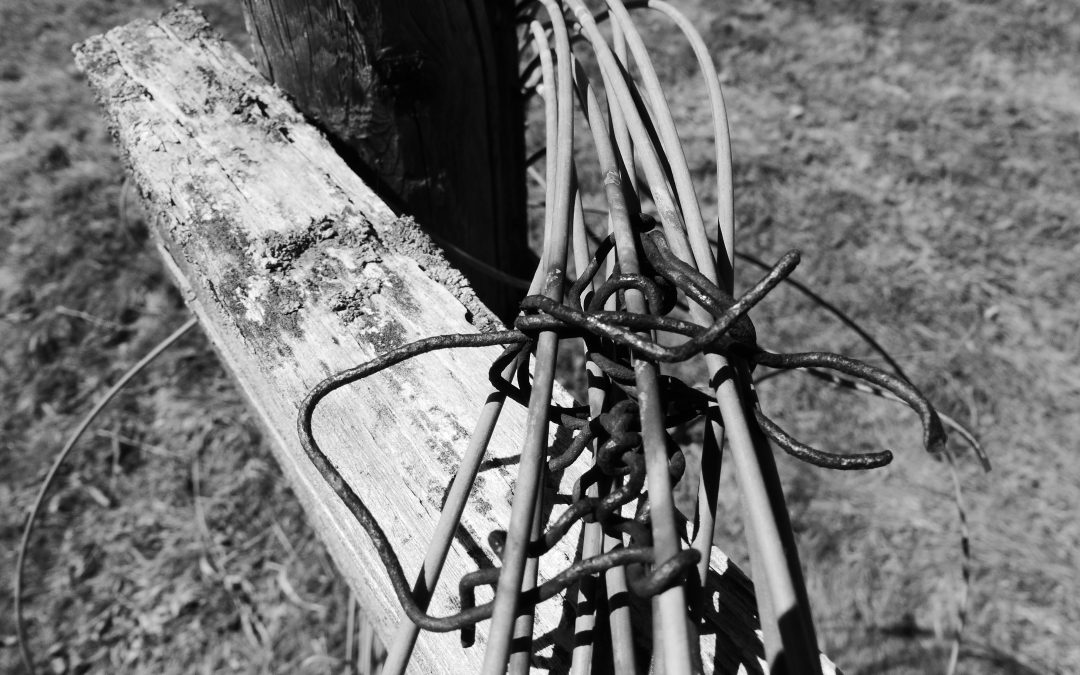
Image description: A black and white close-up of wood, twigs, and metal twine, with dry grass in the background. Photo credit: Mel Vee. Mel Vee is an aspiring photographer and her guest post series will feature her photography.
This is a guest post by Mel Vee.
Mel Vee mesmerizes, captivates and incites with her spoken word. She is a passionate advocate for the power of narrative to heal and liberate. A general disturber of shit, Mel Vee seeks to blur and disrupt all kinds of distinctions. She is a core member of the Uproot YYC, a grassroots collective for artists of colour dedicated to uprooting systemic barriers in the arts community. She was a member of Calgary’s 2017 slam team, who were semi-finalists at the Canadian Festival of Spoken Word and co-creator of The Unlearning Channel podcast.
This post is the first is a four-part series, one per week for the month of May. Together, this series will comprise the third entry in the Feminism from the Margins series.
Content note for suicidality, illness, and threatened violence.
Wake up early for a change. Stop being such a lazy fuck.
Go to morning meditation – it is important for you to be there.
Make your partner breakfast and lunch.
Try to make breakfast for yourself but you’re distracted. Will get back to it later.
Your friend is suicidal and she needs help – she doesn’t have much support.
Brush teeth.
Put on clothes.
Another friend lost her job – she might be homeless soon. You have to help somehow.
Put on shoes. Walk out door.
Another ambulance is at the house across the way. Last week there was a man covered in blood wielding a knife. Need to look for a new apartment. Another item on the to do list.
Your friend could stay with you if she needs to. You don’t just leave friends like that.
Walk back from meditation. The community is struggling and needs money. You decide you should probably volunteer more.
Do dishes.
Plan for the next meal. You have no energy to cook but cannot afford to eat out.
You remember the days where there wasn’t enough food in the house and you ate peanut butter for dinner; sardines if you were lucky. Curse yourself for being so damn ungrateful – at least you have food to cook! Hear your father’s voice remind you of how ungrateful you are.
Feel shame.
Think of resources for your suicidal friend.
Know mental health resources for LGBTQ folks are often a joke – but you try anyway.
Realize you should exercise – it’s important for your health. Promptly delay exercising by answering emails. They never stop coming; someone is always itching to hit send.
It’s the same old – “We need you to volunteer. This is an important cause. We can’t afford to pay you but we appreciate your time. You can build up your profile. It’s only temporary.”
Your aunt is sick again. Her no-good kids keep hitting her up for money. She needs someone to talk to even though you could use a quiet moment but you love her and it’s the least you can do.
The timer you set to write for 10 minutes has 8 seconds left. Guess you won’t be writing today.
Deadlines are piling up. All the shit you said yes to is finally catching up. You vow not to say yes to anything else EVER AGAIN and yet you say yes to even more.
You still need to exercise.
Go to work. Radiate warmth and kindness to people with a pathological sense of entitlement.
Be expected to have read every book written in the span of human civilization. Get cussed out for daring to manage others expectations and refusing to tolerate abuse. The customer is always right. Fight back tears in the washroom. Remember this job is all you have and your mother told you never to rely on anyone for money, especially a man. Smile even bigger at the next customer.
Yet another friend is about to be out on the street. You want to help but you just cannot. Feel helpless. Useless.
Go to your second job.
Meet one friend for coffee after.
Go to that show tonight. You need to show your face or else people will think you don’t take this seriously and that you’re not paying your dues.
Your partner is tired from their job so they cannot really help with chores. You try not to get upset because they are not trying to make your life difficult on purpose. But still…
More emails and texts.
A friend you rarely see becomes upset and demands to know why you don’t have time for them.
You cannot think of a good reason to say no and they are not that bad. It will only be an hour.
Schedule her on the only day you had free.
Another friend is having a breakdown. They simply want to talk.
Your partner is in the mood even though you barely have the energy to keep your eyes open but you can’t remember the last time you two had sex. Feel ashamed.
The laundry is piling up. The floor needs to be vacuumed. That’s for another day.
Try to go to sleep. Spend at least an hour wondering how your life got like this. Wondering where you went wrong, if you went wrong, if you should be more selfish. What should you cut?
Realize you’ve already cut everything extraneous from your life.
*Sigh*
Realize you don’t even have time to appreciate the irony in this.
Know you will do it all over again the next day. And the day after next. And the day after that.
Know you will keep doing this and know you can’t stop. Know that you want to stop but also know you never will.
This post is the third in the year-long Feminism from the Margins series that Dulcinea Lapis and Tiffany Sostar will be curating, in challenge to and dissatisfaction with International Women’s Day. To quote Dulcinea, “Fuck this grim caterwauling celebration of mediocre white femininity.” Every month, on the 8th, we’ll post something. If you are trans, Black or Indigenous, a person of colour, disabled, fat, poor, a sex worker, or any of the other host of identities excluded from International Women’s Day, and you would like to contribute to this project, get in touch!
Also check out the other posts in the series:
by Tiffany | Apr 21, 2018 | Business, Coaching, Narrative therapy practices, Writing
(This is an expansion of a post that was shared with my Patreon patrons last month.)
I am learning how to do narrative therapy, how to be a narrative therapist, how to engage with my clients in ways that are narratively-informed. But what does that mean? What is narrative therapy? What does a narrative therapist do? What benefit does narrative therapy offer?
One of my favourite things about narrative therapy, and the piece that comes most easily to me, is the creation of documents to extend conversations from one individual or group out into a wider community – collecting, formatting, and sharing the insider knowledges that marginalized communities have developed and are using to resist injustice. I create courses, interview communities and generate resources and posts, host workshops, and I love when this facilitation work can be extended into a shareable resource or document.
Since documentation is my jam, I am going to create a series of blog posts that explore and share some of my favourite pieces of narrative practice. If you’re interested in these practices, and you’d like to set up a narrative session, or ask me further questions, comment or send me an email! My goal with this series of posts is to invite you into the process, offer you some tools that you can try out on your own, and maybe even entice you to get in touch and work with me.
In this first post in the series, I’m going to talk a bit about collective documentation and share an experience from the Advanced Narrative Skills teaching block that I attended recently.
(This story is shared with the permission of my collaborators, Julia and Tarn.)
Part of narrative practice is the creation of collective documents. These are documents that are meant to honour shared experience without erasing difference, and they are often used to make visible the skills, stories, and knowledges that people use to get through difficulties or resist injustices.
At the teaching block, we spent some time in groups of three, practicing this work. We each took turns being the interviewer, the interviewee, and the witness. The job of the interviewer was to listen to carefully, notice the phrases that were repeated or the themes that were emerging, and ask questions to elicit rich descriptions and preferred outcomes. (This idea of preferred outcomes or stories is one that I’ll come back to in a later post.) The job of interviewee was to respond to the questions. And the job of the witness was to take notes, which is often referred to as “rescuing the said from the saying of it” (this is a phrase of Michael White’s, explored in some depth in this article by David Newman).
This “rescuing” (which can be a problematic word to use, especially for white therapists working with people of colour, because there is a long and violent history of “rescue” being something done to marginalized folks, done by privileged folks) is used in many therapeutic documents, not just collective documents. (In a later post, I’ll write about some other types of therapeutic documents, and how I use them.)
Tarn, Julia, and I each asked, answered, and “rescued” on the following prompts (from the “Generating material for collective documents: What gets us though hard times” hand-out in the University of Melbourne and Dulwich Centre Master of Narrative Therapy and Community Work):
- Describe something that gets you through hard times
- Share a story of a time when this special value, belief, skill, or knowledge has made a difference to you or others
- Speak to the history of this skill, value, or belief. How long have you done this? Who did you learn it from/with? Who has recognized this /acknowledged this? Who would be least surprised to know about this?
- Is this linked to particular groups, family, communities, or cultural history of which you are a part? Is this linked to collective traditions and/or cultural traditions?
Then we each had an opportunity to hear what the “rescuer” had recorded while they listened to us being interviewed, and to correct or change or add to the story that we heard back. This is a critical part of narrative therapy, and part of my practice – you are the expert in your own experience, and you have control over the story that you tell and that is told about you within the therapeutic setting. Your words, your meanings, your stories – those are yours.
One thing that I appreciate about narrative therapy is that there is an accountability back to the people we are working with, to ensure that their stories, words, and experiences are taken up and interpreted in ways that feeling honouring, respectful, and accurate. This is part of how we resist pathologizing or further oppressing the people that come to us for help in navigating their stories.
Once we’d had a chance to try out each of the three roles, we collaborated on creating a document. We went for a long walk together through the park near the Dulwich Centre, and talked about where we noticed echoes and resonances between our stories. Once we found the thread that we wanted to use to tie the stories together – in our case, it was an experience of flow between togetherness and aloneness – we wrote the document through a series of drafts, shared back and forth and added to by each of us.
This is the document we created:
Together and Alone: How We Get Through Some Hard Times
A window into some Hard Times.
In Calgary, Tiffany is making a strong Earl Grey, adding double-fold vanilla extract and vanilla sugar, frothing hot milk, and assembling it all in a blue-and-purple octopus mug. The skill of the London Fog.
In Kathmandu, Julia is making a cup of coffee and writing three pages in the quiet of the house before bringing her practice into group sessions, where she will rescue words, shape them into poetry and stories, and share them back. The skill of writing.
In the Blue Mountains where she grew up, Tarn is sitting on a rock, the river far below, gum trees and black and white cockatoos all around, and across the river the white stripes of gum in the deep green of the trees. The skill of going into places of space and nature.
These are very different skills.
They have very different histories.
Tarn grew up on 50 acres of bush land, and the birthmark on her forehead is the same shape as Tazmania, where her parents have hiked every year, for 45 years. Now she lives in the redness and dryness of central Australia, near Honeymoon Gap, surrounded by all that resilient life, trees that have adapted and grown prickly and dry. She’s loved the land since she was tiny, and has made choices to live where she can get out into that vastness. But even in the city, she finds the flowers on the ground and the mice scurrying through the bushes. This is a skill with deep roots.
Julia learned to love writing stories at the same time she learned to write. Her stories were a survival strategy during a difficult time, and she loved books and reading. She lost touch with her love of writing after a betrayal of trust by a teacher, and now that she has it back, she is learning how to use it for herself and for others. This is a skill that has been reclaimed.
Tiffany learned to make London Fogs when they were housebound with pain, when the kitchen was as far as they could get in a day. Now they can move again, walk again, get out to cafes again, but the London Fogs have stayed, and have become a cherished ritual shared with others. This is a newer skill.
Despite all this diversity in history and expression, there is resonance.
There is a flow here, between togetherness and aloneness and everything in between.
How we engage with the flow is unique to each of us – Tarn connecting to generations of people who have lived on and loved the land through time spent alone – togetherness in the alone time; Julia, who grew up with books as friends and teachers, writing alone before writing with others; Tiffany engaging a skill learned in the isolation of illness and now shared with friends who are struggling.
But, despite the fact that we each enter the flow in our own ways and with our own histories, we each bring both solitude and multitude into these skills that get us through hard times.
We wonder how others engage with aloneness and togetherness, and how people find other flows that include other ways of getting through hard times. We especially wonder where these diverse flows lead.
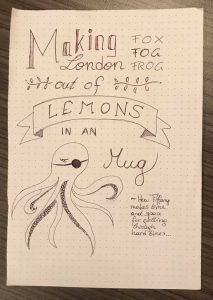
The next day, Julia shared this drawing with me, which I am planning to frame and hang in the office where I meet with clients.
Image description: A piece of art made for my by my classmate. Text reads ‘Making London Fox/Fog/Frog out of Lemons in an Mug ~ How Tiffany makes time and space for getting through hard times.’
The fox/fog/frog piece is an inside joke based on some pronunciation chaos, and the art itself has become another part of the collective document, and a gift that tethers me back to the idea of community, connection, and collaborative learning.
So, how does this have the potential to help my clients?
The idea that the skills, values, beliefs, or knowledges that get us through hard times have their own histories, their own roots into our communities, and their own rich stories is one that can be incredibly helpful when we are struggling. Often, we breeze past the skills, beliefs, values, and knowledges that get us through our days – small things, like a mug of tea, or larger things, like the ability to plan a trip or create art.
Narrative therapy offers practices to help us recognize, honour, and document these skills, beliefs, values, and knowledges.
This can be useful for groups, such as partners or family groups going through a hard time. It can also be useful for individuals. And the process of documentation can help translate those skills, beliefs, values, and knowledges into something tangible and material, that can be reviewed when needed, or shared.
If you’re going through a hard time, maybe this practice will help! You can answer the questions for yourself, or with someone in your family, friend group, or community. You can also create the document yourself. And if you’d like help with it, I would love to work together.
by Tiffany | Apr 9, 2018 | Coaching, Online courses, preview/review, Self-Care Salon, Workshops
Good morning, friends and supporters and new acquaintances!
This is our monthly review/preview post. These posts are one way that I keep myself accountable to my patrons (and my own goals), and they also offer people who might want to participate in my ongoing collective projects an opportunity to see what’s going on.
March was a busy and rewarding month – I spent three weeks in Australia, attending the Advanced Narrative Practices teaching block for my Master of Narrative Therapy and Community Work. It was an incredible experience. I really felt like I was at home with my colleagues – I felt like I fit in, and that what I had to contribute was welcome in the space. There are a bunch of collaborations simmering, and I feel like the choice to do this Masters program, even with the cost and stress, was the right one.
Now, the projects! I’m going to try a new format for this post, with the goal of prioritizing my collaborative projects and welcoming new contributors.
So, first, open calls for contributors and participants! These are the projects that are currently in process and open to participation. If you want to get involved, get in touch with me! You can email me, find me on Facebook, or be involved by supporting the Patreon. I do most of this work without any funding or financial gain, and my patrons make that possible.
Extroversion and Mental Health – This project has been percolating for a while, and the initial interviews have been really exciting. My goal for this project is a multi-media resource with validation and support for people who experience themselves as extroverts and struggle with doing self-care and managing challenges like depression, anxiety, or suicidality. The reason this project feels important is because so much mental health content seems to assume introversion, and so many cultural norms equate extroversion with resilience and strength. The multi-media piece is because the extroverts I’ve spoken with so far have consistently commented on video and audio being easier to engage with than pure text, so I’m branching out my resource generation skills and I’m going to learn how to do video! And audio! It’s going to be exciting. Do you want to get involved? I am interested in talking with folks who identify themselves as extroverted (sometimes or all the time), and particularly folks whose extroversion intersects with marginalized identities or neurodivergences – autistic extroverts, fat extroverts, depressed and anxious extroverts, BIPOC extroverts, and all those other folks whose bodies and selves are excluded, dismissed, or expected to be quiet. (This project will overlap with the Quiet Crew collaboration, which you can read about further on!) You can participate online via a skype or text interview, in person in either one-on-one or (if there’s interest) group interviews/conversations, remotely by sending me your thoughts on the topic freeform, or by answering a questionnaire (which isn’t designed yet, so if that’s your pick, just let me know and I’ll get that put together!) I will also be looking for folks who want to do audio or video interviews or segments.
Financial Self-Care Under Capitalism – This project is well underway now, and I’m in the process of arranging interviews, collecting questionnaire responses, and figuring out what this project might look like in its final form. What I am picturing right now is a multi-part project – a downloadable PDF resource (my specialty!) and an ongoing Tumblr project, Nopenomics, that you can read about further on. If you want to participate in this project, we can chat online or in-person, you can send me your thoughts freeform, or you can answer a questionnaire (which has been created, so it can be in your inbox today!). I am particularly interested in hearing from people who are struggling financially, and I am not going to be creating a “stop eating avocado toast” resource – this is meant to be an exploration of how we survive under the abuses of capitalism, and how we resist the harmful individualizing narratives around money that often ignore the structural issues and injustices that so many of us our dealing with. Issues of intergenerational poverty and financial disadvantage, which are so real for Black and Indigenous folks, and also issues of chronic underemployment and housing insecurity, which are so prevalent for many trans and queer folks, will all be acknowledged. This resource is meant to be an honouring of the ways in which we on the margins weave our thin threads into safety nets to keep ourselves and each other alive, and the ways in which we use our money in ways that may not make sense within neoliberal middle-class economics, but do help us keep our heads above water enough to get a gasp of air.
Self-Care for Queer Geeks – This is the resource that accompanies the March Possibilities event. Since I wasn’t at that event, and it was a small event (it was actually only Scott!), I’m collecting interviews and insight from a wider audience. If you identify as queer, and as a geek, I want to talk with you! I’m interested in how we navigate geek spaces – fandoms, video games, groups, etc. – and in how we find and support and create and engage with queer-inclusive content. How do we take care of ourselves, how do we take care of each other, and how do we subvert the heteronormative, trans antagonistic, and misogynist toxicity of many geek spaces. (I have also reached out to Avery Alder to ask if she’d be willing to do an interview for this resource, but she is a busy person so I don’t know if it will work out! If there are other creators you think I should reach out to, or that you can connect me with, let me know!) Opportunities to contribute are pretty standard – in person, online, freeform, or answering a questionnaire (which is in process now and will be ready to send out by Monday).
Feminism from the Margins – This is the project launched last month with my amazing friend Dulcinea Lapis. We’re looking for contributors who want to speak back to the cis white feminism that was so glaringly on display in many International Women’s Day events. This is a year-long project, and we’ll be posting each month, on the 8th, as a way to extend the IWD conversation both in scope (including more marginalized voices, such as trans women, women of colour, non-binary folks, sex workers, and others) and in duration (lasting a whole year rather than contained to one day). I put up the April contribution on the 8th – it’s an open letter to marginalized feminists by Michelle Dang, and it is fantastic. We are still looking for contributors, so if you’re interested, get in touch!
Getting Through the Bad Gender Feels – This is another project that is just starting to gain some momentum. I am interested in speaking with anyone who is trans, non-binary, two-spirit, or otherwise not cisgender (though I do also wonder about including some of the bad gender feels that can happen even to cis folks – am on the fence, and open to your thoughts). If you’d like to contribute or participate in this project, let me know! I’m still working on what format it will take, but I’m starting to collect ideas, interviews, and information.
And then, upcoming events! Here’s where you can find me, online and in-person.
April 8. Sunday morning is the Self-Care Salon! This month we’re talking about self-care for professionals on the margins, and my guest presenter will be Jonathan Griffith, a queer lawyer specializing in family law. We’ll be meeting at Loft 112, from 10:30-12:30, and this will be a special brunch event. (Keep an eye open for the May salon on May 6, it will be part-two in the 3-part series I’m presenting with Pedrom Nasiri, and next month we’ll be talking about polyamory for marginalized folks.)
April 17. Our monthly Possibilities meeting. This month, we’ll be talking about Self-Care and The Closet. We’ll be talking about dominant narratives about the closet, and all the ways in which the closet is complex – it can be oppressive but it can also be freeing, and there are many ways to approach the idea of closets and coming out. At the narrative therapy teaching block, I had the honour of meeting and learning from Sekneh Hammoud-Beckett, whose paper “Azima ila Hayati – an invitation in to my life : narrative conversations about sexual identity” introduces the idea of “inviting in” rather than “coming out,” which can be more culturally resonant for the Muslim youth that she works with. If anyone wants to read this paper ahead of the event, let me know! And as always, I’ll be generating a resource following this conversation and you are welcome to participate in that conversation whether you attend the event or not.
April 23. Trust and Attachment is the latest online course offering, and I am SUPER EXCITED about this course! You can read all about it at the link, but the deets are these: starts April 23, runs for 6 weeks, costs $150 (with sliding scale available and a discount for Patreon supporters). This course grew out of the Bridges and Boundaries course that ran earlier this year, but you do not need to have taken that course to take this one. Register by letting me know that you’re interested!
And now, here are the collaborations and projects that are either theoretical, in the planning stages right now, or coming up in the next month. Many of these ideas were hatched at the teaching block!
I’ll have three assignments due in the Masters program in April – two reflections on readings, and one project outline for my year-long practice innovation project. I have no idea what that project is going to be, but I have many ideas about what it might be. As always, I’ll post my papers for patrons to read.
I’m organizing a sustainability for narrative practitioners group on Slack.
I am coordinating a Dictionary of Delicious Failures collective document. This will involve a bunch of folks (and I’ll be organizing an event in Calgary in May, so keep your peepers peeled for that). Julia, one of my classmates, will be coordinating a similar event in Nepal, and Trina, another narrative practioner, will be coordinating an event in Denmark. Other folks might also join us, but those are the three that are planned.
The Quiet Crew is a group working on bringing together stories of quiet resistance and activism, and challenging the perception of quietness with social anxiety. I met up with one of their members while I was in Adelaide, and we are excited about potential collaborations (particularly when it comes to this project and the extroversion project being two sides of a similar coin – assumptions made about identity based on behaviour).
The Nopenomics Tumblr. This doesn’t exist yet, but it will. A Tumblr open to submissions about all the ways in which we resist, challenge, subvert, fail, and struggle under capitalism. I’m hoping to have a Tumblr + a quarterly zine!
Another classmate would like me to send her 20-ish words that are particularly relevant to the LGBTQIA2S+ communities and she’s going to work with her communities in Mumbai to translate them into three Indian languages. This is part of a project exploring culturally specific experiences of queerness, and it grew out of a conversation she and I had after I collaborated with four of my classmates (all amazing people) to host a presentation and conversation on Judith Butler and gender. You can see the influence of these conversations in the upcoming Possibilities event, and I’m excited to expand my practice to include more awareness of these culturally-specific experiences.
Julia, a classmate and new friend, and I are going to keep in touch regarding mistakes and harm in narrative practice, since we’re both interested in learning how to avoid them (and we’ve both experienced fucking up, haha). Julia, for the record, is just lovely. I am so glad to have met her. She’s also the person who drew the picture of my London Fog octopus, which I shared with patrons in March!
Rosie, another classmate and new friend, and I are … I don’t even know, there are at least ten different potential collaborations. We’re going to keep in touch. They’re going to contribute to the Bad Gender Feels project, for sure, and we’re also considering some kind of trans-continental gender project, bringing their group into conversation with Possibilities and the queer community in Calgary. (Get it? TRANS-continental? Oh my god, I’m hilarious.)
Cheryl White is working on a project about finances, and we’re going to talk about whether her project and my financial self-care under capitalism project might have some collaborative potential. (Cheryl White is one of the core thinkers within narrative therapy, and is the director of the Dulwich Centre and just all around an incredible badass. I really hope this collaboration happens!
Gipsy (the daughter one of the faculty) and I are going to talk about a potential collaboration between the crip crew in Calgary and her Invisible Disability Warriors here in Adelaide. This was a result of me mentioning that I have a few clients dealing with chronic pain or long-term illness, and wanting to find a way to support them better, and Rosie getting super excited and connecting me with Gipsy. We’ve been in touch, and the first stage of this collaboration will be her sending me the video and booklet that her group of ME/CFS and Fibromyalgia folks have created, and then myself and some other folks in Calgary will create an “outsider witness response” document. This is a narrative practice that I learned in Adelaide at the teaching block, and I’m excited to try it out. The second stage of this collaboration might be the Calgary group creating our own booklet and video, and sending it back to Gipsy and her community.
Two of my classmates have trans clients that they’d like help supporting, so both of them will be getting some extra support from me on that – mostly I’m going to send them articles and books to read, but they also wondered if I’d be willing to chat with clients and I said yes. (So, my patrons are supporting me in helping create trans-inclusive therapy settings around the world! I would really love to get involved in more of this kind of work, so I’m hoping that these first two efforts go well.)
And last, but absolutely not least, I’m applying for a Student Engagement Grant from the University of Melbourne, and the project that I’m applying with is the Well, This Sucks project with my sister! (I bet you were wondering where that project would show up in this post. Or maybe you weren’t. But I saved it for last because I am so excited about this!!!!!) The grant application is due April 15, and I’ll be posting my drafts for patrons. 😀
Curious about that project? Check it out:
From the email I sent to David Denborough, when first floating the idea of applying for the grant –
Well, This Sucks. This is a project that I’m collaborating with my sister, Domini, to coordinate. It’s meant to be, in its final form, a collection of “pods” of information for various demographic groups with information on responding to sexual trauma. It was born out of our experience of responding to an assault, and then over the year that followed, tripping over all these gaps in available information and represented voices. We saw a lack of resources for the men who are partnered with people who have been through a sexual trauma, particularly straight cisgender men who are often excluded from most conversations about how to do the emotional work of support. We also saw a lack of resources for more conservative parents who don’t know how to respond or what to say, and end up either saying nothing or falling back on victim blaming narratives. And a lack of resources for supporters who are survivors themselves, navigating the complexity of that. (And that was just in our very immediate circle.)
Then we started looking a bit outside our circle, once we were through the very immediate experience, and realizing how many other voices are missing from so many conversations about this.
What we’re picturing is a web portal that guides people through a series of questions and lands them in a pod of information and resources that is generated collectively by people who share some of their identities or experiences (so, video content and stories from straight cisgender men to welcome other straight cisgender men into a supportive role, and stories and video from men who have experienced assault to create space for other men who are going through the same thing, each in their own pod of information, and so on). The reason we decided on pods was because Domini and I have very different communities – Domini is doing her feminism within more rural conservative communities where issues of queerness, gender, and justice require different language (much more “inviting in” than “coming out” in those spaces!), and I do mine within urban, political queer, trans, and feminist communities that have very different languages and cultural norms. We decided not to try and meet in an uncomfortable middle, but rather honour the diversity of these two very different spaces, and create content that shares a goal of supporting communities following an assault, but doesn’t demand that everyone use the same language or approach the issue in the same way. This was especially important because often the language and norms from my communities is framed as being “better” or “more progressive” than the language and norms from Domini’s communities, but in lived experience this is not always the case. Social justice groups may have all the “right” language, but sometimes they are deeply lacking in compassionate support. Our worry was that if we tried to use language that would feel inclusive of my communities, it would end up feeling alienating for Domini’s communities, and we would lose all the rich insight and experience of folks who can’t speak the Social Justice Warrior dialect and are more “rough around the edges”. (And we also just wouldn’t be able to help them.) So, multiple languages!
Anyway, what I thought for the grant was maybe creating one of the pods! I know that Domini would be keen on the one for straight cis men who are supporters, and that might have some interesting overlap with the masculinities project, too. (I’m partway through reading Michelle Dang’s paper on community responses to sexual assault and she and I will be talking about this project, too!)
I am most excited about this project because my sister is amazing, we’ve been in the planning process for almost a year now, and I think that when this project gets going it is going to be really great. But I’m also somewhat hesitant about it, because it’s huge and it will require a lot of skill, intentionality, and strong supportive partnerships willing to keep us on track and call us in when we fuck up. It’s like… 73% excitement, 21% apprehension, 6% terror.
Reading this again, I realize that I use a lot of exclamation points. Ha.
DD wrote back and said that he thought this project would be a good fit, so we’re going ahead with the application, and we’ll be generating the content for the pod focused on cis straight men who are supporters/partners of assault survivors. So there will be a call for contributors going out once this is underway!
And that’s that! These posts go up early for patrons (and sometimes never make it onto the blog – sorry, February/March!). There’s a lot happening, even more than is listed here, and I’m excited about it!
by Tiffany | Apr 8, 2018 | Feminism from the Margins, guest post, Intersectionality
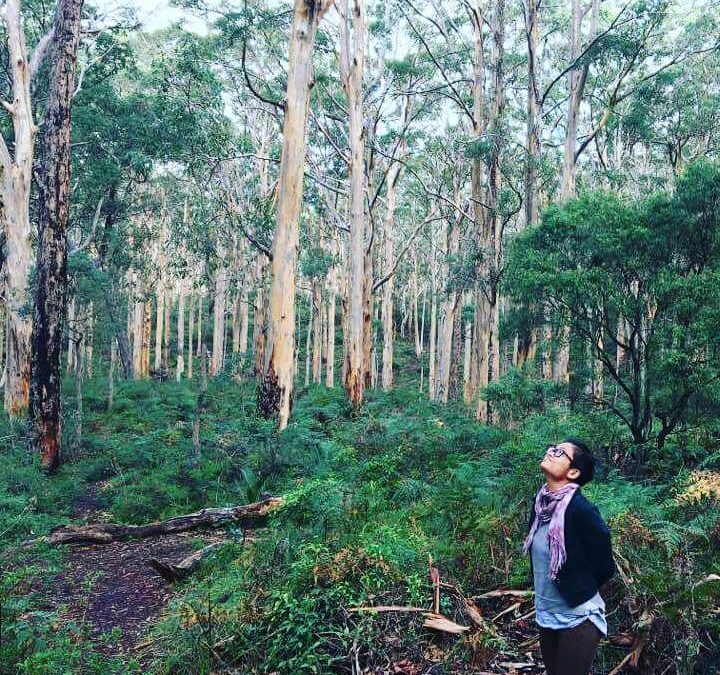
Image description: A person stands in a forest, looking up. Photo provided by Michelle Dang.
This is a guest post by Michelle Dang. Michelle is a cis woman of Vietnamese heritage living on the stolen Aboriginal land of the Jagera and Turrbal peoples (Brisbane, Australia). Michelle is a community worker, narrative therapist and writer. Most of her writing and practice is on feminism, transformative justice and anti-violence work. She will accept any ice cream or basketball challenge. The author can be contacted at michelledang5@gmail.com or follow Michelle on Twitter @dang_power
My beloved friends,
I am writing this because you have shouldered me up. This letter is to all my friends and especially to queer folk, people of colour and those who live on dangerous intersections. If you didn’t already know, I want to tell you now, I love you.
I am not exaggerating when I say that I am alive because of you, that energy and blood runs through my body because of you, that my existence and presence is because of you.
I was deep in the land of hopelessness, succumbed to the hate directed towards my body. We were never meant to survive[i]. You pulled me in, whispered to me that I had more soul in my little toe than the entirety of the white supremacist shit hole I was in. It was your relentless insistence that I matter, that we matter, that we are magical that pulled me out of the pit of despair.
Of course, the pain I am speaking of is one you know intimately. That pain stems from our relationship with whoever our personal Rose is. Rose, aka White Feminism, aka Colonial Patriarchal Feminism[ii], aka Trans Radical Exclusive Feminism, aka Sex Worker Exclusive Radical Feminism.
Looking back, I can see why I fell for Rose. War and western imperialism had displaced my family from Vietnam. When we arrived in Australia, little did we know that we were moving from one occupied country to another. I was yearning for a place to call home. A place that would not replicate the violence I witnessed and experienced in my family, in my homeland or on the stolen land I found myself on.
At the time I had met Rose, I had just left a toxic relationship with Lena, aka Social Work, aka International Development. I was very vulnerable.
I was charmed by Rose’s sweet talk about unity, agency and empowerment. I believed that she would offer refuge to a brown broken-hearted girl like me. I believed that we were bound together through a shared rage at the patriarchy.
And yes, in the beginning, she embraced me, like her own. She showered me with compliments, telling me how valuable I was. She reassured me that she understood my pain, that she would fight for me, for us.
But when the honeymoon was over, I realised that I was escaping patriarchal violence within the home, and within sandstone buildings, only to meet it once again within colonial patriarchal feminist organisations. I could see the tricks and tactics of perpetrators played out on coloured and non-conforming bodies within these structures. Sweet feminist words were used as a smokescreen to cover daily acts of minimisation, silencing, gaslighting, invalidation, intimidation, isolation and bullying.
We were never meant to survive.
But we can leave evidence. Evidence that we did survive. Evidence that we matter. That we resisted and persisted. That we gave up, not on liberation, but on empty promises. So, I give testimony to the ways I have survived, the ways we have survived:
I survived because I stopped giving any more time and energy to a relationship that did not value our hopes, dreams and dignity.
I survived the contradictions and cognitive dissonance, like the time Rose spoke over me to tell me the importance of maintaining a safe space for women.
I survived all the white tears, like every time Rose cried about how horrible racism is, but threw me under the bus when I asked for accountability.
I survived numerous lectures about ‘unity’ and how my feminism is divisive.
I survived, by rolling my eyes every time Rose insisted she was neutral.
I survived by not expressing myself. Because there is a cost to naming racism.
I survived by expressing myself. Because there is a cost to not naming racism.
I survived the nausea that would wake me up every morning, because my gut knew before my head did, that I was entering a war zone. Racism is an attack on the body.
I survived because of Sara Ahmed, Audre Lorde, Mia McKenzie, bell hooks, Vikki Reynolds.
I survived (and my cis privilege allows me to survive) after daring to dream that we could dismantle the gender binary system, as though the act of pointing out cis violence causes the loss of something: harmony, peace, white cis power.
I survived when Rose racially attacked me because it so similar to how POC survive racial attacks on the daily when we snap back at men who sexually harass us.
I survived because you believed me and understood that I was not being over-sensitive or dramatic. Because white feminism has become a master at victim-blaming.
I survived by printing and reading revolutionary black feminist material courtesy of Rose’s printer, and it felt good.
I survived that time Rose and her cronies ambushed and cornered me and aggressively interrogated my feminism because I troubled their feminism.
I survived because of your unapologetic declarations that we are magnificent, legitimate, sufficient and beautiful.
I survived that time we publicly denounced Rose’s hate signs against sex workers at Reclaim the Night, and I was told I was rude and to stay in my lane.
I survived by refusing to enter mediation with Rose so ‘we could resolve our differences’. When harm occurs, what is required is accountability not mediation.
I survived that time Rose misquoted Kimberlè Crenshaw to say that intersectionality was just about racial liberation and not trans liberation.
I survived because as Sara Ahmed would say, I snapped[iii], I left.
I survived because I have my ancestors’ fighting spirit running through me. We were not erased by colonisation, dispossession and genocide and we will not be erased by colonial patriarchal feminism.
Thank you for being fierce, determined and unruly. You created what was not there. You wrote me in to history, you wrote me into existence. Because you dared to deviate, you carved a space for me to deviate. Space for me to breathe. Space for me to survive. Space for me to rest.
To my dear friends, fuck I love you. I love us.
Yours,
Michelle
This piece is inspired by Mia McKenzie’s ‘An Open Love Letter to Folks of Color’ in Black Girl Dangerous on Race, Queerness, Class and Gender and all the love letters I have written and read.
[i] ‘We were never meant to survive’ is the beautiful line that is repeated in Audre Lorde’s poem, ‘A Litany for Survival’.
[ii] Cheree Moreton coined the term Colonial Patriarchal Feminism or Colonial Patri-Fem for short, to describe how white feminists stigmatise and silence the one black voice in the organisation/environment.
[iii] Sara Ahmed uses the term ‘feminist snap’ in Living a Feminist Life as an act of resistance. This is when we have reached a breaking point, “when what you come up against threatens to be too much, threatens a life, or a dream, or a hope” (187).
This post is the second in the year-long Feminism from the Margins series that Dulcinea Lapis and Tiffany Sostar will be curating, in challenge to and dissatisfaction with International Women’s Day. To quote Dulcinea, “Fuck this grim caterwauling celebration of mediocre white femininity.” Every month, on the 8th, we’ll post something. If you are trans, Black or Indigenous, a person of colour, disabled, fat, poor, a sex worker, or any of the other host of identities excluded from International Women’s Day, and you would like to contribute to this project, get in touch!
Also check out the first post in the series, All The Places You’ll Never Go, by Dulcinea Lapis.
