by Tiffany | Jun 6, 2018 | Business, Patreon rewards, preview/review, Writing, Zines
Friends! Where did May even go?! Wherever it went, it’s gone. Here we are in June! And here’s my review/preview post, which was posted for Patreon patrons on the first. It’s a miracle.
Okay, let’s start with May:
The new Patreon rewards have launched, and the first hand-drawn art cards have gone out! I’ve gotten really great feedback on them, and I had a lot of fun designing and drawing them. (If you’ve received your card and feel like sending me some feedback, I’d love to hear it!) The next batch of art cards will be going out in August to all patrons at $10 and up.
I’ve also created my first zine! It’s a tarot-themed zine, not in line with most of what I post here, but I’m really happy with it. I sold it at my first-ever “reading tarot at a fair” event. I think I was the only tarot reader there who wasn’t doing any kind of mediumship or divination – not telling the future, just using the cards to invite the person in front of me to think about their narrative in new ways. I am actually really interested in how tarot and narrative work can work together – I find the metaphors and symbolism in tarot so rich and inviting. Even though I was reading tarot differently than most folks, it worked for me and I got some good feedback, and it’s the only way I can feel ethical about using this tool. And it was a lot of fun! If you’re interested in that zine, it’s available for $5 in either digital or physical form. Send me an email and I’ll send you the zine!
The next zines will be more clearly in line with my narrative work – check the bottom of this post for the call for contribution links! These zines are both open to contributors, and will also feature my original content. All of the zines I’m creating (I am aiming monthly-ish) are sent out to anyone who supports my Patreon at $20 and up, and they will also be available for sale on my website.
My first blog post for the Association of Alberta Sexual Assault Services went up. You can read it here! It’s about how to support your partner if they have experienced sexual violence.
In the Masters program, I got a ton of work done. There were five assignments due in May:
– A 15-minute segment from a narrative therapy session
– Transcription of that segment
– A 1000-word analysis of the segment (these three not posted for reasons of confidentiality)
– A 1000-word reflection paper on the topic of re-membering conversations (posted for $5 and up patrons here)
– A 1000-word reflection paper on the topic of ethics and partnerships (posted for $5 and up patrons here)
The May Possibilities meeting was fantastic. We talked about media representation, and I’ll have the shareable resource completed and posted next week.
I did not get any blog posts written, but I did get the Feminism from the Margins May contribution up, and that was quite a bit more effort than usual since Mel Vee wrote four pieces rather than one. Those pieces of writing are powerful and deeply personal reflections on living as a queer Black woman. You can read them here, here, here, and here.
I did make progress on the Possibilities Youth project. I had two meetings with folks to talk about the logistics of running a youth group, and I have a space booked for a six-week pilot group. I’ll be announcing more details within the next month.
And I facilitated a lunch-and-learn at Chevron on the topic of “Pride 101: LGBTQIA2S+ Terminology” (the handout for that has been posted for $5 and up patrons here), and the feedback was fantastic! (One person wrote, “Thank you so much for organizing this incredibly interesting and very meaningful event. Tiffany was amazing! I learned a great deal and plan to work hard at being a good ally.”)
Sadly, I did not get the grant that I applied for. I’m going to keep trying, though. I just need to find some other ones to apply for!
And now, what’s coming up in June:
The first, and most exciting/terrifying thing for me, is that I’m finally taking this “figure out the marketing” thing seriously. I’m going to get the shop set up on this site, update my page to reflect all of the new services I’m offering, and revise my social media strategy. This won’t happen quickly, but it’s ramping up.
Figuring out my marketing honestly should have been at the top of my priority list a long time ago, but sometimes we don’t make progress until we’re forced to, and that’s okay. It’s not like I’ve been slacking, I just haven’t been focusing on marketing (because marketing is not a natural fit for me, and gives me the Bad Capitalism Feels).
What does that mean for what’s coming up?
I’m going to be posting more often on the Facebook page, here my blog, and on the Patreon (mostly cross-posting, but I’m curious about whether folks have a preference in that regard!). Since I’m going to be posting more often, I’m going to start writing my posts in advance, sharing them on the Patreon early, and then posting them on the blog and the Facebook page. I’m working on getting a little stash of posts written so that I can get that ball rolling. I’m hopeful that this will build interest in the Patreon, and also allow me to engage with my social media audience more effectively.
I’m also going to figure out how to actually be present on Instagram in a more meaningful and effective fashion. And on LinkedIn. And maybe Medium? This is literally me:

Image description: A five panel comic. In the first panel, a person with a beard says, “keep going! you’re almost there!” In the second, a person with a ponytail is running towards a ball labeled “goal”. In the third, the ponytailed person is still running towards the goal and, a shiny golden ball labelled “new goal!” rolls past. In the fourth, the ponytailed person looks after the shiny new goal. In the fifth, the ponytailed person is running after the new goal, and the bearded person says off-screen, “noo, finish the other one first!” This comic is by Catana Comics, and they are so cute!!
And I’m going to figure out this networking thing. I have a coffee date in June with the person who brought me in at Chevron, and she’s going to give me some advice on networking into more lunch-and-learn opportunities.
I’ve also sent a message to a friend of a friend, who has reached out to a few of her connections in HR positions, to see about bringing me in for lunch-and-learns. I still need to figure out how to start networking into more narrative therapy work, but… I’ll get there.
The two blog posts I had hoped to write in May, I will be writing in June. So you can look forward to a post on Self-Care and Caring What Other People Think About Us, and an interview post about major life transitions. I’m also going to be writing a post on re-membering conversations, similar to the post about connecting to our skills that I wrote in April. I’m aiming for once-a-month-ish “intro to a narrative practice” posts.
I’ll be recording and sharing a short series of videos answering questions about narrative therapy. If you want to submit a question, send it to me this week! I’m working on this video series now, and am using it as an opportunity to learn some editing skillz.
The questions I have so far are:
– How do I explain narrative therapy to someone?
– Is it counselling or writing your life story?
– Why would I pick narrative over cognitive behavioural therapy?
– How do I know if narrative therapy is right for me?
– What are the risks, if any, of narrative therapy?
– Isn’t it just pretending that things are different? Isn’t that just avoidance or delusion?
– Do I need to be a writer / creative type person to benefit from narrative therapy?
– How would someone with dissociative tendencies be able to use narrative therapy around periods of time when they weren’t present?
– Can I use narrative therapy to get dates? (This was submitted as a joke, but I’m legit considering answering it because we could certainly talk about what it is you are valuing in the desire to “get dates” and what your previous experiences has been in this regard, and why you are looking for therapeutic help in this way. It’ll be a funny but informative answer, is what I’m hoping.)
Do you have questions about narrative therapy? Send them to me, and I’ll answer them in a video!
I have two assignments due in the Masters program, both 1000-word reflections that I’ll post on the Patreon after they’re written. (Update since this was posted – the first of these is up! If you want to read my Masters program papers, you can get access to those exciting pieces of work for just $5/month.)
And! Very exciting news! Back in April, Cheryl White (one of the directors and founders of the Dulwich Centre) sent me an article that was going to be published and asked for my thoughts. I sent her my thoughts, including some critique. She appreciated the critique and….
*pause for dramatic effect*
… the Dulwich Centre is sending me and another narrative practitioner to Sacramento on a two-day trip to meet the author of the article, David Nylund, and tour the Gender Health Centre and do some narrative sessions with the therapists there, so that I can then share my learning with the Dulwich Centre and help support their increased trans-inclusivity and awareness, and also co-author a paper that will be included in next year’s course readings.
Okay.
Let’s just pause for a second before freaking out about this, and then freak out about this, because this is amazing. This is exactly what I want to do with my life – travel, meet and interview people, create content that will increase justice and decrease marginalization in the world. This is what I want for my life! (Just imagine if this Patreon grew and I could do this kind of work with crowdfunding. *wistful sigh*)
Anyway.
Because May was so challenging in my personal life, I am going to head down to Sacramento a few days early and take a few days to write, read, and recover.
I will definitely post the paper that I write, and any other documents generated as a result of this trip, on the Patreon and probably also on the blog.
*muffled squealing*
I am pretty excited.
And, I’ve also got a couple events coming up in June:
On Sunday, the Self-Care Salon will be running, this month with a focus on Justice and Access to Support. I am very excited about this discussion and the resulting collective document. (Update: This event was fantastic and I will be generating the collective document following the conversation within the next couple weeks.)
On June 19, Possibilities will be talking about Queerness and Parental Relationships (both relationships with our parents, and as parents ourselves).
Now, the zines! (You can also find all of the open calls for contributions in a new album on the Facebook page.)
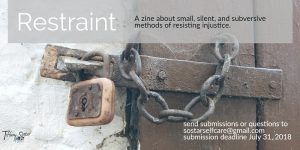
Image description: A rusty lock and chain on a wooden door. Text reads “Restraint: A zine about small, silent, and subversive methods of responding to injustice. Send submissions or questions to sostarselfcare@gmail.com. Submission deadline July 31, 2018.”
Restraint –
1. a measure or condition that keeps someone or something under control or within limits.
2. self-control.
How do we experience restraint?
How do we resist injustice?
How do we break free, break open, break stigma, break barriers?
How do we speak?
Many of us are resisting injustice from a place of external or internal restraint. Either being controlled or controlling ourselves, or both.
We may not “come out” because it wouldn’t be safe, or because it isn’t the way we want to move through our world, or because it would jeopardize our relationships or our work.
We may not “speak up” to bullying, abuse, or injustice because it would put our career in danger, or it would put people we love in harm’s way, or because other people have power over us and we can’t afford to antagonize them, or because we have other ways of resisting those injustices.
(Disabled folks who can’t speak up to injustices committed by their carers because of the power differential, racialized folks who can’t speak up to injustices in the office because they’ll be labelled “angry”, trans folks who can’t speak up to injustices in the medical community because it would put their access to transition support in jeopardy – there are so many of these situations!)
But despite these restraints, people are never passive recipients of trauma or injustice. As David Denborough says in the Charter of Storytelling Rights, “Everyone has the right for their responses to trauma to be acknowledged. No one is a passive recipient of trauma. People always respond. People always protest injustice.” (https://dulwichcentre.com.au/narrative-justice-and-human-rights/)
There are many ways to resist, challenge, and respond to injustice.
This zine celebrates and recognizes the small, silent, and subversive responses to injustice.
It is inspired by the April Possibilities bi+ community discussion of “the closet”, and by the March Self-Care Salon discussion about being a professional on the margins, as well as other conversations and experiences of restraint (both restraint that is painful and externally imposed, and restraint that is joyful and internally chosen).
Do you have a story of restraint?
Send your submissions of art, comics, short fiction, non-fiction, poetry, or essay to sostarselfcare@gmail.com before July 31, 2018. You can also send your questions.
(Depending on the number, size, and content of submissions, some may be edited. Nothing will be put into the final zine altered without the author’s consent.)
AND!
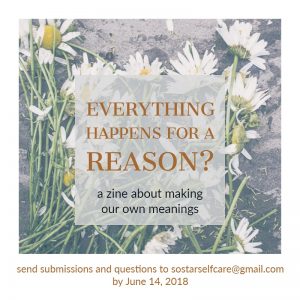
Image description: Cut daisies are scattered on pavement. Text reads, “Everything happens for a reason? a zine about making our own meanings. send submissions and questions to sostarselfcare@gmail.com by June 14, 2018”
“Everything happens for a reason.”
“The universe must have a lesson for you.”
As a response to grief, to loss, to pain, to injustice, these phrases that are meant to be comforting can end up being incredibly hurtful.
Although people do always respond to the traumas, injustices, and hardships in their lives, and these responses often leave us with valuable skills and insider knowledges, the idea that we experience trauma, injustice, and hardship because we’re meant to, or because it’s “good for us”, or we have somehow attracted it, or we need to experience it, is often a bitter pill to swallow.
So spit that pill out!
Let’s write, draw, poem, collage, photograph, paint, and talk about the meaning we make from our hard times (the lessons we learn, skills we develop, knowledges we gain), and the nonsense of our hard times (the *lack* of lesson, the pain that we just feel and do not ever appreciate), and let’s resist the idea that these hard times are somehow necessary, or “good for us.”
Send your submissions to sostarselfcare@gmail.com by June 14, 2018!
And if you have thoughts but aren’t comfortable writing them out, let me know and we can do an interview!
My big collective document projects – extroversion, self-care for queer geeks, financial self-care on the margins, and bad gender feels project, as well as my on-the-to-do-list smaller documents – self-care and the closet, the write-up of the first professionals on the margins meeting, are all in limbo. I hope I’ll have time to get to them in June, but I’m trying to keep my goals reasonable. They will happen eventually, but I’m not entirely sure when!
I really need to book more narrative therapy clients, too. So, if you know anyone, or if you’re interested in working with me, let me know!
Anyway! That’s the review/preview!
Thank you so much to each of my patrons and supporters. The vast majority of what I do is not funded and I don’t charge for the work, and without your support, I don’t know if I could keep going. You make this work possible. <3

by Tiffany | Jun 3, 2018 | #tenderyear, Personal
Image description: A large airplant on a wall of plants. Text reads: “Do not be afraid. Do not be cynical. Continue to trust in yourself and others. Continue to dream of collective liberation. – scott crow”
I rarely say anything like, “Do not be afraid. Do not be cynical.”
I believe in the radical power of the gloom and the shadowed heart. I believe that negativity has a place in this world, and that when we reject it in favour of forced and weaponized positivity, we lose out on so much – we lose the richness of our sadness, our grief, our rage, our despair.
There is hope to be nurtured and cultivated in the moments of hopelessness – we become hopeless because we want better for ourselves, hope is embedded in the hopelessness.
There is desire in despair – we become despairing because we desire something better, something more just, something sweeter and more sustainable.
Today, I flipped open Joyful Militancy, and read scott crow’s quote – “Do not be afraid. Do not be cynical. Continue to trust in yourself and other. Continue to dream of collective liberation.” – and it hit me right in the heart.
Instead of landing as a weaponized admonition, as I often find these kinds of directives, this came as a reminder of the self that is absent but implicit in my fear, my cynicism, my distrust, my scarcity feardreaming. I think that so many of us are experiencing so much fear these days.
As Nick Montgomery and carla bergman write in Joyful Militancy, “Many people’s impulse is to mistrust others from the start, and it makes sense, given that many of us have been living Hobbes’ dream, made real, for centuries. Most everyone we know has been touched by some kind of oppression and abuse, and Empire’s oppressive divisions often lead people to betray even their most intimate relations.”
But they also write about the radical potential of trust and responsibility, and about how trust and responsibility can be a powerful antidote to the mistrust and violence of life under oppression.
This quote reminds me, today, that I am capable of joyfulness and hope, even in moments of despair and fear.
There is a self who is not afraid – who is willing to act with courage even when fear is present.
There is a self who is not cynical – who is willing to open to joy even when disillusionment is present.
There is a self who trusts, myself and others – who is willing to allow for mistakes and imperfection, and to come back to trust, to do the work of building, sharing, and repairing trust even when betrayal or hurt is present.
There is a self who dreams of collective liberation, even when incredible oppression is present.
Maybe that self exists for you, too.
(This post is an expansion of today’s Tender Year post.)
by Tiffany | Jun 1, 2018 | Health, Intersectionality
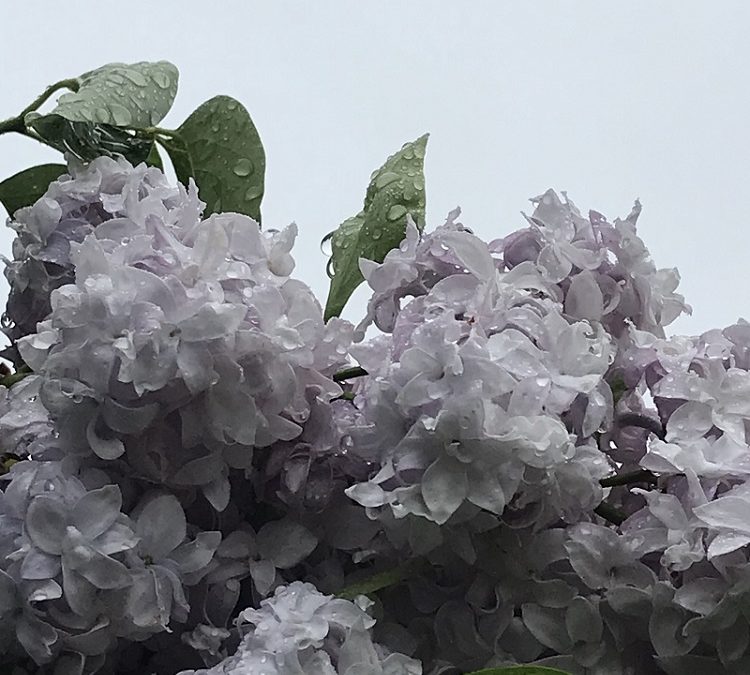
Image description: A close-up of the lilacs in my front yard, covered in rain, with the light grey sky behind them.
As a note, I’m going to be posting more often on the blog! I’m shifting my social media presence and will be doing less personal posting and more of my work here. So keep your eye here and on the Patreon. I may also be starting an email list, so if that sounds appealing to you, let me know!
And if the topic of this post interests you, the upcoming Self-Care Salon: Justice and Access to Support is the place to be! The event will be held at Loft 112 in the East Village, from 1-3 pm, on June 3. The cost is $50, and sliding scale is always available.
This morning, I sat in front of my window with the grey skies above and the rain falling. It was lovely.
I’m thinking about how many of us have to try and survive within hostile systems and environments.
How many fat folks have to go to doctors who are steeped in fatphobic prejudice, have to deal with antagonism from the medical system that is meant to help them, and have to advocate for themselves… but not too loudly, not too assertively, or they risk being written off as belligerent and non-compliant. (Especially if they were women or femmes. *Especially* if they are women or femmes of colour.)
How many folks living in poverty have to deal with support systems that vilify, pathologize, and stigmatize them. Have to debase themselves to receive access to food, to shelter, to any kind of medical or mental health support.
How many racialized folks have to deal with racism in their medical and mental health support professionals, have to educate and advocate for themselves but never too much, never too loudly, or risk being seen as “angry.”
How many trans folks have to deal with gatekeeping by professionals meant to help them access transition support, and stigma and pathologization by professionals meant to help them access other support. How advocating for yourself becomes so much harder when you are trans and also racialized, or trans and also fat, or trans and also poor (which is true for far too many), or trans and neurodivergent (despite the high correlation between autism and gender creativity!).
How so many folks stand at multiple points of marginalization, and how few professionals and experts also stand there.
(There are some, and there will be more. Support and love to all the professionals who came from poverty, who are fat, who are Black, Indigenous, or people of colour, who are trans, who are queer, who are disabled – you’re so needed, and you make such a difference!)
I am thinking about all this power that exists in dynamics that are meant to be supportive, how it ends up being hurtful. Harmful.
How that can leave us scared, hopeless, isolated.
If you’re dealing with a system, a professional, an institution, or some other brick wall today – take a deep breath.
What you feel is valid.
If you feel angry at the injustice, that is valid.
If you feel hopeless, that is valid.
If you feel scared, that is valid.
I do not have any easy answers for how to navigate these systems, how to work within harmful frameworks, how to get through. It’s so hard. The more I read about it, the more I work with people who have *not* received the help they needed from professionals who had more privilege, or from systems and institutions that were not justice-oriented, the more I realize how pervasive and persuasive this problem is. The way it makes us doubt ourselves. The way it shuts us up, keeps us quiet and compliant, and how that is a valid survival strategy.
Breathe, friends.
If you have to go into that office and you know you’re going to face yet more racism, ableism, transantagonism… keep breathing. Find something to hold onto – some thread of whatever it is. Hope, or anger, or coffee with a friend tomorrow.
If you’re heading into that appointment and you know you need something that the doctor or social worker or banker or lawyer or whoever else has the power to withhold, and you’re scared, that makes so much sense.
It *is* unjust.
It *is* unfair.
It *is* hurtful, harmful, violent.
But you are good. You are good enough. You are enough.
Just like you are.
You are just the right you.
There is nothing wrong with you, just because you don’t fit into the box assigned to you.
Take a breath.
Do what you need to do to get through.
You’re doing a good job.
Further reading:
- Stigma in Practice: Barriers to Health for Fat Women in Frontiers in Psychology
- “In our experience, for fat people, it doesn’t matter if you are bad with a “fatty” disease, or if you are in “good metabolic health” (but NOT FOR LONG, according to several medical professionals), the discrimination, humiliation, and stigma, from health care providers is the same. The fact that we, and every fat person we know, have experienced this fat stigma, no matter what their health status, is an indictment on the health care profession. Health care providers, public health policy makers, and institutions of health such as hospitals have substantial work to do if they exist to treat all patients, and improve the quality of life for all patients, rather than deterring and deferring appropriate health care and reducing quality of life through fat stigma, shame, and eventual patient avoidance of health care providers.”
- ‘Trans broken arm syndrome’ and the way our health system fails trans people at the Daily Dot
- “Not a single medical school in the United States has a curriculum devoted to LGBT health issues, much less transgender health issues. Green said the only existing courses that do focus on LGBT health needs are electives taught by students, and it’s not exactly something the medical school leadership wants to change.” (It is important to note that this article is a few years old, and WPATH itself has been critiqued in favour of ICATH – Informed Consent for Access to Trans Healthcare. This article at Slate covers some of the issues.)
- Why I Left my White Therapist at Vice
- “Being on the receiving end of the defensive anger of white fragility from someone who I had not only trusted to be a professional care provider with the ethics and background to deal with my needs, but with whom I had also shared some of my most vulnerable thoughts and feelings, means that I am loath to seek out therapy moving forward. To be blunt, I felt exploited. This is something that no individual, and in particular no one opening themselves up for healing, should ever have to endure. But sadly, it’s not uncommon.”

by Tiffany | May 31, 2018 | Feminism from the Margins, guest post, Health, Identity
Image description: A black and white photo of the back of a Black woman’s head in a head wrap. Photo credit: Mel Vee. Mel Vee is an aspiring photographer and her guest post series will feature her photography.
This is a guest post by Mel Vee.
Mel Vee mesmerizes, captivates and incites with her spoken word. She is a passionate advocate for the power of narrative to heal and liberate. A general disturber of shit, Mel Vee seeks to blur and disrupt all kinds of distinctions. She is a core member of the Uproot YYC, a grassroots collective for artists of colour dedicated to uprooting systemic barriers in the arts community. She was a member of Calgary’s 2017 slam team, who were semi-finalists at the Canadian Festival of Spoken Word and co-creator of The Unlearning Channel podcast.
This post is the second is a four-part series, one per week for the month of May. Together, this series will comprise the third entry in the Feminism from the Margins series.
Content note for rape, sexual assault, descriptions of misogynoir.
I learned from an early age that my body was not my own.
My Black body was created to be of service to anyone who showed up and demanded it. This Black body, the only home I have on this speck of stardust navigating the cosmos, was as foreign and alien to me as those distant galaxies.
Why should it have been any other way? I received the message clearly that my body was a means through which others could actualize their own wants and desires. My body was not a safe nor joyous place; not a place to be treasured and tended to gently. My body was a vessel – to serve others, for men’s desires, and for birthing children, but never for me.
My education in the precarity and disposability of the Black female body began at home with the women in my family. Their necessarily strong, beautiful black bodies were always in service to others. Most of the women in my family were and are never still.
One aunt, whom I love dearly, always comes to mind. As far back as I can remember, she was always in motion, toiling away for others. She toiled in her home, at her work as a nurse’s aide and in her church. She did it all. Raised a family, held down a career, opened her home to countless unwanted and discarded people in the community and never spoke a word about her struggles to anyone. No one ever questioned what toll this constant availability and service would wreak on her body and mind.
Her pace continued unabated for the entirety of my childhood, adolescence and early adult years until one day, the inevitable happened. She snapped, culminating in a one month stay in a psychiatric ward. People whispered about what might be the culprit for her decline without ever approaching the truth, that she was used up until she had nothing more to offer.
Barely a few months of marginal concern went by before things returned to “normal”. The unceasing demands, the perpetual toil and the complete disregard for her well-being until her health completely failed and simply never returned. She now spends much of her time bedridden. I feel blessed when I receive a message from her because it means her pain eased up just enough to manage a text. My aunt, once a pillar of our family, reduced to sending texts during a brief respite from her unending pain.
Her body bears the cost of continual and unceasing labour for people who took and took and left her an empty shell. Her body is racked with osteoarthritis, diabetes, high blood pressure, and she constantly struggles to maintain a healthy weight. I am certain some will attribute this to the inevitable ravages of age, but I know in my bones biology is only one part of the narrative.
Her body fought back in the only way available, it shut down. My aunt toiled for years without rest for others. Everyone around her demanded more and she gave more. When her health declined, all the people who had taken from her vanished, without a trace. I wish I could say my aunt is an isolated case, but this is the fate of many women in my family. Our bodies, time and energy are used up until there is nothing left and few, if any, stick around to pick up the pieces. My aunt cautions me continually about her fate and encourages me to take care of myself. It is a grim reminder that I take to heart.
What is most grotesque about the situation of my aunt and so many women like her is how normalized this is; how people expect the Black female body to be at service and at the ready.
Our bodies are not meant to be lovingly inhabited by ourselves. The roots of these expectations are deep, undoubtedly tracing their history to chattel slavery where our bodies were literally not our own. How do you love a body that was never meant for you to enjoy; a body that was historically regarded as property and in contemporary times is a reminder of your presumed inferiority?
My own body bears the scars of the precarity and disposability of the Black female body. My left arm is scarred from my wrist up to near my shoulder. All of these wounds are self-inflicted. Even after a decade of being free from self-harming behaviour, my scars are still visible. I wear them openly as an act of defiance, to hold a mirror up to a society whose violence I internalized and enacted upon myself.
I had no shape, no words for the anger and hatred I felt for being born in a Black female body; a body people regarded as valuable only so far as it could serve. I lashed out against a world which continually shows its brutal and naked contempt for me and people who look like me. I lashed out against the one person I knew had no recourse. Myself. I lashed out because rage is all I could muster. Someone had to be punished for the wound of being a Black girl in a society drenched in anti-Black racism and misogynoir.
In the process of addressing trauma and healing in my life, it has become evident that my internalized misogynoir had caused me to disassociate and distance myself from my body. I became an unwilling occupant in a body that others had treated with the utmost contempt; culminating in rape, sexual assault and violence. I sought to protect myself emotionally in the way traumatized people do, by distancing myself emotionally from the source of pain, my brown and despised body; a body that was valuable only to the extent it could serve.
I am now undergoing the painful but enriching process of coming home to my body; the process of reclaiming a body others have treated with contempt and disrespect. I am now learning to inhabit my body and treat it with love, respect and dignity. I am learning slowly to prioritize the needs and desires of my body. I am learning that my body is worthy of fighting for and keeping alive.
I am coming home now to this brown body after 28 years. I am coming home to this brown body which has been the site of so much grief and violence. I am coming home to this brown body where I laugh, love, fight, move, dance and sing. I am coming home to this brown body, imperfections and all. I am coming home to the only body that will carry me until I die.
I am reclaiming my body in defiance of a society that regards brown bodies with violence.
I am reclaiming my body in honour of all the Black women who no longer can.
I am reclaiming my body so others know it is possible.
I am coming home to my brown body, in the only home I will ever know in this beautiful and sometimes terrifying cosmos.
I am finally coming home.
This post is the final piece in the third contribution to the year-long Feminism from the Margins series that Dulcinea Lapis and Tiffany Sostar will be curating, in challenge to and dissatisfaction with International Women’s Day. To quote Dulcinea, “Fuck this grim caterwauling celebration of mediocre white femininity.” Every month, on the 8th, we’ll post something. If you are trans, Black or Indigenous, a person of colour, disabled, fat, poor, a sex worker, or any of the other host of identities excluded from International Women’s Day, and you would like to contribute to this project, get in touch!
Also check out the other posts in the series:
by Tiffany | May 24, 2018 | Uncategorized
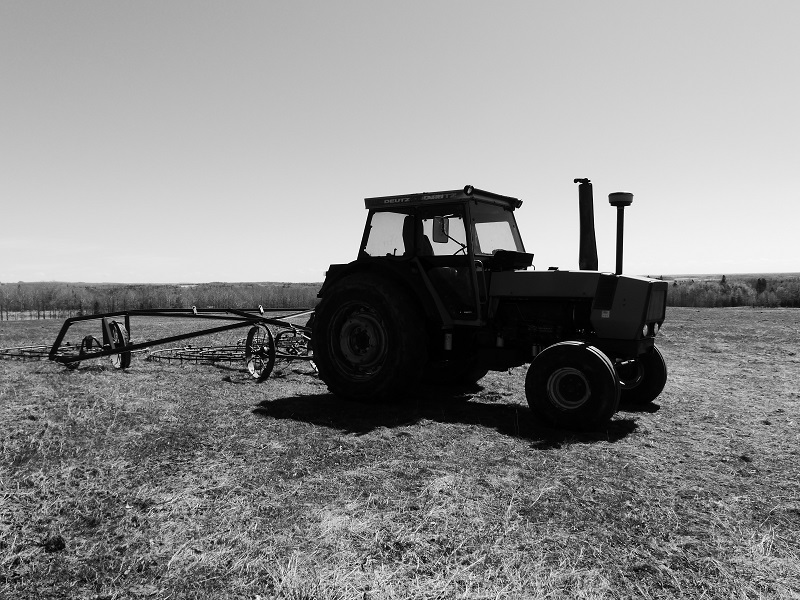
Image description: A black and white photo of farm equipment in a field. Photo credit: Mel Vee. Mel Vee is an aspiring photographer and her guest post series will feature her photography.
This is a guest post by Mel Vee.
Mel Vee mesmerizes, captivates and incites with her spoken word. She is a passionate advocate for the power of narrative to heal and liberate. A general disturber of shit, Mel Vee seeks to blur and disrupt all kinds of distinctions. She is a core member of the Uproot YYC, a grassroots collective for artists of colour dedicated to uprooting systemic barriers in the arts community. She was a member of Calgary’s 2017 slam team, who were semi-finalists at the Canadian Festival of Spoken Word and co-creator of The Unlearning Channel podcast.
This post is the second is a four-part series, one per week for the month of May. Together, this series will comprise the third entry in the Feminism from the Margins series.
Content note for gun violence, misogyny, terror.
Yet another shooting. Another city. Another place we thought was safe. Countless lives senselessly destroyed; scarred beyond all recognition.
The facts are becoming piercingly clear – there is no safe place to hide from white male violence. Yes, you read that last line correctly. The vast majority of mass shootings in America are committed by men[1], and mostly white men. I refuse to omit this from the conversation around mass violence, gun control and domestic terrorism in the Western world. To omit this fact would be tantamount to gross negligence.
I’ve been thinking about this a lot.
I came from little and nothing was expected of me. As a queer, working-class Black girl, I had to be exceptional to even be visible at all. This society has never doted on me or presumed my innocence. I’ve been regarded largely as a strange and just barely tolerable presence. I learned to shrink myself and become small so as not to upset or draw attention to myself. I learned to despise everything about who I am because I didn’t match up to a white[2] male[3] standard of humanity.
Now the sons of the Western world are furious that people like me are gaining rights at what must seem like a startling pace and enjoying freedoms and privileges that should not have been barred from us in the first place. I think it is a grotesque irony that these men, who have been doted on, and for whom the world’s finest resources have been extracted and entire cultures devastated and destroyed, now turn around to bite the hand that feeds. Such a nasty surprise.
Or is it?
A wise friend of mine said it succinctly, “we are raising white men to be entitled to a pathological and increasingly tragic degree.”
How does it happen?
Societally reinforced white male entitlement, coupled with a world that seems increasingly fragmented along racial and ethnic lines, compounded by the increasing awareness of the sheer brilliance of marginalized people around the world (who have previously been assumed incapable of brilliance). Add the rage you’d feel at being bested by people you presumed to be your inferiors and you have the making of a toxic brew.
The latest tragedy was apparently sparked by a girl who publicly rejected a boy’s unwanted sexual advances. She had been clear about her refusal and rejected him for some time. She did nothing other than say no and he killed her. He felt entitled to her life. In his eyes, she deserved to die because she refused to say yes. Her refusal now seems tragically heroic. So many of us are coached to say yes in order to avoid this fate. Yet this doesn’t keep us safe, and there is another familiar story – a woman who was exceedingly kind, who gave one of these supposedly misguided but nice young men a chance, then ends up in an early grave.
You cannot be nice to these people, you cannot be cruel.
Either way, you risk life and limb if you dare to raise the ire of one of these men.
Last week I attended active shooter training at work which omitted this vital statistic of white male violence in a stunning act of cowardice and intellectual dishonesty. I shut down. I refused to speak out in that moment because I knew I would be dismissed as the angry Black bitch. But how could I concentrate after? How do you concentrate knowing what is lost by being silent?
My innocence is lost now.
I walk around with more fear. I fear today might be the day when I cross the path of an enraged white male and it may cost me life or limb.
I fear success now because then I may be in someone’s crosshairs. Someone might become obsessed with me and make my life unbearable.
I fear being angry or rude to a white man because it might cost me or someone else our lives.
I cannot go out into public innocently anymore, because when will it happen here too?
Will I die with all of my music still inside of me? My mother weeping over this person she tended to and loved, now still in her casket? All of my potential buried with me.
I discussed the writing of this post with the editor of the series, who brought up an excellent point of white feminists obligation to address the near-epidemic of dangerous white male entitlement.
If the solution is to simply leave it to Black women or queer women or queer Black and racialized women to fix, that simply will not do. Black women cannot save you from this; we cannot save you from yourselves. White women and other white men raise white men and have the best chance of changing the culture of white male entitlement.
Black women have been sounding the alarm bells and fighting white male violence ceaselessly, and are often dismissed as angry or paranoid, their lives threatened (and sometimes outright killed). So now it’s time for everybody else to speak up.
Certainly white women in general have more opportunity and access to white men. I am certain you know someone who fits the description: entitled, arrogant, jokes about hurting others and seemingly has no regard for human life. They believe the world owes them something and feel they are increasingly oppressed or endangered. Often this occurs with socially inappropriate or callous behaviour. Of course, when these behaviours are questioned, people who refuse to see the truth chalk them up to youthful mistakes or ignorance rather than recognizing a system that reinforces and encourages white men to continue to behave in ways that are threatening us all.
So, what can you do if you find yourself in the presence of a white man and you feel threatened (for understandable reasons)?
Choose to see the reality of the person in front of you.
If there is something that puts you on guard about a person, trust that intuition. Do what you need to take care of yourself. Give yourself permission to create boundaries and defend yourself. While people are individuals, do not join others in refusing to look at patterns of white male violence which blind us to the danger right in front of us.
You do not need to approach the world with guns blazing but rather with a clear ability to accept the reality of the person right in front of you, for better or worse. If all else fails, distance yourself from these people when possible. Your life is not worth the appearance of niceness.
Dealing with white men’s racism is already enough for me. Often it is assumed Black women will save everyone, often to our own detriment. It is time for all of us to save ourselves.
These are your brothers, uncles, fathers, sons, and friends. These are the people who are living next door. These are the good old boys. We all have a responsibility here and it cannot fall solely to the most vulnerable to speak out.
This problem of the violent effects of white male entitlement will not be niced to death, but will require our intelligence, wit, preparedness and a willingness to not turn from the truth.
[1] “Mass Shooters Are All Different. Except for One Thing: Most Are Men” https://www.nytimes.com/2018/02/17/us/mass-murderers.html
[2] “Identifying Whiteness – An Invisible Norm” https://geezmagazine.org/blogs/entry/identifying-whiteness-an-invisible-norm
[3] “Male as the Neutral Default” https://thesocietypages.org/socimages/2013/02/16/male-as-the-neutral-default/
This post is part of the third in the year-long Feminism from the Margins series that Dulcinea Lapis and Tiffany Sostar will be curating, in challenge to and dissatisfaction with International Women’s Day. To quote Dulcinea, “Fuck this grim caterwauling celebration of mediocre white femininity.” Every month, on the 8th, we’ll post something. If you are trans, Black or Indigenous, a person of colour, disabled, fat, poor, a sex worker, or any of the other host of identities excluded from International Women’s Day, and you would like to contribute to this project, get in touch!
Also check out the other posts in the series:
