by Tiffany | Sep 4, 2018 | Business, Identity, Personal, Woo
(This post was available a week early to my patrons. My Patreon helps support this work, and I appreciate my patrons more than I can say!)
Tarot is an important part of my life, and has been for quite a few years.
I use tarot as a way to think about what’s happening in my life, with tarot spreads acting as invitations to think about situations in specific and focused ways. I have also used tarot in narrative therapy in a similar way – inviting community members to engage with the cards as a visual way to explore their stories. I also use tarot as part of my slowly developing spiritual practice. I’ve written before about how I use tarot as self-care, in this post that introduced my tarot practice, and in this post about how to use tarot as a self-storying tool.
I participated in parts of the Owl and Bones August tarot challenge on Instagram. There was a prompt for each day, and it was an interesting process to notice was came up, what kept coming up, and how I responded to the cards. (I will admit that my participation was a bit more hit and miss while was away, mostly because I was so sick.)
On August 22nd, the prompt was “Where are things out of balance?”
I drew the Nine of Wands.
Image description: The Nine of Wands from The Wild Unknown tarot deck, against a black background.
This card is about stamina and inner strength – it’s about continuing on the long path.
Carrie Mallon, a tarot blogger who has written posts for each of the cards in the Wild Unknown deck (which I’m using here) writes about the Nine of Wands:
“The Nine of Wands shows that sometimes we need to draw on our inner reserves. We need to protect what is important to us, we need to protect our energy. We need to keep going, even though we may feel a little tired from being so on-guard. This kind of perseverance can be admirable, but can also lead to weariness.”
I thought, of course. Work is out of balance! I’m working too much. I’m always on the edge of burnout. I’m too busy, there’s too much going on, there’s too much pressure and stress. Work. This is about work.
But for some reason, I paused before posting the picture and that little response to it on Instagram. Instead, I sat with it for a few days.
I wondered why it was so easy to come to that interpretation.
I wondered about what the effect of having this story so prominently in my mind might be – how does it impact my days to always be framing myself in terms of “the edge of burnout” and “doing too much”?
I was a little uncomfortable with this line of inquiry, because I am always cautious when I feel myself edging towards “shift the narrative.” So often, this is used as a bludgeon against people who are legitimately struggling with injustice.
“Just shift your narrative!”
“Just focus on the positive!”
How about, just bite me.
However, this idea of shifting my own narrative is a theme that’s been coming up for me in a lot of areas lately. I have noticed that I’ve pushed so hard away from weaponized positivity that I sometimes feel like I’ve lost my connection to any kind of positivity at all. It’s easy, lately, to find myself feeling hopeless, trapped, powerless.
Even though it is unjust to demand that hurting people “focus on the positive,” that doesn’t mean there is never a time to re-frame.
In my narrative therapy training, I’ve been taught to “linger with intent” in the problem story – to invite community members to talk about their problems without shame or judgement, and to look for ways to strengthen their connection to preferred outcomes and preferred selves within those stories.
What this looks like in practice is that I listen to the stories that community members bring into narrative therapy sessions with an ear open to “double-storying” – what’s not being said here, but might be present anyway? In a story of anger, for example, there is sometimes a sense of justice that refuses to be silenced. In a story of hopelessness or exhaustion, there might be a cherished belief that things could be, and should be, different.
This means deepening stories of resistance and response, looking for those moments of choice and asking questions that connect people to their own acts of agency and to the ways in which they’ve responded to the problems in their lives. It also means looking for what people are valuing – what they hold to be precious or cherished, what they want for themselves and the world, what they hope for and dream – and working to strengthen their connections to the histories of those values.
This feels different than telling people to “shift their perspective” or to “think positive.”
It’s hard for me to write about this in clear and confident ways because I’m in the middle of the struggle myself.
What I do in a narrative therapy session is try to help people shift how they are oriented towards their problems and their own stories. I try to shift the narrative!
But outside of narrative therapy sessions and the respectful framing that I’m learning in my narrative therapy training, what I see in so much self-help writing is demands to “change your perspective and change your life,” with a subtext that seems to say that people have invited their own suffering, that they’re experiencing the consequences of their own “low vibrations” or “negative thoughts,” or that they have both the power and the responsibility to single-handedly and through the power of positive thinking change their external context. I hate these demands so much.
But what I’ve noticed in myself is that in rejecting the culture of “manifest your best life” positive thinking, I have also rejected a lot of helpful wisdom (wisdom that shows up in narrative therapy, too, and that I love in that context!) In rejecting the idea that individuals are responsible for changing social contexts that they can’t control, I have found myself also rejecting the hope for any change at all. I have focused so much on the harms of individualizing problems that I sometimes think I have forgotten the hope of collective action. I have focused on resisting narratives of “manifestation” and I think that I have sometimes lost sight of narratives of agency and choice.
I don’t know what to do about this.
But I do know this – when I pulled the Nine of Wands, my mind leapt to a very specific narrative of myself. It is the narrative of overwork. The narrative of “the edge of burnout.” It is a narrative I know very well, and anytime a narrative comes that easily, it’s worth questioning.
Because, even though it is a narrative that comes with my critique of capitalism and my feelings of powerlessness in the face of late stage capitalism, it’s also a thin narrative of myself. (“Thin description allows little space for the complexities and contradictions of life. It allows little space for people to articulate their own particular meanings of their actions and the context within which they occurred.” – from What is Narrative Therapy on the Dulwich Centre’s excellent site.)
I started wondering, what if the thing that’s out of balance isn’t work, but my narrative about work?
(And, since it’s Sunday when I’m writing this, and Sunday in the Tender Year is when I pick a binary and challenge it, what if it isn’t either/or, but rather both?)
I started asking myself what is rendered invisible when I focus only on the part of my working self that is so tired and overwhelmed?
The answers came slowly, especially because I was sick. But they did come eventually.
What gets erased is the joy I take in my work.
What gets erased are the positive effects of my work.
What gets erased is the support I have in my work (including from my patrons!) and the growth that I am inviting into my life by continuing to do this work.
My choices get erased in this narrative, which is a narrative of work being foisted on me – work that I have to do in order to pay the rent, work that I have to do in order to get where I need to be.
But I do feel joy in my work.
There are positive effects that result from my work.
I have so much support for my work, and I do make choices.
After sitting with this idea of work / narratives of work, I laid out another tarot spread for myself.

Image description: A Wild Unknown tarot spread and a muffin on a wooden table. The spread includes the Nine of Wands, the Four of Cups, the Ace of Wands, the Four of Wands, and the Son of Pentacles. The Father of Cups is also visible on top of the deck.
I pulled out the Nine of Wands, and then laid out my favourite spread with that as the focus.
My favourite spread is the elements – a five card spread with a focus card (or a card that represents the situation or the whole), and then cards for air/mental self, water/emotional self, earth/physical or material self, and fire/creative, passionate, or spiritual self.
In the air position, I had the Four of Cups.
The Four of Cups in the Wild Unknown always strikes me as being a card about feelings of scarcity – that rat is trying so hard to keep control of all the cups, to make sure they don’t tip or get stolen. The Four of Cups is often about feeling like there isn’t enough, and in this deck (more than most others) it makes me think of the way scarcity can invite us into desperation and a desire to control our situation more tightly than we need to, more tightly than we actually can. This card says, “I can’t let go of anything, or I will lose everything.”
It landed like a hammer and I almost didn’t even flip the rest of the spread. This card speaks directly to what I had been thinking about over the four days since originally pulling the Nine of Wands.
Maybe I’m out of balance about this because I am so focused on scarcity. I am so terrified of scarcity. I am terrified of financial insecurity – I have experienced acute financial scarcity in the past, and I am chronically on the edge of it (and have been since my divorce), and those thoughts consume me sometimes. Especially when I think about work, and about throwing myself more fully into my narrative work.
I noticed the moon in both the Four of Cups and the Nine of Wands. That dark crescent in the Four is a rich golden colour in the Nine of Wands – two different narratives of the same moon. Am I working towards that bright sliver of light, or am I clutching what little I can in the shadows? It’s the same thing, but it’s a very different story of that same thing.
So that first position is air, how I’m thinking about the situation.
I moved on to the rest of the spread.
Water – how am I feeling about this situation? Where are my emotions here?
The Ace of Wands. This is a card about new beginnings, and about passion. When I think about work, I do think in terms of scarcity – a lack of time, a lack of money, a lack of resources, a lack of faith in myself. And a lot of that is justified, but it isn’t the whole story. Because when I feel about work, particularly about my narrative work, my community organizing work, my writing work – I feel passionate and excited. I feel like I’m building something! I feel like there’s value here, and the potential to do something new and needed. This card resonated for me, too.
Then across the spread to Fire – where is my passion and creativity here?
The Son of Pentacles. I see the same golden crescent moon as in the Nine of Wands, and notice the pentacle (a symbol of earth and grounding and materiality) centered in it – another narrative of this same story that adds stability to the potential and “enoughness” of that rich crescent.
Carrie Mallon writes about this card:
The Son of Pentacles leans into the card, pressing forward slowly but surely. An orange crescent moon frames a pentacle above him. The background is dark, but lightens where he gazes.
The Son of Pentacles is not one to act with great haste or passion. He is purposeful and careful in all that he does. Once he has decided to move in a given direction, that is simply where he goes. He sticks the course and slugs through the mud to reach his goals. He doesn’t always trust easily, but if someone does earn his trust, he stands by them without fail.
On the positive side, this attention to detail can be essential. The Son of Pentacles is thorough and has unparalleled determination to finish what he starts. On the negative side, he can fall prone to tunnel vision.
…[The] Son of Pentacles is looking down at his chosen path. He is so resolute in his endeavors that he may forget to look up and assess his current surroundings. He may have a difficult time with changes and flexibility.
That also resonates with what I’d been thinking about this whole work/narratives of work thing. I recognize my own determination, but I can also see how sometimes I get focused on a particular idea or narrative and it’s hard for me to deviate from that. I also find this interesting because this card is in the fire position – it’s all about passion. But the Son of Pentacles is not a passionate card. He’s determined, focused, attentive but not passionate. And I am passionate. I am passionate in general but I am especially passionate about my work.
Except, not so much lately.
Lately, I’ve been so tired. I’ve been so fixed on how hard it is, how hard I’m working, how hard I have to keep working, and I haven’t been feeling my fire. I’ve been feeling sad and hopeless lately – climate change, economics, politics. I’ve been doing my work, but I’ve been doing it more like the Son of Pentacles than I would like.
And the lovely thing about that is that I can make choices about whether I continue like this! The cards are not fixed, fatalistic. The cards are a conversation. And I can make choices, make changes. I can invite more fire into this part of my life.
Finally, Earth – where is my physical and material self in this?
The Four of Wands. Where the Four of Cups is about scarcity and lack, the Four of Wands is about celebration and reaching milestones.
I’m interpreting this card as an invitation to notice successes as they happen, rather than constantly watching for upcoming failures or challenges.
The fact is, some things have gone really well in the last while! I have First Class Honours in my first course of the Masters program. My birthday offer of $37 narrative therapy sessions has been popular, and I only have 25 of these sessions left. (If you’d like to take advantage of this offer, get in touch! I’d love to work with you.) I have a lot of ideas for posts and projects, and lots of people are interested in participating in these projects. The next zine is almost ready to be printed!
I’m going to try to notice those things when they happen, and to let myself linger in those stories of success and hope.
It’s really difficult looking at our narratives and allowing them to shift (or even acknowledging that a shift might be possible or desirable).
I appreciate the way that tarot invites me into these difficult and rich conversations with myself and with my stories.
Onward!
by Tiffany | Sep 2, 2018 | Possibilities Calgary
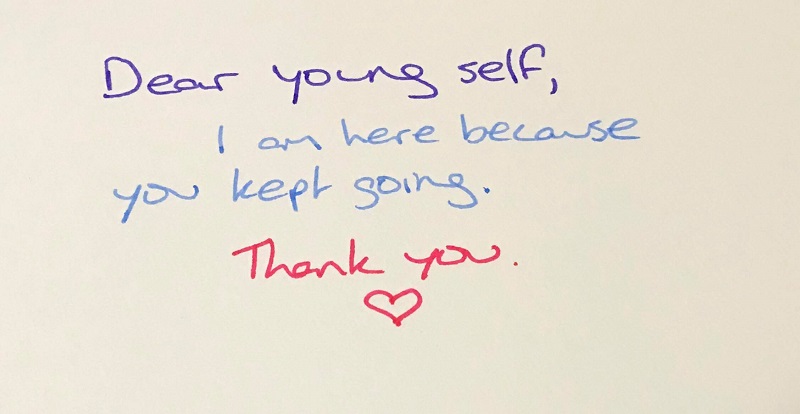
Image description: A hand-written note in blue, pink, and purple ink. “Dear young self, I’m here because you kept going. Thank you. <3”
We’re back after our summer hiatus!
In September, we’ll be talking about how we got through. The things we knew, and the things we wish we’d known.
I find the “it gets better” narrative often so frustrating. It doesn’t always get better, and that narrative can be so discouraging for folks who don’t see a way that it will get better.
But one thing that is always true, is that we got through. We made choices as younger queer folks that have allowed us to get to this point. We resisted. We persisted. We did what we needed to do.
In September’s conversation, we’re going to talk about what we did, and how we got through. We’ll spend some time talking about what we held close, what we cherished, what we hoped for, what we held onto in order to get through.
And then, we’ll turn the conversation into a shareable resource that might offer hope to other folks who are trying to get through!
I’m pretty far behind on getting the collaborative documents pulled together, but they’re happening slowly but surely!
You can see the first of our collective documents here, extending our November discussion about queerness and physical self-care – https://tiffanysostar.com/queerness-and-physical-self-care-resource/
And the second, about queerness and holiday self-care, here – tiffanysostar.com/holiday-self-care-resource/
And the third, winter self-care for weary queers, here – https://tiffanysostar.com/winter-self-care-for-weary-queers/
And the fourth, self-care in queer relationships, here – tiffanysostar.com/self-care-in-queer-relationships-resource/
Our September meeting will be on Sept 18, from 6:30-8:30 PM at Loft 112. There will be conversation, complexity, and, most importantly, community.
There is a small fee associated with renting the space, and you can support the event by either donating at the event or becoming a Patreon supporter.
We have a new focus on self-care and self-storying for the bi+ community (bisexual, pansexual, asexual, two spirit, with an intentional focus on trans inclusion), and a new framework for sustainability (you can now support this work by backing the Patreon at www.patreon.com/sostarselfcare).
There is no cost to attend.
This is an intentionally queer, feminist, anti-oppressive space. The discussion will be open, as they always were, to all genders and orientations, as well as all abilities, educational levels, classes, body types, ethnicities – basically, if you’re a person, you’re welcome!
These discussions take place on Treaty 7 land, and the traditional territories of the Blackfoot, Siksika, Piikuni, Kainai, Tsuutina, and Stoney Nakoda First Nations, including Chiniki, Bearspaw, and Wesley First Nation. This land is also home to Métis Nation of Alberta, Region 3.
It is important to note that Possibilities Calgary is a community discussion group and not a dating group.

by Tiffany | Aug 20, 2018 | Identity, Neurodivergence, Patreon rewards
Image description: A notecard hanging from a string. Text reads: Do you like me?
(This is an edited and expanded version of a post that was shared with my patrons one week early. If you’d like early access to my posts, and the ability to suggest changes or make comments before they go up on my blog, consider backing my Patreon!)
On April 9, 2018, I wrote to Jonathan, who has been a patron since the beginning of the project (and a partner for 10 years!), “Your birthday is coming! What do you want me to write about this year?”
He wrote back almost immediately, “Caring what others think.”
I like decisiveness.
And I like this topic.
He continued:
Just to expand on the topic…
The shame I feel over caring what other people think is difficult to navigate. When I was a kid I was told, over and over again, that I was just supposed to be myself and not care what other people think.
That sentiment really oversimplifies things. On the one hand, I get it. Caring too much about what other people think can really paralyze you. It gives other people a lot of power over you. It creates a lot of pressure, sometimes, to do things that you wouldn’t otherwise do. It stunts your ability to develop your own ideas, your own interests and your own destiny.
Caring what others think is seen as a sign of weakness. It means you don’t have your own personality; you’re two-faced; you lack principle and your own moral compass. We don’t trust people who care what other people think because we think of those people as fake. Caring what others think “too much” can be inaccurately pathologized as mental disorders such as paranoia, bi-polar and attention seeking disorders.
On the other hand, all of the non-vocal messaging you get is that it’s actually really, really important to worry about what other people think. Your social networks depend on what other people think about you. Your job depends on what other people think about you. Your ability to access resources depends on what other’s think of you.
It’s a cruel myth that only the weak care what other’s think. Corporations literally invest billions in controlling what other people think about them. Politicians direct a considerable amount of their power and capital towards carefully curating their public image. Many of our public institutions operate entirely based on people’s impression of the institution.
Clearly, it’s important to carefully balance the stock you place in what other’s think and your own self-confidence and commitment to be “true to yourself” despite social pressure. It’s complicated.
I’m out of balance over it. Caring what other’s think causes me anxiety. When I feel like someone is upset or angry with me I fixate on that. When I feel like someone thinks poorly of me or has a negative impression of my skill set it completely eats away at me. It makes conflict resolution very difficult for me to manage sometimes. It also means that I sometimes have a hard time being honest and authentic not only with the people around me but also with myself. I’m struggling to find a way to bring that into balance. I think, over the years, I’ve developed real strengths because of my obsession with what other’s think. I’m very keen to non-verbal communication and a pretty empathetic person. I’ve learned a lot about social cues and can pick out social patterns better than most. Meeting expectations is important to me and, when I have proper balance in my life, I’m pretty good at exceeding expectations because I care what other people think. I think my compassion also stems from caring and that’s not something I care to lose.
So, I think the concept of caring what others think is one that could really benefit from some exploration. It’s one of those deceptively simple ideas that actually has a lot of layers and a lot of depth to it.
After this post was suggested, this topic kept coming up. And it kept coming up in ways that really supported Jonathan’s insight into the way this idea “has a lot of layers and a lot of depth to it.”
It showed up in narrative therapy sessions, where one of my community members identified “caring what others think” as something that is both a cherished characteristic that allows them to bring empathy and compassion into their relationships, and also something that keeps them from acting on their own desires and needs.
Then it showed up in that same way for another community member. They care a lot about what other people think of them, and it’s both something they value in themselves and also something that they experience as a block or obstacle when trying to care for their own needs.
Then it showed up in a similar was for a third community member, who also talked about this particular experience in work contexts, where caring about what coworkers think is a skill that keeps them from oversharing and allows them to maintain boundaries, but also has them feeling isolated sometimes.
This idea of “caring what others think” became the basis of the “too much of a good thing” project that I’m undertaking as part of my master of narrative therapy and community work program (Note: I am still looking for participants for the project, so if it sounds interesting to you, get in touch!) Because the idea was growing so much, it seemed impossible to come back to this original writing prompt. I felt that I needed to get the whole project done in order to present something worthwhile.
(Sounds a bit like I’m caring about what others think of my writing, right? This shows up frequently for me, and it means I generally publish work that I’m proud of, and I don’t share nearly as much as I would like to. For the next while, I’m working on challenging this urge towards perfection and I’ll be sharing things that are a little less intensely edited. We’ll see how it goes!)
In May, this idea of “caring what others think” showed up in my own life in a big way when I was suddenly thrown headfirst into a situation where “what people think about me” became something I had to care about intensely. I was feeling (and being) observed and critiqued in personal and impactful ways. Writing about this topic felt more and more impossible.
It was everywhere! Overwhelming!
I decided to come back to this post, even though the “too much of a good thing” project is still underway, because “caring what others think” seems critical on its own. Although this topic fits within a larger framework, it deserves its own examination and exploration. As Jonathan pointed out, “it’s a cruel myth that only the weak care what other people think.” But that myth is everywhere. It’s one that impacts most of us in one way or another.
Ask the Internet
If you google “caring what other people think,” you’re likely to get a whole bunch of results with instructions for how to stop, and often with language that pathologizes or shames people who do care what other people think.
In one post on Psychology Today, the author writes, “One of our more enduring social fallacies is the idea that what others think of us actually matters. While this notion clearly has primal evolutionary roots, its shift from survival instinct to social imperative has become one of our greatest obstacles to self-acceptance.”
I have questions about this.
Is it a fallacy that what others think of us actually matters?
What my boss thinks of me matters to my employment.
It matters what the community members who consult with me think of me. It impacts my efficacy as a narrative therapist. Some research suggests that the best indicator of success in the therapeutic relationship is the “therapeutic alliance” (meaning the positive relationship between the therapist and the person consulting them). One review of the literature found that multiple studies “indicated that the quality of the alliance was more predictive of positive outcome than the type of intervention.” If that’s the case, it matters a whole lot to my work as a narrative therapist what people think!
I also wonder about the “primal evolutionary roots” of caring what people think. I am skeptical of most evolutionary psychology, given its many problems. (For one view on these problems, this problematically hetero- and cisnormative Scientific American article is a good place to start.) I particularly question this “primal” nature of the issue given the very contemporary context within which so many of us do care what others think.
For marginalized individuals especially, caring what people think can keep us alive. Caring what others think means knowing, deeply and intimately, what the dominant expectations are so that we can do our best to adapt to them.
For neurodivergent folks on the autism spectrum, caring what others think is part of the training – look at the language used in the popular Social Thinking program. (Content note on this link at the Social Thinking site for unsettling language about autistic kids. If you just want to read critiques, many of them by autistic writers, this facebook thread is full of information, but also upsetting to read.) “Expected” and “unexpected” behaviours, where “unexpected” means that the child hasn’t responded to the “hidden rule” and could be making people “uncomfortable.” Talk about teaching kids to care what others think!
On a more positive note, caring what other people thinks can foster a sense of being “accountable to the whole,” to quote my friend and mentor Stasha. This accountability to the whole means that we maintain an awareness of how our actions impact each other, and when Stasha made this comment I wondered whether a more intentional and compassionate relationship with the idea of caring what people think might be one way to challenge the individualism and isolation that our current capitalist context enforces.
Another article, this time from Lifehack, quotes Lao Tzu, “Care about what other people think and you will always be their prisoner” and concludes, “Once you give up catering to other people’s opinion and thoughts, you will find out who you truly are, and that freedom will be like taking a breath for the first time.”
Again, I have questions.
The Socially Constructed Self
Is “who I truly am” really something that happens entirely in isolation, entirely internal and apart from other people and what they think? I don’t think that it is.
I brought this question to one of the narrative therapy groups I’m part of, and I was very worried about what the group would think of me. I wrote, “This is an absolutely ridiculous question because I feel like I have read *at least* seven different version of this idea, but I’ve been searching and failing, so, halp?! I am looking for a good, comprehensive-ish, ideally readable-by-non-academic-audiences (but I’ll take an academic article also) resource on the idea of the self being shaped by context and relationships.”
I felt ashamed of the fact that I needed help, but the responses that I got were incredibly validating!
One person commented to say they were following, and I said, “You have no idea how relieving it is to realize I’m not alone in this.” They replied, “I think one of the most dangerous things a therapist can do is let their ego in the way of asking questions – well, that’s what I tell myself as I manage my “imposter syndrome” ?”
Someone else said, “So glad you asked!! I need just the thing and didn’t think of asking here!”
So many of us caring so much what each other would think, and finding solidarity and companionship in realizing that we’re not alone in it. Although the way that anticipatory shame keeps us silent is a problem, I think that the shared experience is valuable. And normal. In that group, we are all either practicing therapists or students of narrative therapy or both, and we still care deeply about what other people will think of us. We can respond to the ways in which this caring becomes a problem without demanding that we suddenly cease caring entirely. And without accepting that we are somehow incomplete because of it!
One of the responses was from someone linking me to this resource by Ken Gergen.
Gergen’s “Orienting Principles” are here (from the link – I highly recommend following the link and listening to his talk!):
We live in world of meaning. We understand and value the world and ourselves in ways that emerge from our personal history and shared culture.
Worlds of meaning are intimately related to action. We act largely in terms of what we interpret to be real, rational, satisfying, and good. Without meaning there would be little worth doing.
Worlds of meaning are constructed within relationships. What we take to be real and rational is given birth in relationships. Without relationship there would be little of meaning.
New worlds of meaning are possible. We are not possessed or determined by the past. We may abandon or dissolve dysfunctional ways of life, and together create alternatives.
To sustain what is valuable, or to create new futures, requires participation in relationships. If we damage or destroy relations, we lose the capacity to sustain a way of life, and to create new futures.
When worlds of meaning intersect, creative outcomes may occur. New forms of relating, new realities, and new possibilities may all emerge.
When worlds of meaning conflict, they may lead to alienation and aggression, thus undermining relations and their creative potential.
Through creative care for relationships, the destructive potentials of conflict ma be reduced, or transformed.
Two things jump out at me particularly: that worlds of meaning are created within relationships (which I take as a direct contradiction of the idea that we “find out who we truly are” only outside of relationship and others influence), and that together we can create alternatives.
Individualism
On a similar note, I also have questions about why freedom is so individualized, if there is so much creative potential in relationships.
Of course, these articles that advise us on how to stop caring what others think of us aren’t suggesting that people shouldn’t have relationships, and treating them as if they are would be setting up a straw man that isn’t there. However, I think that there is an individualist discourse present in these articles that suggests that we can have relationships without caring what the people in our relationships think of us, and I think that discourse invites a lack of accountability and collaboration, and suggests that there is a core self that exists apart from the self within relationships. I disagree with this idea.
Melanie Grier, another wise friend, said:
I think a good question to always ask yourself is *whose* approval you are seeking and how it serves you. I’ve been thinking about this as I’ve returned to school and have been working to let go of the desire for approval from my parents, understanding that as a practically impossible pursuit.
It feels good to be liked… and I think if that is your motive, just to be liked for the dopamine rush it provides, it can cause an issues once your self-worth can easily become interconnected with the external experience completely independent of you.
But the desire for approval from valued mentors, friends, partners, peers can serve us differently – it can help us build functional, healthy relationships where both parties are mutually invested in behaving in a way that results in approval or liking. It holds us accountable in a way, wanting to do right by a person. And I think we often grow by keeping expectations of each other reasonable. Working to feel validated, if consciously motivated, can help us do awesome things, I believe…
I find even knowing that people dislike me helps me self-reflect. It can again clarify values, sometimes discovering where you’re not willing to budge.
A lot of this resonates for me, because there are many elements of society that will never like or approve of me, because I am non-binary, I am bisexual, I am polyamorous, I am AFAB and often am read as femme. When I care what these people think of me (in the sense of wanting them to like or approve of me), I am caught in an impossible trap because the only way to gain that approval is to change who I am. However, even there I do care what they think because what they think points to systemic and structural injustices. I care what they think because I want to change the social context within which those thoughts of transantagonism, heterosexism, femmephobia, and all the rest (as well as all the injustices that I don’t face as a white settler with thin privilege, English language privilege, educational privilege, etc.)
Melanie also said, “I think we are too interconnected as a species and biosphere to be an island. We impact each other too much.”
I agree.
In yet another article, Tinybuddha suggests that, “Worrying about what other people think about you is a key indicator that you do not feel whole without the approval of others,” and, “When you are truly content with who you are, you stop being concerned with whether or not other people like you.”
The same types of questions come up.
Why does caring about the approval of others mean I don’t “feel whole”? Why can’t I “feel whole” while also caring about approval? Why is the approval of others automatically dismissed, when it is critical to having consensual and mutual relationships? What is active consent, other than enthusiastically and intentionally caring about getting the approval of the person you’re interacting with before taking an action?
This connects to Melanie’s points about whose approval we’re seeking, and to the idea of certain types of approval being entirely unavailable. Social isolation is recognized as a source of pain and distress, and social isolation is tied directly to what people think of us (whether we are likeable, friendable, loveable). And yet, the idea that we shouldn’t care what people think seems to greatly privilege individualism – being ourselves, being okay with being ourselves, even if that means being by ourselves.
My questions in writing this post kept coming back to why we valorize individualization. Why is it better to be an island? Why do we even believe we can be islands?! Isn’t there a whole song about how that doesn’t really work out? Sure, it may be true that the rock feels no pain, and the island never cries, and maybe that’s what we are hoping for when we distance ourselves from caring what others think. But that’s not the life that I want for myself.
Melissa Day points out that this valuing of individualization only happens within certain contexts. She writes:
[W]e fetishise individualism only within certain prescribed boundaries. Think of the hipster – I was into that before it was cool. Okay, great, you’re an individual. But someone who’s into completely different music/food/subjects and isn’t doing it to be “cool” or doesn’t have those become popular isn’t looked on as a heroic individual, but rather a weirdo or a freak (and yes, those words hurt and were chosen specifically). The sense I get is that there are two types of “don’t care what others think.” 1. They feel secure enough that who they are or what they like falls in society’s norms that they can be individual but still part of the whole 2. They like what they like and it falls so far outside society’s norms that caring about what others think really isn’t an option. This is written from the perspective of someone who had two choices growing up – change who you are and conform or stop caring about other people, be yourself, and take the lumps that followed.
…
I think… that it ties into this idea of everyone is special and unique. I would think the end goal of being different comes from a place of “If I am the same as everyone else, I will not be Special and Special is good.”
We are, collectively, put into a complex conundrum – we must care what other people think, and we must fit in, but we must do it in exactly the right way or we risk deviating too far from the norm and being punished for it.
As NoirLuna points out, “I feel like life would be way easier if blending in had been one of my options, but I figured out young it wasn’t, and managed to stop trying. (Which was for the good.)”
Wanting to Be Liked
Why is it a problem to care whether or not people like me?
I want my friends, my family, my lovers, my companions on this journey- I want them to like me!
I want them to like me because I know that I tend to spend time with people that I like. I am invested in relationships with people that I like. And I assume that other people are, if not exactly like me, then at least a little bit like me. So if my friends like me, they’ll want to spend time with me. They’ll want to be close to me. And I am invested in that outcome.
I have found that people are more likely to spend time with me when they like me.
And the reverse is also true. I have found that I don’t enjoy spending time with people that I don’t like, and I don’t enjoy spending time with people who don’t like me!
But then again…
There is a way of caring about what others think that can invite trouble. As Jonathan writes, “I’m out of balance over it. Caring what other’s think causes me anxiety. When I feel like someone is upset or angry with me I fixate on that. When I feel like someone thinks poorly of me or has a negative impression of my skill set it completely eats away at me. It makes conflict resolution very difficult for me to manage sometimes. It also means that I sometimes have a hard time being honest and authentic not only with the people around me but also with myself.”
Many folks can relate to that.
This topic has been challenging to write about because I, too, care “too much” about what other people think. I want people to like me. I want people to think that I am a good and worthy person. I want people to think that I am competent and capable.
The problem, as I have come to understand it in the process of sitting with this prompt, is not necessarily in caring what others think (I think I’ve been clear that I don’t consider that a problem!) but rather, when I create a totalizing narrative of myself based on what other people think. What I mean by that is, if I can only be “a good person” when everyone else agrees that I am so, that’s a problem. It’s a problem because no person is good all the time, no person can be.
Similarly, if I want to be a “worthy person” and I can only perceive myself to be that when everyone thinks I am, that’s a problem!
Ditto competency.
Ditto capableness.
The problem, in my mind, is when there is only room for a single story of the self. When that story is the one told by someone else’s opinion of us (including their opinion that we can only be “whole”, or “free”, or “authentic” when we don’t care what others think), it invites so much shame to the table. It invites us into so many feelings of personal failure. We need many stories of ourselves – stories of being good and stories of being less good, stories of being liked and stories of being less liked, stories of success and stories of growth. It is okay to care what other people think. It is okay to be conflicted about caring what other people think. It is okay to actively reject what other people think. There’s space. We need that space.
I struggled with this topic because, as much as I reject the idea that caring what other people think means I am somehow “not authentic” or “not whole” or “not free”, I have internalized the idea that I shouldn’t care what other people think. That it “isn’t any of my business” and that “the only thing I can control is myself.”
But this framing grates.
It feels wrong.
It feels far too individualizing.
Of course I care what people think of me! And so do the community members who consult me, and so does the patron who requested this topic, and so might you.
The idea that we should be fully autonomous, insulated individuals, small islands of personhood operating on our own, without caring or being moved by other people’s opinions… I think that’s a really harmful and hurtful idea.
That doesn’t mean that I am governed by other people’s thoughts, or that I am responsible for their thoughts, or that I am incomplete because I care about their thoughts. It means that, as Ken Gergen outlines, my reality (my worlds of meaning) is created through collaboration and context. When I engage meaningfully and intentionally with the people around me, including what they think of me and my actions, a lot of good in my life is made possible by this caring.