by Tiffany | Nov 22, 2018 | Downloadable resources, Identity, Intersectionality, Writing
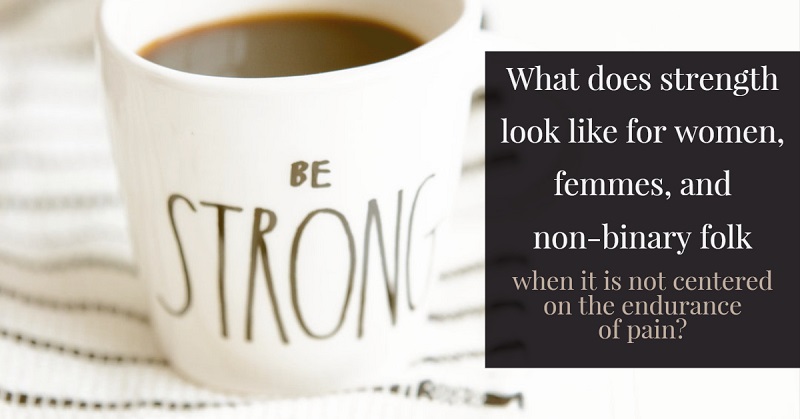
Image description: A cup that says “be strong”. Text block reads: What does strength look like for women, femmes, and non-binary folk when it is not centered on the endurance of pain?
This document is also available as a PDF, which can be downloaded and freely shared. This PDF will be updated with stories that are shared in response, and will eventually be available as a printed zine.
What does strength look like for women, femmes, and non-binary folk when it is not centered on the endurance of pain?
This question is not meant to erase the strength that is so heavily present in our need to endure, to survive, and to carry on from the violences in our lives, but it is meant to ask what else is there? What else do we have to offer? What forms of strength go unnoticed even to ourselves?
Strength
by Andrea Oakunsheyld
While processing a very impactful breakup, I talked to myself a lot. I listed all the things that I have already been through and come out the other side. I talked to myself about the things that I have already managed to endure because enduring those meant that, in my mind, I should be able to endure this.
I was so lucky to be thoroughly caught by my communities in this time, and to have many conversations about myself and my broken relationship. These conversations were centered largely on endurance and the ways in which my communities perceived me to be a strong individual.
After weeks of contemplation and conversations, I came to the realization that I was only seeing my strength through taking stock of past endurance of pain.
It occurred to me that this was a very feminized account of strength, and one that I was sure many women, femmes, and non-binary folk could identify with. It’s certainly not the definition of strength that I would instinctively ascribe to men or the masculine-identified, and I became distressed that I had such a narrow conception of my own strength, and by extension, the strength of women, femmes, and non-binary folk in my communities.
It makes sense for endurance and the endurance of pain to be an indicator of strength, but not the only indicator of strength that feminized folks perform. So, I was left to ask myself – what does strength look like for women, femmes, and non-binary folk when it is not centered on the endurance of pain?
This question is not meant to erase the strength that is so heavily present in our need to endure, to survive, and to carry on from the violences in our lives, but it is meant to ask what else is there? What else do we have to offer? What forms of strength go unnoticed even to ourselves?
My percolations on feminized or non-binary strength have led me to reassess many aspects of social life that I had already valued but never seemed to internalize as strength.
When interrogating this topic for myself, I found that strength comes in the very ordinary navigation of every day. It is in the empathy that we offer long before we are coerced. It is in the emotional labour that we offer up to ourselves to heal our traumas, and to our communities to create a network of support. It is in sensitivity. It is in community care because we know that to alienate one another is to bring destruction. It is in self-care, the other side of the coin, in which we offer ourselves the same care we offer to others. It is in caring for our bodies, minds, and spirits in the most intimate way because they are ours. It is in the contract with our network that states that we will give what we have to offer and will respect each other enough to say when we need recovery of our own. It is in boundary setting because setting our own boundaries better equips us to recognize and honour the boundaries of others.
Strength is in the feminized labour of the hearth and home. Maintaining basic needs and basic comforts. It is in the nurturing of the family that some of us provide (chosen and blood family alike). It is in activism where we rally around those in the margins and we demand better. It is in questioning of the fundamental systems of our everyday life and choosing an alternative path. It is in our differences. It is in the bravery we show when we must face the danger of being our non-normative selves and practicing our non-normative lives.
Strength is in every heart learning its own worth and it is also in those who are still discovering it. Strength is in the ability to be humbled and to admit to wrongdoing. It is in the commitment to do and be better. It is in the accountability we have to those around us. It is in being grounded in the earth and in community. It is in making a proper home in our own skin and being in our own bodies, in the ownership of our bodies and our sexuality. It is in sexual healing, however that looks. It is in showing ourselves self-compassion when we can’t quite manage self-love. It is in going out into the world every day to face down the very violences that have so far defined our strength.
Our strength is in the queer, the disabled, the racialized, the poor, and the further marginalized, but not merely because of what they, and we, have endured. Our strength is in us because of the unique things that we have to offer parallel to enduring pain and violence, the things that bring their own virtues.
After percolating on all of these things it seems a grim shame to me that these were not included in my original conceptualization of my strength. These other indicators of strength are important to conceptualize, at least in part, outside of the endurance of pain.
Stories of our strength: women, femmes, and non-binary folks respond to the question
Kassandra:
Your question reminded me a story from my family. The period of Junta in Greece, my mom and her brothers were chased and some of them exiled for their left-wing political action. In her 20’s my mom was the only woman in the family who decided to escape to another country in response to the daily interrogation and police abuse. Although she was coming from a working-class family with no educational background, while she was in a foreign country, being a woman and not being able to speak the language, she decided to be the first in the family who will try to study. However, she faced lots of racist attacks both for her race, her class and her gender. She was scared, and lonely, and in pain. One day after an incident when someone mocked her for being Greek, poor, incapable woman, she got truly devastated and she went to meet one of her brothers who was also staying in the country. Her brother told her a phrase that I’ve seen my mother return to whenever she is looking for her place of strengths to stand on. He said “whenever someone mocks you for your class or your race or your gender, remind yourself of Lernaean Hydra (from the Greek mythology). They might think that you are beheaded, but like Lernaean Hydra once a head is off, another one will grow and then you will still have voice to protest. Take your time to let your next head to grow and then protest!’ I don’t know if that answers your question, but I guess what I have learnt about what strengths look like for my mum is that it’s related to protest in its own pace and as an ongoing life process. I hope that make sense.
Anita:
I really love Kassandra’s contribution. It connects to how I relate to the idea of strength being social more than individual. There is a lot of pain and difficulties for marginalised peoples and the dominant discourse is to endure and especially endure alone. I take a different stance. Sometimes we have to find someone else we can share with. Even when family lets you down, work colleagues or fellow activists disappoint us there is someone, an exception who we can connect with, even if only in memory. Sharing strengthens us and undermines isolation. Sharing can promote organisation and often brings along laughter and solace. In my group of sisterfriends we practice sharing and thinking through actions, consequences etc. In other words, we get practical.
Laura:
For me strength can be a metaphor of structure (this could be organic and growing or built of materials or simply a metaphor of posture and position which allows us to hold ourselves strong) which makes other things possible – connection with others in the present, a centring of the ways we prefer to be ourselves, enough places to hold hope and joy, connection with our important histories, enough stability to be open to experience and change, creating spaces for others to grow, quiet places to reflect and reconsider, as well as endurance.
Marta:
Strength can be seen as not giving up on dreams. A metaphor can be like the little green plant raising from the snow and with time becoming a bush, a tree a flower. Follow our heart´s call. Birds gathering branches and things for a nest where they are going to put their eggs that will support babies someday.
Jessica:
My ability to set my ego / self aside to become wholly present to the experience of other life; my plants and heir happiness in new soil, my friend as they live their lives. It requires strength from me emotionally and psychologically to take a time out and allow myself to connect fully to another reality, immerse in it, ask myself IF in ways that aren’t about psyching myself out, but are about connecting within equally without. Also, physically, finding joy in the added effort of another 5lbs more. Am I understanding and getting it, or did I miss something?
Jacie:
Ease to explore & realize your priorities OR in other words, liberty of determination
My daughters would say it’s in my smile–perhaps it’s in acceptance?
Juliana:
Knowing your truth and priorities and being able to hold on to them even in the face of lies and distractions that society aims at you.
A Conversation
Shannon: It seems tied to power a lot in jobs and social power too. It’s not an easy question to answer though. The main places my brain is jumping to are enduring pain or else just professional type athletes. It’s like a brain-teaser. At first, I thought maybe there was a trick to it. Maybe there still is.
Tank: Challenging the status quo. Challenging dichotomy. Challenging the notion that we are not part of nature. Nurturing power-with instead of power-over/challenging hierarchies. Loving self, despite patriarchies constant attempts to tell us that we have no value.
Shannon: I interpreted this so differently than you and I’m pretty sure it’s because I feel completely powerless the vast majority of the time
Tiffany: That’s so valid, Shan. It kind of IS a trick question, except the trick isn’t in the question, it’s in the way so many of us have learned to view our strength only in terms of endurance and pain.
Tank: Well that is an important finding! Power is very relational, for example my white or class privilege makes it safer for me to challenge. The question helped me realize that I mostly frame this idea of ‘strength’ as endurance of pain. All interpretations help to understand a concept this big.
Shannon: Tiffany, no but it was that I didn’t think of it in terms of *my own* strength at all OR what *I* think of as being strong. Just other people. I missed the point so much that I didn’t even get tricked by the trick. I wasn’t even on the same page.
Shannon: Tank, yeah it was just surprising to me and everything makes me cry so that was not surprising to me at all.
Tank: Shannon, you pointed out how power works systemically = very useful. It is revolutionary to have this conversation about how we have noticed that pain endurance is the main definition of strength for non-men in this society. I found your thoughts very useful.
Tiffany: You noodles are making me tear up right now. I would add this moment of compassion and collaboration as one definition of strength – the strength we find together and share with each other.
Shannon: Tank, thank you
Tank: Oooooo it all makes me cry as well. Probably a strength, ha!
Shannon: Must be
Michelle:
i offer resistance in hope
i offer resistance in losing hope
i offer resistance through words
i offer resistance through silence
i offer resistance in my presence
i offer resistance in my absence
you can offer all your hate,
and still i will offer you my resistance
I don’t think I’ve ever really intentionally examined the multiple meanings of strength, particularly outside the idea of enduring pain. But of course, there are other definitions. This reflection has me thinking about ‘giving up’ and resignations as strength. I wrote this poem during a difficult time where I made the decision to resign from an organisation I had dedicated so much time and energy to. At the time, I felt like resigning meant that I was giving up on the struggle, abandoning the women and non-binary folk I was in solidarity with.
I stayed for so long because I felt that surely my cis-gendered, professional privilege and 9 years experience in the sector and dogged determination to create change would help transform the institution. Staying and therefore enduring pain was in part an act of bearing witness, part stubbornness, part hope for change, and part inflated responsibility.
Feminist work within institutions demands ongoing resistance and endurance, but as Sara Ahmed asks: ‘But what if we do this work and the walls stay up? What if we do this work and the same things keep coming up? What if our own work of exposing a problem is used as evidence there is no problem? Then you have to ask yourself: can I keep working here? What if staying employed by an institution means you have to agree to remain silent about what might damage its reputation?’
Staying was strength, but it also became complicity. My position as a woman of colour and public support for the gender diverse community was being used as evidence that there was no problem with racism or transphobia. In the final months of my employment, it had dawned on me that my presence was inadvertently upholding the walls of Colonial Patriarchal Feminism2 and trans exclusive radical feminism. The ongoing denial, gaslighting and attacks made me realise that I was being played.
So I quit, I resigned.
A couple of months later, I held a retirement party and invited all my friends join me in quitting with giving any more time and energy into systems that sustain the white cis-heteropatriarchy. So, with a baseball bat and some unwanted fruit, we took to the field and smashed all the symbolically toxic fruits from our lives. It was the best. I have since come to appreciate that resistance and strength comes in many forms, both in staying and leaving. But for now, I feel a great sense of freedom and pride that I can still do feminist work, and I would say more effectively and joyfully, outside of those systems.
[1] https://feministkilljoys.com/2016/08/27/resignation-is-a-feminist-issue/
2 Cheree Moreton coined the term Colonial Patriarchal Feminism or Colonial Patri-Fem for short, to describe how white feminists stigmatises and silences the one black voice in the organisation/environment
Miri:
Strength looks like self care, caring for friends and lovers, building family, resisting heteronormativity/racism/ableism/colonialism. Being out, embracing your identity whatever that may look like for you <3 <3 It doesn’t always have to look like enduring pain.
Suzanne:
I think strength for femmes is in prioritizing yourself and how much of your time and energy you offer to the outside world and why you offer it. So many femme folks feel like they can’t say no, or offer their time and energy to everyone who asks without prioritizing their own needs first, or evaluating whether they actually want to participate. The times I feel like I really identify strength in femmes is when I see someone identify an unreasonable ask and stand their ground, or prioritize their own well being over someone else’s. I think what makes it so magical when femme folks do this is that it usually isn’t done in an aggressive way, it’s the way many femmes can express themselves empathetically and not need to sacrifice vulnerability and emotionality in the process.
I can relate almost anything back to Buffy the Vampire Slayer, but she has a line where she tells the other slayer Kendra that her emotions are what give her strength and that she is lucky to have them. For me, as someone who has struggled with mood issues and is definitely pretty sensitive and empathic, I totally identify with this. I feel EVERYTHING so deeply, and I have been told for so long that this is wrong or a burden to others, and frankly that’s BS. My emotions are a huge factor as to why I’m a bad ass and why I see myself as strong. Not just in enduring pain, but in being aware of how every little thing affects me, so I have learned to use this in the way that I take in new information and learn, and the ways I interact with the world. Masculine strength always seems to be tied to suppressing and ignoring emotions, and femme strength is emotional intelligence and awareness. Strength is seeing how emotionality and “rationality” are woven together, and using that intelligence to make the tough calls. It’s seeing the entire picture when the world tells you it’s not there.
Wow that all just came out of my head all at once, so thank you for that prompt and I hope it’s helpful!
Candice:
When I was first given this question, it was very difficult for me to think of feminine strength that didn’t involve any pain at all. After talking with my family, I realized one of the main strengths of a woman is their amazing willpower. It is one of the things that allows us to be able to function through unimaginable pain and discomfort.
I believe most of our best qualities comes from our ability to be resolute once we’ve made up our minds to do something.
The strength to be able to create art, relationships and solutions out of little to nothing.
The strength required to bear the worries and problems of those around us when we choose to take on a nurturing role.
The strength to persevere through mentally and emotionally challenging spots in our lives.
The strength it takes to search for who you are and to give yourself space for mistakes as well as growth.
I find often times we discredit some of our strength and power because we aren’t functioning at the levels we expect of ourselves. But I have discovered that sometimes our strength can come from saying no, or from recognizing our limitations and allowing ourselves to exist in respect to that limit instead of overdoing it.
Like with any strength, it takes time to mould and develop a strength of mind. I think that’s why some of the most admired women have had decades to grow in their wisdom and willpower. However, unlike other strengths, the power of our minds deepen with time and experience.
Kalista:
Strength is existence. Existing as ourselves, fully and completely, without being property or object. Strength exists in the wholeness of true friendships and loving relationships that create space for us to be unabashedly ourselves. Strength exists in every pore of our body when we defy societal expectations, when we research our issues, when we change patriarchal policies, and when we find ways to keep on existing even when the world tells us not to or that we can but just not here. Strength is existence.
Erin:
When I think of female* strength I think of the strengths and characteristics that distinguish females from males traditionally. I think of traits that if they were more celebrated in leadership roles and sought after we may have a world with less war and conflict. Obviously there are always exceptions to these norms.
The traits of female strength I think of are compassion and patience. An often natural nurturing ability that sympathizes and allows women to be great listeners. The ability to multi-task and compartmentalize. The tendency to be able to see the bigger picture, see a situation from another perspective or see the effects of a decision much later down the line.
I think these are the core ones at least!
* Traditional definitions of “female” and “male” often include cisnormative understandings of sex and gender. Talking about these traditional roles can be important, especially when we understand that these understandings are not situated in any objective reality. This resource is intentionally trans and non-binary inclusive.
Tiffany
Sometimes I know that I am strong. But so many times, I do think of this strength in terms of what I have endured. I think about it in terms of pain, and struggle, in terms of what I have survived. I think about making it out alive, through multiple serious depressions. I think about the hostile voice that I lived with for a period of time, and that occasionally returns. I think about my history of self-harm, and I think that I am so strong to have found ways to alchemize all of that into the work that I do now as a narrative therapist and community organizer. I think, good job, me.
But when Andrea shared this question with me, it resonated somewhere deep in my heart. I wanted to find answers for my own strength, beyond these ideas of pain, struggle, endurance, survival. I wondered if there was anyway to understand my relationship to strength outside of these ideas.
And when I sent the first draft of this project to Andrea, she said, “Are you not doing your own entry in the project though, dear?”
It was hard to find these stories in my own internal library. They were quiet.
I thought about when I have felt my strength come close to me while I am joyful. I thought – sometimes strength is laughter. A good strong laugh is something I have had since I was a child! That’s strength, too.
And I thought about strength in hope. I thought about spending time with small children. My niephlings, and other children in my life. I thought about the strength of holding space for their joy, and for their learning. The strength of imagining a world with space for them despite my own fears for the future. I thought – sometimes strength is choosing hope when despair is equally close at hand.
I also thought about how sometimes strength is easier to access when I’m rested, peaceful, and at ease. At first, this thought made me uncomfortable. I thought, does this mean that I’m not really strong when I’m struggling? Does this mean I’ve been wrong about everything about myself? But I don’t think that’s the case.
I think that there are many different ways to be strong, and that one way of being strong is by allowing myself some ease. Sometimes when I feel rested and supported and cared for, that’s when I feel strongest.
And then there’s that little piece. “When I feel supported and cared for.” That part challenges the internalizing narratives, the individualizing narratives about strength. What might happen if I didn’t need to be strong on my own? What if I could imagine strength in community, strength in connection?
It’s not always about what I endure alone. Sometimes it’s about what I co-create with my communities.
Exploring your own strength
These are some questions to help you explore your own ideas about strength beyond metaphors of enduring pain.
- What does it mean to be strong? Are there definitions of strength accessible to you that go beyond enduring pain?
- Can you share a story of a time when you been strong in these ways? What allowed you to access this strength?
- Are there other ways to be strong?
- Who taught you about strength?
- Can you remember seeing strength in a woman, femme, or non-binary person in your life?
- Do any of these women, femmes, or non-binary folks know that you see strength in them? What has seeing this strength in their lives made possible in your own life?
- Who in your life, living or no longer living, real or fictional, knows that you are strong?
- What would you want women, femmes, and non-binary folks to understand about strength? Are there insider knowledges that you would want to share?
We (Andrea and Tiffany) would love to hear your stories of strength, and to keep this conversation about the strength of women, femmes, and non-binary folks going.
We would also love to hear any response that you might have to the stories shared in this document.
If you would like to share your response, please email it to Tiffany at sostarselfcare@gmail.com.
Andrea Oakunsheyld is a student at UBC in a Masters of Community and Regional Planning with a concentration in Indigenous Community Planning, a Fieldworker with Amnesty International Canada, aspiring theorist, community organizer and activist, bigender pagan witch, and nerd living and learning on the traditional and ancestral territory of the Musqueam, Squamish, and Tsleil-Waututh First Nations. Her work includes grassroots activism, particularly in queer, women’s, and queer contexts; “calling in”; queer children’s literature and subversive literature; subversive cities; and community planning.
Tiffany Sostar is a narrative therapist, community organizer, writer, workshop facilitator, and tarot reader living and working on Treaty 7 land (Calgary, Alberta) where the traditional custodians are Niitsitapi (Blackfoot) and the people of the Treaty 7 region in Southern Alberta, which includes the Siksika, Piikuni, Kainai, Tsuut’ina and the Stoney Nakoda First Nations, including Chiniki, Bearpaw, and Wesley First Nations, as well as the Métis Nation of Alberta, Region III. They work primarily with queer, trans, disabled, neuroqueer, polyamorous, and other marginalized communities. If you would like to work with Tiffany, you can find them at:
www.tiffanysostar.com | sostarselfcare@gmail.com | @sostarselfcare
You can support more of this kind of community-led, collective narrative practice work by backing Tiffany’s Patreon at www.patreon.com/sostarselfcare
This project was initiated by Andrea Oakunsheyld in late July, and is now ready to share! These kinds of collaborative, community-led projects are among my favourite parts of my narrative work, and although they often take months or years to complete, it is always incredibly rewarding. If there’s a topic like this that you want to talk about turning into a project like this, get in touch with me!

by Tiffany | Nov 19, 2018 | Calls for Participants, Gender, Health, Identity, Writing
Image description: a wooden heart among greenery. Text reads, “celebrating international men’s day”
International Men’s Day is celebrated every year on November 19. That’s today! (In my part of the world, at least. Belated greetings to my colleagues across the international date line!)

Image description: Twitter user @Erinkyan “happy international mens day, especially to trans men, disabled men, men of colour, queer men, mentally ill men, feminine men, elderly men, poor men, male survivors, and other vulnerable men. and a big fuck you to MRAs that further isolate and harm men in the name of misogyny.”
This post a celebration of this day, and also the official launch of a new project! Keep reading to find information about the new project at the end of this post.
There are so many ways that men are harmed and vulnerable under patriarchy. Because it’s not just patriarchy. It’s also ableism. Transantagonism. Racism and white supremacy. Colonialism. Ageism. Heterosexism. Patriarchy is a critical hub in this web of oppressions and privileges, but it is not the only hub, and it is not the only intersection that we need to address.
Men are differentially vulnerable.
They become more vulnerable the more they deviate from the ideal of white, straight, cisgender, able-bodied, English-speaking, educated, middle-and-upper class, young, fit, neurotypical manhood.
Men are vulnerable in different ways.
Black men and boys face police violence at disproportionately high rates in both the United States and in Canada. Indigenous men and boys also face disproportionately high rates of police violence and incarceration. (This post at The Conversation examines Canada’s shameful treatment of Indigenous folks within the ‘justice’ system.)
Men are more likely to die of suicide (as this British Columbia Medical Journal discusses), and men who are victims of domestic violence (regardless of the gender of their abuser) are less likely to find support either socially or structurally (as this article by the BBC discusses).
Men who are victims of sexual assault, either as youths or as adults, also face a lack of social and structural support. Although there have been important shifts in this cultural landscape, particularly by men responding to #MeToo (Terry Crews most publicly), there is still a significant cultural pressure to maintain an idea of masculinity as impervious to harm (as this Atlantic article discusses). This pressure comes both from proponents of patriarchal masculinity who are invested in maintaining these rigid gender systems, and from some advocates who are invested in the idea of men-as-perpetrators. Acknowledging the vulnerability of men is destabilizing to patriarchy, but it is also destabilizing to some of the gendered ways of understanding violence that have helped women and feminists frame the issue of violence against women. As this article by the Yale Journal of Law and Feminism notes, “The domestic violence movement historically framed its work on a gender binary of men as potential perpetrators and women as potential victims.” (link is to a PDF)
This article by Scientific American also talks about violence by women, and makes the important point that, “To thoroughly dismantle sexual victimization, we must grapple with its many complexities, which requires attention to all victims and perpetrators, regardless of their sex. This inclusive framing need not and should not come at the expense of gender-sensitive approaches, which take into account the ways in which gender norms influence women and men in different or disproportionate ways.”
And it is important to also recognize that there are men who have been both victims of violence and have also used violence against others. These men are often unable to access any supports that recognize and respond to both sides of their story, since many services for survivors of sexual or domestic violence do not work with people who have used violence against others, and services for men who have used violence against others often do not include support for survivors.
Toxic masculinity invites men into violence and dominance, which means that men are often cut off from emotional supports and connections, and it also means that people around men are vulnerable to violence and dominance. Not all men accept this invitation into a specific kind of masculinity, but all men receive the invitation – patriarchy is the air we breathe.
And, just like it is men, women, and people of all genders who are harmed by these norms of masculinity, it is also true that men, women, and people of all genders uphold and support these norms of masculinity.
As Vivek Shraya writes in her fantastic book, I’m Afraid of Men:
“And so, I’m also afraid of women. I’m afraid of women who’ve either emboldened or defended the men who have harmed me, or have watched in silence. I’m afraid of women who adopt masculine traits and then feel compelled to dominate or silence me at dinner parties. I’m afraid of women who see me as a predator and whose comfort I consequently put before my own by using male locker rooms. I’m afraid of women who have internalized their experiences of misogyny so deeply that they make me their punching bag. I’m afraid of the women who, like men, reject my pronouns and refuse to see my femininity, or who comment on or criticize my appearance, down to my chipped nail polish, to reiterate that I am not one of them. I’m afraid of women who, when I share my experiences of being trans, try to console me by announcing “welcome to being a woman,” refusing to recognize the ways in which our experiences fundamentally differ. But I’m especially afraid of women because my history has taught me that I can’t fully rely upon other women for sisterhood, or allyship, or protection from men.”
That’s important to note, too. (Vivek’s book also speaks about the problem with the idea of the “good man,” and makes a strong argument for not using the term “toxic masculinity.” You can read more about that in this article by Vice. I highly recommend reading her book.)
But this is International Men’s Day, so let’s turn the focus back to men. And to a definition of men that is much more broad and expansive than the thin description of dominant masculinity, with its demands of ability and class and race and the tight confines of The Man Box (this page offers an overview of “The Man Box” study in Australia, which looked at men’s views and experiences of masculinity, and also includes a link to the full report).
There is no single truth about masculinity. (I am thankful for narrative therapy and its focus on multistoried lives and experiences. And I am thankful for Chimamanda Adichie and this TEDtalk about the dangers of a single story!)
Gendered assumptions about emotions mean that men, regardless of any other intersection of identity, are often not supported in their emotional lives. This leaves men at risk in their own lives, and less equipped to support their community members.
These issues are complex, and talking about them requires care and a willingness to invite complexity to the table.
If I’m honest, I found this post challenging to write.
This is partly because I am not a man. I have never experienced being read as a man in this patriarchal world. When I try to empathize with the experiences of men, I do so from my position as a non-binary individual who was assigned female at birth, as someone who is read as a “woman” by anyone who doesn’t know me.
But there are men in my life who have helped me begin to understand the complexities of being a man under patriarchy.
I am thankful for these men, who advocate for men’s issues and also support social justice. They challenge toxic masculinity (by which I mean, the gendered assumptions that invite men into performances of gender that are hostile to other genders, that coerce men into rejecting anything deemed “feminine”, that limit the range of emotions and emotional responses available to men, that locate successful masculinity in a specific performance of heterosexuality, ability, and capitalist productivity), and they look at this issue with nuance – toxic masculinity harms men, and it also harms everyone else.
So, how do men unlearn these hostile lessons of patriarchy? How do they learn other ways of being men?
I’m in the early stages of a collaborative project exploring how men have discovered feminism and learned about social justice. My goal is to speak with a wide range of men about their experiences, and create a collective document and resource that other men can learn from. If you would like to be part of this project, get in touch!

Image description: two books stacked with purple flowers on top. Text reads: “Men! Let’s talk about how you learned about feminism and social justice. A collective documentation project. Contact sostarselfcare@gmail.com”
If you appreciate this work, you can support me on Patreon!
by Tiffany | Nov 10, 2018 | Narrative therapy practices, Writing
Image description: An addressed envelope to Dr. Ford, c/o Palo Alto University.
The following is the collective letter to Dr. Ford, the result of October’s Witness and Respond event in Calgary, Alberta, and the contributions of people elsewhere. It has been mailed to Dr. Ford, who is, as of yesterday, still receiving threats. We hope that she will also continue receiving support.
Dear Dr. Ford,
This letter is the collective work of a group of people who met in Calgary, Alberta, Canada in October to watch your testimony and talk about what it meant to us and made possible in our lives. It also includes the contributions of people in Calgary and in Adelaide, Australia who watched your testimony on their own and sent in their thoughts. This letter represents the responses of almost a dozen people, each of whom was moved by your actions.
We want to express our appreciation for your actions. We were inspired to do this by Anita Hill’s sharing that receiving support was helpful to her following her own experience, and also by the work of narrative therapists at the Dulwich Centre using letter-writing as a way of showing support.
As we watched your testimony, we were curious about what it was that allowed you to take these actions; to say the name of your assaulter after so many years, to write the letter to your representative, to meet with political aides, to describe the assault again and again despite the fact that it was so difficult for you, to come forward publicly with your story, and to stand in front of a Senate committee and, as you said it, “relive this trauma in front of the world.”
We saw each of these actions as a choice that you made, and we wondered, how did you make those choices? What values were you holding onto? Who supported you in these actions?
We heard you say that “sexual assault victims should be able to decide when and where their private details are shared”, and that it was important to you to describe the assault in your own words. It was clear to us watching that you have held this value close, and that despite the intrusion of reporters into your life, forcing you to tell the story in ways you may not have chosen otherwise, you kept this value centered in your opening statements. For those of us watching who have felt pressured into disclosure or ashamed of our stories, your strong assertion of our right to tell our story in our own time, in our own way, in our own words, was powerful.
Witnessing you tell your story allowed one person in our group to identify an incident from her own high school years and enabled her to speak about this incident with people in her life.
Another person said, “The courage to speak up is significant to me, when so many people don’t. When I myself have not. At the time it was a fear of the mocking, and the being pulled apart and condemned. I did not have the strength to endure that process at the time on top of what I experienced. Now I would maybe feel differently. Maybe because I am stronger now and maybe because of these stories. Dr Ford’s testimony in shaking voice made me want to cry with pride that she did speak up.”
Your shaky voice was something that many of us noted. Some of us also speak with a shaky voice, and have felt worried that we will be dismissed because of it. Hearing you speak in a voice that shakes like our own was a moment of validation that some of us had never experienced before. We saw that it is possible to speak in a shaking voice and still speak with confidence and calmness. Some of us also recognized within ourselves that hearing your shaking voice did not make us doubt you or dismiss you. We had feared that if we spoke in a shaky voice, nobody would hear us or believe us. But you did, and we did hear you, and we do believe you. Rather than seeing weakness, we saw the strength it took for you to speak. We feel closer to our own shaky-voice strength, having witnessed yours.
We also saw you adding to the community knowledge of what trauma is, and how it can operate in the brain. Your references to norepinephrine, to the hypocampus and amygdala, and to other scientific knowledge was validating for some of us. We wondered if this indicated a way that you were “re-valuing” yourself, and claiming space for science as a celebration. One of us wanted you to know that she, too, is a scientist and that seeing you use “science as a safe place” was validating for her.
We also saw that you spoke even though you didn’t know what the outcome of your speaking would be, and this is important. One of us said, “Just because you’re good, doesn’t mean you’ll be rewarded. But she did whatever she could to stop [the confirmation] from happening.” This makes it possible for us to also take action even when we may not see the outcome that we want.
We also heard you say, “It is not my responsibility to determine whether Mr. Kavanaugh deserves to sit on the Supreme Court. It is my responsibility to tell the truth.” In this, we saw you valuing integrity over outcome, and as we each move into what promises to be a difficult time for marginalized communities in the United States, in Canada, in Australia, and elsewhere, we are better able to hold onto our own integrity even when it seems that we might not get the result we are looking for.
We saw you acknowledge your fear without expressing any shame for it. Throughout the testimony, we saw you declining to engage with any invitations to shame. So many of us have felt afraid to share our own stories, and have felt ashamed of that fear. Your actions make it possible for us to shift our relationship to fear, and to see it as something that we do not need to be ashamed of. It is okay for us to be afraid, just like it is okay for you to be afraid. You described your fear so clearly, and also described the very real outcomes of your actions – even worse than you had feared! In your testimony, some of us felt for the first time that fear does not have to be accompanied by shame.
We also saw that your actions are part of a collective, and you are part of a community of women speaking up. Anita Hill also spoke despite not knowing the outcome of her speaking, and although it took many years, her actions are part of the legacy of speaking that you are now part of, and that we are invited to join. Tarana Burke founded the Me Too movement a decade ago, and we see her as another part of this long legacy of speaking the truth even without knowing the outcome. This helps us locate ourselves within a collective, and as part of a long history of resisting injustice. Your actions have helped us find each other, to find the history of this resistance, and have helped us open up conversations that otherwise might not have occurred.
We are actively searching for each other now, looking for other people who want to take similar actions, who want to speak out. As one person put it, we hope that “speaking the truth will be contagious over time.”
Dr. Ford, we watched your testimony together after your assaulter had been confirmed to the Supreme Court, and so we knew what the outcome of your actions would be.
Rather than diminishing the impact of your work, this allowed us to see that what you have made possible through your actions extends far beyond one unsuitable man’s appointment to a position of power. You have mapped out actions that will allow more of us to speak, and to keep acting in alignment with integrity despite the actions of people in power.
With warmth, respect, and appreciation,
Tiffany and many others
(Although there were many names signed to the physical letter, I didn’t want to expose anyone online, even by first name.)

by Tiffany | Nov 9, 2018 | Intersectionality, Narrative therapy practices, Possibilities Calgary, Writing
Image description: An ornate pink, blue, and white background. Text reads – Solidarity : a Possibilities Calgary event in solidarity with the trans community : Nov 20, 2018 | Loft 112 | Writing a collective letter in support of the trans community on Trans Day of Remembrance
November’s Possibilities event falls on Nov. 20, Trans Day of Remembrance. (The official Transgender Day of Remembrance event happens in Calgary on November 18 at 1:30 pm at CommunityWise.)
Possibilities, although we are a group for and by the non-monosexual communities (bisexual, pansexual, asexual, and otherwise non-monosexual), has always been trans-inclusive, and many of our founding members are trans. This year, we will host a conversation with the goal of writing a collective letter of support from our community to the transgender community.
This is particularly important this year because transgender rights are under increased threat, very actively in the United States and looming on the horizon if conservatives gain power in Alberta and in Canada. This is a hard time to be a trans person looking to the future, and the goal of this event is to document our collective support for our trans community members and for trans folks beyond our bi+ community.
This event is open to transgender and cisgender members – we will be expressing our support both for and as transgender folks, and support from many parts of the community is important.
This collective letter will be part of the ongoing Letters of Support for the Trans Community project.
Notes about Possibilities:
There is a small fee associated with renting the space, and you can support the event by either donating at the event or becoming a Patreon supporter.
We have a focus on self-care and self-storying for the bi+ community (bisexual, pansexual, asexual, two spirit, with an intentional focus on trans inclusion), and a new framework for sustainability (you can now support this work by backing the Patreon).
There is no cost to attend.
This is an intentionally queer, feminist, anti-oppressive space. The discussion will be open, as they always were, to all genders and orientations, as well as all abilities, educational levels, classes, body types, ethnicities – basically, if you’re a person, you’re welcome!
These discussions take place on Treaty 7 land, and the traditional territories of the Blackfoot, Siksika, Piikuni, Kainai, Tsuutina, and Stoney Nakoda First Nations, including Chiniki, Bearspaw, and Wesley First Nation. This land is also home to Métis Nation of Alberta, Region 3.
It is important to note that Possibilities Calgary is a community discussion group and not a dating group.
by Tiffany | Oct 20, 2018 | preview/review
Reasons to join my Patreon: when I get super busy and forget to make the review/preview posts public until 2/3 of the way through the month, you’ll have already read it, so it won’t matter! And you’ll get access to the behind-the-scenes review/preview content that gets edited out of the public posts.
Alright! This post is way late, but better late than never! Want the recap on September, and what I thought October would look like? Here it is! (October has turned out quite a bit busier than this anticipated, but that’s a story for a different post.)
21 days ago, when this was first written, it was October 1.
On September 30, the Tender Year ended. This is a huge thing – the Tender Year has been a full year-long project, and I feel… I feel a lot of things at this ending! But I also feel like this project ended at a moment when I am mid-marathon, and so it has just dropped out of my life but I don’t have time to pause and honour that. I can’t take a couple days to process, sit with what I’ve learned and how this project has changed me. So, my goal is that I will take this time… eventually. I’m not sure when.
But that’s forward to the preview, so let’s start with the review.
September.
Sage
Early in September, I spent a whole day with Michelle Robinson and her family. I didn’t write a post about this, but this was an incredible experience. I had reached out to Michelle because I have been exploring my own spiritual practices, and had a question:
If it is true that my spirituality is connected to being present in the physical world, connected to nature in some way (which I have learned that it is),
And it is true that I am a settler on this land that I am connected to,
And it is true that plants are part of my spirituality,
And it is true that some plants are part of Indigenous spirituality, which I have no right to,
And bringing in non-indigenous plant species is tied to colonialism and could be further violence against the land,
Then how do I practice my spirituality respectfully – honouring the plants that are here on this land where I am a settler, without appropriating in ways that perpetuate ongoing colonial violence.
This is an ongoing process of exploration, and I am thankful to Michelle for her part in helping me figure this out. You can read more about this in the Patreon post, but it doesn’t feel right to share it more publicly at this time.
Narrative therapy
I also spent a lot of time working on my practice innovation project for the Masters program. I hadn’t narrowed down my focus between “using narrative practices to navigate ‘too much of a good thing’ experiences” and “using narrative practices with polyamorous communities” even last month, but in September I realized that I really did have to make a decision so that I could start writing the final paper.
I picked polyamory, for a few reasons:
First, I’ll continue the other project regardless, just a bit slower. So it didn’t feel like a very high-stakes decision, since I know that I will end up doing both.
Second, I am helping coordinate the Horizons: Conference on Polyamory and Non-monogamies in November, so it made sense to get two uses out of one project – the oral presentation that I’ll give in Adelaide at the end of this month, I will also give (though slightly expanded) in Calgary in November.
And third, I am really keen to expand the pool of resources for therapists working with the polyamorous community, because right now it is deeply lacking and this has real and tangible impacts on polyamorous folks who are looking for support.
So, to this end, I conducted both interviews and narrative therapy sessions on the topic of polyamory. I wish that I’d had more narrative therapy sessions, but that’s just not how it worked out. I really do need to figure out my marketing – I posted the call for participants once, and then never re-shared it. *facepalm*
I did 38 hours of narrative therapy this month, which is still shy of my goal, but getting there.
For those of you who are curious or interested, I do still have some of the “37 for $37” narrative sessions available (this was a promotion I ran for my birthday – charging $37 for a session in honour of my 37th birthday).
(Mid-October update: I did not write my paper on polyamory at all. I wrote it on using narrative practices to respond to the current political situation, and that is also what I’ll be presenting on at the teaching block.)
Events and Groups
September was full of events.
I planned to run the Resilience self-care salon with my sister on Sept 9, though nobody showed up, so we just chatted. I’m really looking forward to collaborations with Domini, so keep an eye for those coming in the future.
I ran the Possibilities discussion event, with the topic of “how we got through,” on Sept 18 and it was phenomenal. I am still working on pulling the resource based on our discussion together (and am leaning to a simple blog post rather than a full PDF, just because these projects accumulate faster than I can finish them!). I really loved this conversation, and some parts of it have stuck with me all month. You can read one of my reflections on this conversation in this long Facebook post. (I feel like I should be pulling more of those posts into blog posts, but I haven’t figured out a flow for that yet.)
I also ran the Bi+ Visibility Event on September 23, and it was amazing. We had a panel discussion that I was really proud of, lots of people attended and seemed to have a great time, the informational postcards turned out great, and the poetry event was small but lovely. I would like to write up a blog post about this, but haven’t had time because…
I woke up September 24, looked at the news, and realized that the following week was going to be horrific. So I threw together an impromptu self-care support group for anyone who wanted to join (we ended up with 10 participants). All week, from the 24th to the 30th, I sent out two emails each day checking in. We also had two online group chats, and one in-person tea-and-pastries chat yesterday morning. This was a really successful experience, in my opinion (and based on the feedback I’ve gotten), and at the conversation yesterday we talked about how to extend this work into the coming year, since with all of the elections coming up, it is likely to be stressful AF. I have ideas about how to do that, and I’ll write about those when we talk about October. I am also considering taking the emails and turning them into a little downloadable PDF that could be used as a “do-it-yourself” one-week self-care support. (Mid-October update: this group is what developed into the project I wrote my paper on, which Patreon supporters have access to!)
The last event of the month was the coffee chat for the Very Professional: Marginalized Professionals group. This happened on Sept 29, and I’m planning on these to be monthly. There is also a secret Facebook group (to maintain people’s privacy), so if you’d like to be added to that, let me know! I am still working out the logistics of how this group will run, but the original idea was that it would be a subscription-based support group for professionals (meaning people in “professional” careers, where the heavy expectations of gendered/abled/educated/classed/raced professionalism come into play).
Writing
I wrote one paper for the Masters program (which hasn’t been graded yet), and most definitely did not keep up with my other writing goals. At all.
So!
Onward to October!
I did honour the ending of the Tender Year in one small way – I started a new planner today.

(A planner, open to this week, with a task-pad on it.)
Here’s what’s coming up:
October 5, 8 am: The Art of Narrative Practice essay is due. This is meant to describe, using one exemplary practice story, how I am adapting narrative practice to my specific context. I have gone through at least a dozen different outlines of this, and have no idea how to do this effectively or well. This is worth a significant percentage of my grade, and I am a ball of anxiety. One of my classmates participated in the one-week self-care group and suggested that I should write the essay on that, but since I have to demonstrate how my narrative work shifted a community member’s experience of their problem, or resulted in their feeling more connected to a preferred story of themselves or their lives or their agency within their lives, and I didn’t really do “how is this group impacting you” interviews, I don’t know how to do this. So, I don’t think I will. But it was a big confidence boost to see that a colleague sees me using narrative in innovative and effective ways!
October 8, 8 am: The draft of my Narrative Practice and Research Synthesis paper is due. This is the draft version of my final paper, and although it will not be graded, it is a big deal. And I am definitely not ready. At all. *gulp*
October 14, 1:30-3:30: I’ll be hosting the No spoons left, only knives: Honouring our anger narrative workshop. This is in response to what has been happening in the news in the last couple weeks.
October 15: Pregnancy and Infant Loss Awareness Day. I will be resharing the collective document that I generated last year. You can find it here – it is a queer and trans-inclusive resource, and this is still a significant gap in the available resources for families and individuals who have experienced this kind of loss. If you do have a chance to read over it and you would either like to share your story, or make suggestions for content that should be included, let me know. I have set aside 5 hours on the 12th to work on this document.
October 16, 6:30-8:30: I’ll be hosting the Possibilities October discussion, and I have not set a topic yet. Ideas? Things you’d really like to discuss or see a resource (eventually) created about? Let me know. I’m setting up the event tomorrow.
October 17, 9 pm: Get on a plane and fly to Australia. (!!!!!!!)
Sometime during the week of October 29-November 2: 30 minute oral presentation on my practice innovation project
October 29: Submit research poster on the topic of my practice innovation project
October 31: Dinner with the team heading up with trans and queer youth clinic at the family therapy clinic in Adelaide, because Rosie and I have been staying in touch about their work getting this up and running, and the Dulwich Centre has authorized Rosie to hire me as a peer consultant for her work. (I have started to do some of this – there are now two therapists who consult me on topics related to transgender, queer, or polyamorous folks. That’s kind of exciting, hey?!)
So, between now and VERY SOON, I have to get a lot of writing done, come up with both my oral presentation and my poster, host a couple events, and keep up with my narrative therapy sessions (and hopefully book more of those!)
I am also working on another event, which I’d like to run before I leave.
When everything was happening with the Kavanaugh hearings, I wrote to David Denborough and Cheryl White at the Dulwich and said:
I wondered if you have any thoughts about how to pull together some kind of narrative response or project re: what’s happening with yesterday’s hearing and today’s news that Kavanaugh will most likely be confirmed.
I wondered, particularly, if there were any narrative projects or responses to what happened with Anita Hill and how that impacted people? Or other narrative responses to situations where a great injustice has been carried out in very public ways like this. The George Zimmerman trial, similar. It feels like this happens pretty often.
I don’t really know what to look up, in terms of how to find maps, or ideas for projects, or what to do. And I know lots of people are responding – the responses are both crushing and heartening – but I also see that a lot of folks are talking about feeling helpless, unable to act, disconnected from a sense of agency. There is so much hurt this week. (I mean, always. But this week has been particularly hard, as we see the rape apologists just crawling out of the woodwork.)
We are all bystanders, but we are watching something that symbolizes and crystalizes lived experiences. I don’t know how to support myself or my communities in response to this. Particularly after the news of Jeff Flake’s decision to support the nomination this morning. Calling our politicians hasn’t done anything, it seems. I don’t want to individualize responses into simple “self-care” but also… I don’t know what else to do.
And it’s just, my communities are experiencing such intense retraumatizing this week. Yesterday and today especially. And I think, there must be something? I know there are ways to respond. I just don’t know what they are or how to do them. I wondered if you might have an idea, or even just some papers I could read to start thinking about what I could do.
I put together a little “emergency survival” group on Monday and we’ve been doing daily check-ins, but I feel like I want to do something more? I don’t know. I want to do something with my hands other than hold all this grief and fear.
Anyway.
You both have a wealth of knowledge when it comes to putting together responses to crisis and tragedy and so I thought I’d ask about whether you have ideas, or if you know other folks who are working on this that I could support or contribute to their work, or anything like that.
Thank you. Even if there’s nothing, I really appreciate that narrative therapy has given me new ways to think through problems. Your work makes such a difference.
Warmly,
Tiffany
David wrote back and had some really great suggestions for a letter writing event, and some other potential directions for using narrative practice to respond.
I love these suggestions, so I will be putting together an event for folks to collectively view both Dr. Ford’s testimony and also the video of Ana Maria Archila and Maria Gallagher confronting Flake in the elevator, and then facilitate a narrative conversation about this and generate letters that can be shared with Dr. Ford and Ana Maria Archila and Maria Gallagher, and also perhaps posted as open letters available to other survivors.
I am still working on the details of this, but I feel strongly that I want to pull this together and that it’s important. And then, going forward, I want to figure out how to create some kind of narrative project that does the work David outlines, of challenging, and making visible, and making visible the resistances to, and that can “problematize dominant gendered discourses of ‘pliability, friendliness, flirtatiousness, sexual availability, forgiveness’.” But that will wait until after I get back from Adelaide.
(Mid-October update: I did run this event, it was fantastic, and I will be writing it up for the next preview/review post!)
So, phew!
A big month past, and a big month ahead.
I do want to say, there are some new Patreon supporters this month and that means so much to me!!!
Thank you.
